

Rubric: Politics
Format: INVESTIGATIONS
Author: Sinisa Brkic (sb)
North Korea’s intervention in Russia’s war has grown from covert munitions shipments into a state-to-state military enterprise involving troops, ballistic missiles, construction units, money, battlefield experience and possible technology transfers. Behind the public language of friendship lies a harder question: what exactly is being exchanged, who controls the money, what happens when North Korean soldiers die, and how far can Moscow and Pyongyang push a partnership that collides with a sanctions system Russia itself once voted to create?
The war has created something neither country had before
The North Korea-Russia relationship is often described as a revival of Cold War ties. That description is incomplete. The alliance taking shape since 2023 is not simply a restoration of the Soviet-era relationship. It is a wartime bargain built around immediate shortages, sanctions pressure and complementary needs.
Russia entered the full-scale invasion of Ukraine in February 2022 with far greater conventional military resources than North Korea. But a prolonged industrial war created demands that Moscow had not planned to sustain indefinitely: enormous quantities of artillery ammunition, replacement missiles, manpower and industrial capacity. North Korea, by contrast, possessed large stockpiles of Soviet-standard ammunition, factories designed for mass military production and an army numbering well over one million active personnel. What Pyongyang lacked was modern combat experience, hard currency, reliable access to energy and food, and advanced military technology.
Those needs began to converge visibly in 2023. Kim Jong Un traveled to Russia in September of that year and met Vladimir Putin at the Vostochny Cosmodrome, a location that immediately focused international attention on possible Russian assistance to North Korea’s satellite and missile programs. In the months that followed, satellite imagery and Western intelligence assessments indicated a rapid increase in maritime and rail traffic connecting North Korean facilities with Russian logistics networks. What had initially looked like a diplomatic rapprochement increasingly resembled an arms pipeline.
From ammunition supplier to combatant
The first phase of the partnership centered on weapons. North Korea has been accused by Ukraine, South Korea, the United States and other governments of supplying Russia with millions of artillery rounds, rocket systems and short-range ballistic missiles. The Multilateral Sanctions Monitoring Team later reported that Russian vessels had transported the equivalent of millions of 122mm and 152mm artillery rounds from North Korea. Ukraine has also documented debris it identifies as North Korean KN-23 or KN-24 family ballistic missiles used in Russian attacks.
The significance of those deliveries is not simply numerical. Artillery remains one of the decisive resources in the Ukraine war. A supplier capable of replenishing ammunition on an industrial scale gives Russia the ability to maintain fire rates that would otherwise place still greater pressure on its own factories and foreign procurement networks.
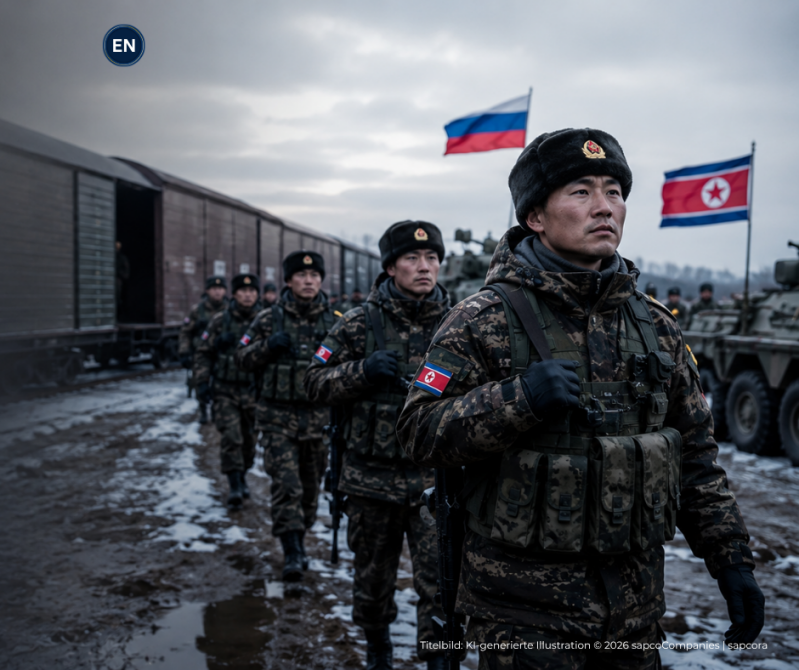
By late 2024 the relationship crossed another threshold. Intelligence agencies reported that thousands of North Korean troops had arrived in Russia. Moscow and Pyongyang initially avoided a full public acknowledgment, but the deployment became increasingly difficult to conceal. In April 2025, Russia publicly praised North Korean troops for fighting in the Kursk region, and North Korea confirmed that Kim Jong Un had ordered the deployment.
That admission transformed the political meaning of the alliance. North Korea was no longer simply a sanctioned arms supplier. Its soldiers had entered a European war on Russia’s side.
The treaty that gave the alliance a legal narrative
The political framework had been prepared months earlier. During Putin’s June 2024 visit to Pyongyang, Russia and North Korea signed a Comprehensive Strategic Partnership Treaty. Article 4 provides for mutual assistance if either party is subjected to an armed attack.
Moscow and Pyongyang have relied on this treaty to portray North Korean participation in the Kursk fighting as collective defense. Their argument is strengthened by geography: the first acknowledged North Korean combat operations occurred on internationally recognized Russian territory after Ukrainian forces entered the Kursk region.
But the treaty does not settle the wider legal questions. A bilateral agreement cannot override binding obligations created by the United Nations Charter or Security Council resolutions. It also cannot retroactively legalize prohibited arms transfers, military training or other forms of cooperation that fall within the DPRK sanctions regime. The distinction between helping Russia repel forces from Russian territory and supporting Russia’s wider war against Ukraine is therefore central to the legal debate.
This distinction has become even more important as the cooperation expands beyond Kursk. In August 2026, Ukrainian military intelligence said a North Korean missile unit of roughly 90 personnel was deploying to Russia’s Voronezh region, potentially with up to 120 ballistic missiles and six launchers. Reuters reported that a source familiar with U.S. intelligence said Washington was aware of the deployment. If North Korean military personnel become directly involved in missile operations supporting strikes on Ukraine, the partnership moves further away from the narrow public narrative of defending Russian territory.
How many North Korean troops are actually involved?
There is no single verified public number. Estimates have changed as reinforcements arrived, casualties accumulated and new units were announced. South Korean, Ukrainian and Western assessments generally put the first large deployment at roughly 11,000 to 12,000 troops, later rising toward 14,000 to 15,000 after reinforcements.
Ukraine said in 2024 that at least 500 North Korean officers were among the force and identified senior generals accompanying the deployment. The presence of high-ranking officers mattered because it suggested that Pyongyang was not merely sending expendable infantry. It was also building its own command, liaison and learning structure inside Russia.
North Korean troops reportedly suffered very heavy losses during their first months in combat. Russian and Ukrainian sources described early problems including unfamiliarity with drone warfare, language barriers and different tactical procedures. Later assessments indicated that the units adapted quickly. By September 2025, South Korea’s intelligence service estimated that about 2,000 North Korean soldiers had been killed. British military intelligence later estimated more than 6,000 casualties from a force of about 14,000, including killed and wounded.
By mid-2026 the manpower dimension widened again. Russia said North Korea would provide 1,000 sappers and 5,000 military construction workers for demining and rebuilding in Kursk. Ukrainian President Volodymyr Zelenskyy subsequently alleged that Russia was preparing to bring in another 30,000 troops. That figure is a Ukrainian claim and has not been independently verified. It should therefore be treated as an indicator of possible preparations, not an established deployment total.
The command structure: whose soldiers are they once they reach Russia?
One of the least transparent parts of the deployment is command and control. North Korean soldiers remain members of the Korean People’s Army, but they operate in coordination with Russian forces. Ukraine said the initial plan involved creating several formations of roughly 2,000 to 3,000 North Korean soldiers and integrating them with Russian units.
The senior North Korean officers identified by Ukraine included Colonel General Kim Yong Bok, associated with special operations forces, and Colonel General Ri Chang Ho, linked to North Korea’s Reconnaissance General Bureau. Their reported presence suggested that Kim Jong Un wanted direct political and military oversight of the deployment rather than leaving North Korean troops entirely under Russian command.
That arrangement matters for accountability. If unlawful conduct occurs, investigators would need to determine not only which soldiers carried it out but who exercised effective command, who issued operational orders and which military hierarchy had the ability to prevent or punish violations. In a joint operation involving two tightly controlled militaries, responsibility can become more difficult to trace, not less.
What does Russia pay for a North Korean soldier?
Neither government has published a troop-payment agreement. The available figures come from intelligence assessments, defectors, analysts and reporting based on South Korean sources. They therefore must be presented as estimates rather than contractual facts.
A widely cited early estimate put Russian payments at about $2,000 per soldier per month. The Center for Strategic and International Studies cited South Korean intelligence reporting at that level in 2024. Associated Press reporting, drawing on experts and former North Korean soldiers, estimated that 90 to 95 percent of the stipend could be retained by the North Korean state, leaving only a small share for the soldier.
Later South Korean research produced higher estimates for the amount Russia may be paying the state: roughly $2,800 per month for an ordinary soldier, around $3,000 for non-commissioned officers and as much as $5,000 for senior officers. Those estimates imply that a force of 15,000 personnel could generate tens of millions of dollars per month for Pyongyang before other forms of compensation are counted.
The critical point is that the phrase 'soldier salary' can be misleading. The payment appears to function primarily as a state-to-state revenue stream. A North Korean serviceman may ultimately receive only a fraction of the amount attributed to him. The rest can be absorbed by institutions that control foreign-currency earnings.
For Pyongyang, this model is familiar. North Korea has historically used overseas workers to earn hard currency, with the state retaining large shares of wages. The military deployment appears to reproduce elements of that system under far more dangerous conditions.
What happens when a North Korean soldier dies?
The answer is obscured by the same secrecy that surrounds the wage system. Russia and North Korea have not published an official death-benefit schedule for deployed North Korean troops. South Korean reporting and research have cited estimates of approximately $6,000 to $10,000 in Russian condolence or compensation payments for each North Korean soldier killed.
Those numbers are not independently verified contractual rates. They should be understood as intelligence-based estimates of money transferred to the North Korean side, not necessarily cash paid directly to a bereaved family.
The domestic compensation system is more visible. Kim Jong Un has personally participated in ceremonies honoring fallen soldiers and their relatives. North Korean state media has depicted bereaved families receiving public recognition, and Kim has promised that the state would care for the families of those it calls martyrs. Housing, political status, education opportunities, Workers’ Party membership prospects and preferential treatment can all have significant value in a society where access to housing, residence and institutional privilege is heavily controlled by the state.
This creates a disturbing economic structure. A soldier can generate monthly foreign-currency revenue while alive and another payment when killed, while the state determines how much of either amount reaches the family. The absence of a transparent contract makes it impossible to establish the precise distribution of those funds.
Why would a soldier agree to go?
The question of voluntariness is difficult because North Korea does not operate a military labor market comparable with those of democratic states. Military service is compulsory, political obedience is intensely enforced and access to information from outside the country is restricted.
At the same time, it would be too simplistic to assume that every deployed soldier is unwilling. Former North Korean soldiers interviewed by international media have said a foreign deployment could be attractive because even a small retained share of Russian payments might dwarf normal official incomes. Combat service could also improve a soldier’s status, create opportunities for party membership or produce benefits for his family.
The result is a system where coercion and incentive can coexist. A soldier may volunteer for a deployment while still operating within a state structure that severely limits meaningful refusal. That ambiguity matters when assessing the ethics of the arrangement, especially if troops are exposed to unusually high casualty rates or discouraged from surrendering.
The ideology of dying rather than being captured
North Korea has placed extraordinary political weight on battlefield sacrifice. State propaganda has presented the Kursk deployment as a test of loyalty and national honor. Kim Jong Un has publicly honored soldiers killed in Russia and elevated their families as symbols of patriotism.
Reports from captured North Korean soldiers and intelligence assessments have suggested that some troops were instructed to avoid capture. In 2026 Kim praised soldiers who had killed themselves rather than being taken prisoner. Such messaging raises serious questions about the pressures placed on personnel and about whether soldiers are being encouraged to deny themselves protections available under international humanitarian law.
A captured member of an organized armed force in an international armed conflict may qualify for prisoner-of-war status under the Geneva Conventions, depending on the circumstances. Prisoners of war must be treated humanely and cannot be punished merely for lawful participation in hostilities. Encouraging soldiers to die rather than surrender therefore has consequences beyond propaganda: it can deprive them of legal protections designed precisely for combatants who fall into enemy hands.
Russia’s ammunition problem and North Korea’s industrial advantage
North Korea’s value to Russia is rooted in industrial history. The Korean People’s Army was built around Soviet and Chinese systems, and North Korean factories have spent decades producing ammunition compatible with Soviet-caliber weapons. That gives Pyongyang a form of strategic leverage that few countries possess.
The Ukraine war has demonstrated that advanced missiles and drones do not eliminate the need for mass artillery. Both sides have consumed shells at rates that exposed the limits of Western and Russian industrial capacity. North Korea can supply ammunition from existing stockpiles while expanding production.
Satellite imagery analyzed by independent research organizations has shown sustained activity at North Korean ports and border facilities linked to Russia. The scale of movement suggests a logistical system rather than occasional shipments. Once established, such a system can move ammunition, missiles, components and potentially other military goods in both directions.
What North Korea may be receiving in return
Cash is only one possible component of the bargain. Seoul, Washington and independent analysts have repeatedly warned that Russia may be providing North Korea with food, energy, economic support and military technology.
The most sensitive possibilities involve space launch systems, ballistic missiles, air defense, aircraft, electronic warfare and submarine technology. Direct evidence varies by category, and not every reported transfer has been independently confirmed. But the strategic logic is clear. North Korea has technologies Russia needs immediately; Russia possesses technologies North Korea has struggled for decades to master.
Pyongyang’s satellite program is a prominent example. Kim met Putin at the Vostochny Cosmodrome in 2023, and North Korea subsequently achieved a successful military reconnaissance satellite launch after earlier failures. Analysts have debated the degree of Russian assistance, but the sequence intensified concern that battlefield support could be exchanged for technical help.
Even without a single dramatic transfer, access to Russian engineers, training, testing data, battlefield feedback and military institutions can accelerate North Korean learning. Technology transfer is not limited to handing over blueprints. It can occur through expertise, components, troubleshooting and operational knowledge.
The battlefield itself may be the most valuable payment
For North Korea, Ukraine is an unprecedented laboratory. The Korean People’s Army has not fought a large conventional war since the 1950-1953 Korean War. Its exercises cannot reproduce a battlefield saturated with reconnaissance drones, first-person-view attack drones, electronic warfare, precision artillery, satellite surveillance and rapidly changing tactical software.
North Korean soldiers who survive deployment can return with knowledge of how modern units conceal themselves from drones, coordinate fires, assault fortified positions and operate under electronic attack. Officers can incorporate those lessons into doctrine and training. Weapons designers can receive feedback from the combat use of North Korean missiles and artillery.
This learning has direct implications for South Korea, Japan and U.S. forces in Northeast Asia. The danger is not only that North Korea earns money from Russia. It is that Russia is helping produce a more experienced North Korean military.
A sanctions system Russia helped create
The legal and political contradiction is striking. Russia voted for multiple United Nations Security Council resolutions that built the sanctions regime against North Korea after its nuclear and missile tests. Those measures include sweeping restrictions on arms transfers, military assistance, financial services, sensitive technology and the overseas employment of North Korean nationals.
The Security Council’s 1718 sanctions framework requires states to prevent prohibited arms-related transfers and restrict scientific and technical cooperation that could contribute to North Korea’s banned programs. Resolution 2397 also required the repatriation of North Korean nationals earning income abroad, subject to limited exceptions.
Russia now argues that its relationship with North Korea is legitimate and that military cooperation under the bilateral treaty does not violate international law. Western governments, South Korea, Japan and the MSMT dispute that interpretation, particularly where weapons, training and sanctioned forms of assistance are involved.
This is not merely a diplomatic disagreement. It exposes an enforcement problem built into the international system: a permanent Security Council member can be bound by resolutions it previously supported while using its veto power to block new enforcement mechanisms.
The March 2024 veto changed the enforcement landscape
For years, the UN Panel of Experts attached to the 1718 Committee investigated sanctions violations involving North Korea. Its reports were among the most detailed public records of illicit shipping, overseas workers, arms networks and financial evasion.
In March 2024, Russia vetoed renewal of the panel’s mandate. China abstained. The sanctions themselves remained in force, but the principal independent UN investigative mechanism monitoring compliance disappeared.
The timing was consequential. Allegations of North Korean weapons transfers to Russia were already intensifying. By eliminating the panel, Moscow did not abolish the sanctions, but it weakened the institution that had been documenting violations and providing member states with common evidence.
A group of governments later created the Multilateral Sanctions Monitoring Team to fill part of that gap. Its 2025 report focused directly on military cooperation between North Korea and Russia and concluded that multiple arms transfers and forms of training violated existing Security Council resolutions. Moscow and Pyongyang reject such accusations.
For an investigation into the alliance, this institutional history matters because the partnership is developing at the same time that the global system designed to scrutinize it has become more fragmented.
The overseas-worker loophole and the blurred line between soldier and laborer
The arrival of North Korean sappers, construction personnel and other workers adds another layer of complexity. UN sanctions prohibit member states from granting work authorization to North Korean nationals and required the repatriation of North Koreans earning income abroad.
Russia has maintained that some categories of North Korean personnel do not fall within prohibited labor arrangements, particularly when they are military personnel operating under bilateral agreements. Critics argue that large-scale deployments of construction workers or income-generating personnel risk recreating the very foreign-currency system the sanctions were intended to dismantle.
The legal classification depends on facts that are not publicly transparent: whether workers are military or civilian, who pays them, what functions they perform, whether income is transferred to the North Korean state and under which immigration or military status they enter Russia.
That opacity is itself strategically useful. The more personnel categories overlap, the harder it becomes for outside governments to distinguish military assistance from reconstruction labor, and sanctioned labor from treaty-based deployments.
The hidden financial scale of the alliance
No public accounting exists for the total value of the relationship. Estimates vary widely because analysts must assign prices to artillery shells, missiles, troop deployments, food, fuel and technology.
Some research has placed the value of North Korean weapons and military support in the billions of dollars, while direct cash compensation from Russia may be much lower. This apparent imbalance may be misleading because strategic technology, energy supplies, debt relief, market access and diplomatic protection are difficult to price.
For Kim Jong Un, the alliance may therefore be more valuable than a conventional arms-sale contract. It generates foreign currency, creates demand for North Korean military production, strengthens ties with a nuclear-armed permanent member of the Security Council and provides a channel for technology and combat experience.
For Putin, the value is equally strategic. North Korea supplies goods and personnel that Western sanctions were intended to make harder for Russia to obtain. The relationship is therefore partly an alliance of sanctions adaptation: each side offers the other resources that international isolation has made scarce.
The human-rights question behind the military economics
The financial model cannot be separated from North Korea’s domestic system. The state controls military careers, foreign assignments, family privileges and access to much of the formal economy. That means the ordinary assumptions behind a paid military deployment do not necessarily apply.
If the government keeps most of a soldier’s compensation, the arrangement resembles the revenue model long associated with overseas North Korean workers, where salaries are heavily appropriated by state-linked entities. If families of dead soldiers receive status benefits rather than the full monetary compensation attributed to their relatives, the state remains the central beneficiary and distributor.
This does not prove that every soldier is trafficked, forced or deprived of compensation. The available evidence is insufficient for such a blanket conclusion. But it does mean that any calculation of 'what a North Korean soldier earns' should distinguish between the amount Russia may pay, the amount Pyongyang receives and the amount the soldier or family actually controls.
Why China is watching carefully
The alliance also complicates China’s position. Beijing remains North Korea’s largest economic partner and historically its most important external patron. A North Korea that becomes less dependent on China because it receives money, energy and military support from Russia gains greater room to maneuver.
China has reasons to welcome strategic pressure on the United States and its allies, but it also has reasons to avoid uncontrolled escalation on the Korean Peninsula. A more militarily capable North Korea, strengthened by Russian battlefield technology or emboldened by a formal defense relationship with Moscow, could create instability Beijing does not fully control.
The image of Kim, Putin and Chinese President Xi Jinping appearing together at major events has encouraged talk of a new anti-Western bloc. The reality is more complicated. Russia and North Korea have developed an operational wartime alliance. China’s relationship with both is deeper economically but more cautious militarily. That distinction will shape how durable the emerging alignment becomes.
The alliance is already changing security calculations in Asia
South Korea now has to consider that a future crisis on the peninsula could involve not only North Korean forces but a North Korean military with recent battlefield experience and stronger ties to Russia. Japan faces the same problem through the missile dimension, particularly if Russian assistance improves North Korean guidance, reconnaissance or launch capabilities.
The United States must consider the possibility that pressure in Europe and Northeast Asia could interact. A major Korean Peninsula crisis would compete for air defense, intelligence, naval assets and political attention at the same time Washington and its allies are trying to sustain deterrence in Europe.
Russia benefits from that linkage even without sending its own forces to Korea. By strengthening Pyongyang, Moscow increases the strategic costs faced by the United States and its allies in another theater.
The unanswered questions
Despite the growing volume of evidence, the most important details remain hidden. There is still no public troop contract, no authoritative breakdown of Russian payments, no transparent casualty register and no independently verified account of what each bereaved family receives.
It is also unclear how much Russian military technology has actually reached North Korea, how command responsibility is divided during joint operations, whether North Korean forces will move from Russian territory into occupied Ukrainian regions in larger numbers, and how many additional troops are genuinely being prepared.
The opacity is not accidental. Both governments benefit from uncertainty. Moscow can minimize the appearance of dependence on a much poorer partner. Pyongyang can control domestic information about casualties and money. And both can exploit ambiguity when responding to sanctions allegations.
What the alliance ultimately reveals
The North Korea-Russia relationship is often presented as evidence that isolated states are finding one another. The deeper lesson is more concrete. Modern sanctions can restrict access to capital, technology and trade, but they also create markets for states willing to exchange the resources that sanctioned governments lack.
Russia needs ammunition, manpower and politically reliable suppliers. North Korea needs hard currency, energy, technology, military experience and protection from diplomatic isolation. The war has allowed those needs to be matched.
That is why the alliance is reshaping more than the battlefield. North Korean soldiers are becoming part of Russia’s manpower system. Russian military institutions are becoming a training environment for North Korea. Weapons and money are moving through channels that challenge UN sanctions. Casualties are being transformed into state propaganda and, according to intelligence-based estimates, financial compensation.
The central investigative question is therefore not whether Moscow and Pyongyang have become closer. That is already clear. The question is what each side is prepared to trade next, and whether the international system still has the tools to see, document and constrain the exchange.
North Korea and Russia: The Alliance Reshaping the War. An investigative look at the North Korea-Russia military alliance: troop deployments, weapons flows, soldier payments, casualty compensation, sanctions, command structures and the strategic price Moscow may be paying Pyongyang.
Kommentar hinzufügen
Kommentare