

Rubric: Politics
Format: INVESTIGATIONS
Author: Sinisa Brkic (sb)
A new anti-corruption operation has reached into Ukraine’s parliament and the Office of the President at a moment when the country’s democratic institutions, wartime governance and European future are already under intense scrutiny. This investigation traces what is known, what is not known, how Ukraine’s anti-corruption system was built, why it came under political pressure, how earlier cases reached senior officials and what the latest operation could mean for Kyiv’s rule-of-law credibility.
What happened on August 19
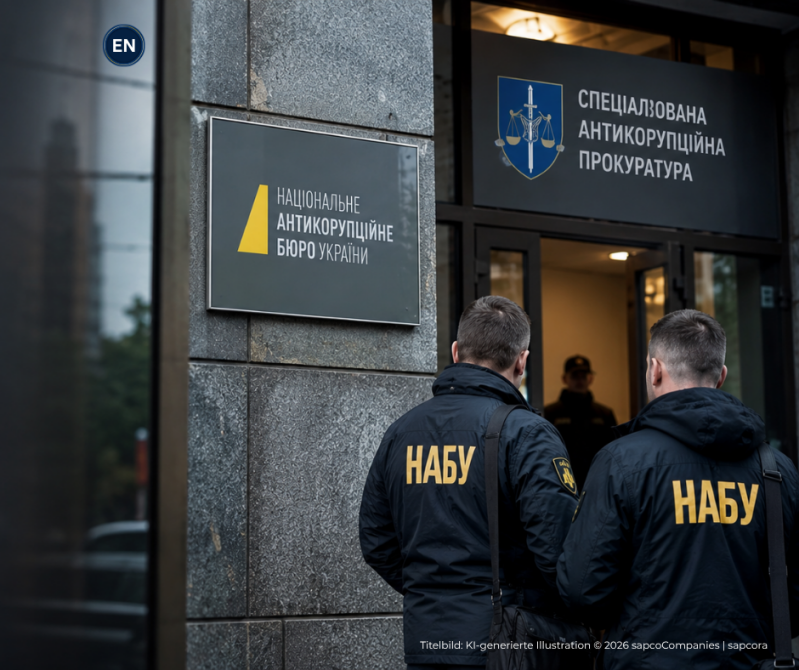
On the morning of August 19, 2026, Ukraine’s National Anti-Corruption Bureau, NABU, and the Specialized Anti-Corruption Prosecutor’s Office, SAPO, announced a special operation aimed at exposing what they described as a criminal organization. According to the agencies’ public statement, the alleged organization operated under the direction of a sitting and a former member of parliament and involved senior officials from the Office of the President as well as other individuals.
At the time of publication, NABU and SAPO had not publicly identified the alleged organizers, had not published a full factual narrative of the suspected scheme and had not announced final charges or convictions arising from the operation. That distinction is essential. An investigative action, search, notice of suspicion and criminal charge are legally different stages, and none is equivalent to guilt. Under fundamental criminal-law principles, every person involved is presumed innocent unless and until convicted by a competent court.
Ukrainian media, citing law-enforcement and political sources, reported that investigative actions concerned Deputy Head of the Office of the President Iryna Mudra, sitting MP Vadym Stolar and former MP Maksym Mykytas. Some reports also mentioned officials from the Ministry of Justice and representatives linked to Sense Bank. Those names had not, at the time this report was prepared, been formally confirmed by NABU and SAPO in their initial official statement. For that reason, newsmedia.report treats them only as individuals reportedly connected to investigative activity, not as persons proven to have committed any offence.
Later in the morning, media reported that NABU had released a short fragment of intercepted conversations associated with the operation, which Ukrainian outlets referred to as “Forest Gump.” The fragment reportedly included discussion of money and references to the presidential office. A short recording cannot by itself establish the identities, roles, context or criminal liability of participants. Its evidentiary meaning depends on authentication, the full recordings, corroborating documents, witness evidence, financial records and judicial review.
Why this is bigger than a single corruption case
The significance of the operation lies less in the number of people mentioned than in the institutions it touches. Ukraine is fighting the largest war in Europe in generations while simultaneously attempting to qualify for European Union membership, secure continued international financial support and convince its own population that wartime centralization has not become a permanent substitute for accountability.
The Office of the President has accumulated extraordinary influence during martial law. That concentration of authority is partly a consequence of war: military command, diplomacy, emergency governance and the management of international support require rapid decision-making. But concentrated power creates an equally strong need for independent oversight.
NABU and SAPO were designed precisely for that purpose. They were created after the 2014 Revolution of Dignity because Ukraine’s traditional police, prosecution and court structures had repeatedly failed to investigate politically connected corruption. Their independence was intended to make it possible to investigate ministers, lawmakers, judges, senior officials and people close to the presidency without requiring political permission.
That is why every investigation involving the presidential office becomes a test of the entire post-2014 reform architecture. The question is not merely whether one official acted unlawfully. It is whether the institutions are genuinely able to investigate people close to executive power without retaliation, obstruction or selective enforcement.
The system Ukraine built after 2014
Ukraine’s modern anti-corruption architecture emerged from the political collapse of the Viktor Yanukovych era. The 2014 uprising was driven by many factors, including European integration, abuse of power and public anger over systemic corruption. The government that followed faced intense pressure from Ukrainian civil society, the European Union, the International Monetary Fund and other international partners to build institutions capable of prosecuting high-level corruption independently.
NABU became the specialized investigative body for top-level corruption. SAPO was created to supervise and prosecute NABU cases. The High Anti-Corruption Court, known as HACC, was later established to adjudicate those cases through judges selected under a process designed to reduce political interference. The National Agency on Corruption Prevention was tasked with preventive functions such as asset declarations, conflicts of interest and political-finance oversight.
The architecture was deliberately fragmented. No single institution was supposed to control investigation, prosecution and judgment. NABU investigates. SAPO directs and prosecutes. HACC decides. That separation is not bureaucratic excess; it is the central safeguard against political capture.
The system has never been flawless. Cases have moved slowly. Some investigations have failed. Critics have accused the institutions of selective priorities, weak case management or excessive public communication. But the European Commission has repeatedly treated the independence and effectiveness of NABU, SAPO and HACC as core benchmarks in Ukraine’s rule-of-law reform and EU accession process.
The legal chain: from search to conviction
Public discussion of corruption investigations often collapses very different legal stages into one another. A legally accurate reading requires separating them.
A search is an investigative measure used to obtain evidence. Being searched does not mean a person is a suspect and certainly does not establish guilt. A notice of suspicion is a formal procedural step indicating that investigators believe there is sufficient basis to suspect a person of a criminal offence. It is not a conviction. An indictment or referral to court means prosecutors believe the available evidence is sufficient to seek a judicial determination. The trial court then assesses admissibility, credibility, intent, causation and legal classification. Appeals may follow.
For organized-crime allegations, prosecutors generally must prove more than a loose network of people who know one another. They must establish the existence and structure of an organized criminal arrangement, the role of particular participants, their knowledge and intent, and the connection between individual acts and the alleged common criminal purpose. Where money laundering is alleged, prosecutors must also prove the relevant link between assets and predicate criminal conduct. Where bribery or abuse of office is alleged, they must prove the elements required by the specific offence.
This is why responsible reporting must avoid phrases such as “corrupt official” before judgment. Even where investigators use the term “criminal organization” to describe their working theory, the final legal characterization belongs to the court.
The 2025 confrontation over NABU and SAPO
The current operation cannot be understood without the political crisis of July 2025.
On July 22, 2025, the Verkhovna Rada adopted legislation that significantly expanded the powers of the Prosecutor General over NABU and SAPO. The changes gave the Prosecutor General broad authority over case access, reassignment and prosecutorial control. Because the Prosecutor General is appointed through a political process and is institutionally much closer to the executive than SAPO, critics argued that the changes destroyed the practical independence of the anti-corruption system.
The law was signed by President Volodymyr Zelenskyy. The administration argued that the changes were needed to improve coordination and address alleged Russian influence within the anti-corruption institutions.
The reaction was immediate. Thousands of Ukrainians protested in Kyiv and other cities. The demonstrations were politically significant because they represented the most visible domestic protest movement since the start of Russia’s full-scale invasion in February 2022. Protesters were not rejecting the war effort. Many were explicitly defending the idea that Ukraine’s European and democratic identity required independent institutions even during wartime.
The European Union also reacted sharply. EU officials emphasized that independent anti-corruption bodies were central to Ukraine’s accession path and to the rule-of-law commitments underlying European support. International financial institutions had likewise tied governance reforms to Ukraine’s long-term economic stabilization.
Within days, Zelenskyy reversed course. A new bill restoring key guarantees of NABU and SAPO independence was submitted, adopted by parliament and signed on July 31, 2025. The speed of the reversal showed both the vulnerability and the resilience of Ukraine’s institutional system: executive power had been able to weaken the bodies rapidly, but domestic protest and external pressure were able to force a correction.
Why critics believed the 2025 move was connected to investigations
The political controversy did not occur in a vacuum. At the time, NABU and SAPO were investigating or prosecuting a growing number of senior officials, members of parliament and figures connected to the presidential administration.
SAPO leadership said in 2025 that the agencies were investigating corruption allegations involving dozens of current and former MPs and had brought cases against senior officials, including individuals with close political connections to the government. The Financial Times reported that SAPO chief Oleksandr Klymenko believed high-profile cases were likely among the reasons the agencies had come under political pressure.
Critics also pointed to the chronology. Raids and criminal cases involving NABU personnel occurred immediately before parliament moved to restrict the agencies’ independence. Government and security officials said some actions were necessary because of suspected Russian infiltration and other misconduct. NABU and SAPO responded that wrongdoing by individual employees, if proven, should be prosecuted but did not justify dismantling institutional independence.
No public evidence established that the July 2025 legislation was enacted for the purpose of protecting a specific suspect. That claim therefore remains a political allegation, not a proven fact. What is established is that the legislation would have given the politically appointed Prosecutor General much greater power over investigations involving senior officials, and that the move occurred while the anti-corruption agencies were pursuing politically sensitive cases.
The cases that moved closer to the presidential inner circle
The year after the 2025 confrontation demonstrated why institutional independence mattered.
Operation Midas, initially centered on alleged large-scale corruption in the energy sector, became one of the most politically consequential investigations of the wartime period. Prosecutors alleged that a criminal group connected to the state energy sector extracted kickbacks and laundered substantial sums. Businessman Tymur Mindich, a former business associate of Zelenskyy, became a central suspect in public reporting. Mindich denied wrongdoing and left Ukraine, according to reporting on the case.
The investigation later reached former senior officials. Andriy Yermak, who had served as head of the Office of the President and was widely regarded as one of the most powerful figures in wartime Ukraine, resigned in late 2025 after anti-corruption investigators searched his home. In 2026, NABU and SAPO accused him of involvement in an alleged money-laundering scheme connected to a luxury residential project near Kyiv. He denied the allegations.
Former deputy prime minister Oleksiy Chernyshov and other senior figures were also drawn into anti-corruption proceedings. Again, the existence of charges does not establish guilt, and several of those accused have denied wrongdoing.
The significance is institutional rather than personal. By 2026, the anti-corruption bodies had demonstrated that they were willing to investigate people who had occupied the highest levels of executive power. That fact makes any new operation involving the presidential office politically explosive even before its legal contours are fully known.
There is no public case against Zelenskyy
One distinction must remain explicit.
President Volodymyr Zelenskyy has not been publicly identified by NABU or SAPO as a suspect in the August 19 operation, and the available material reviewed for this report does not establish that he personally participated in the alleged conduct under investigation.
Corruption investigations involving presidential advisers, former business associates or members of an administration do not automatically establish criminal responsibility on the part of the president. Criminal liability is individual. It depends on evidence of conduct, knowledge and intent attributable to the person concerned.
Politically, however, investigations involving close associates can affect a president even without personal criminal exposure. They raise questions about appointments, supervision, institutional culture, access and whether warning signs were ignored. Those are questions of political responsibility and governance, not substitutes for proof of criminal conduct.
Conflating those two categories would be legally wrong and journalistically misleading.
Who is Iryna Mudra, and why her reported involvement matters
Ukrainian media reported on August 19 that investigative actions were taking place in connection with Iryna Mudra, a deputy head of the Office of the President responsible for legal matters. At the time of publication, the initial official NABU statement had not named her or announced a formal suspicion against her.
Mudra joined the presidential office in 2024 after serving as deputy justice minister. Her work has included some of Ukraine’s most important international legal projects, including efforts related to Russian state responsibility, compensation for war damage and the creation of mechanisms addressing the crime of aggression.
Her portfolio makes the reports especially sensitive. A senior official responsible for legal and justice-policy matters occupies a position at the intersection of domestic law, international accountability and institutional reform.
But sensitivity is not evidence. The existence of a search or reported investigative interest does not establish that Mudra committed an offence. Until NABU and SAPO publish formal details, the precise reason for any investigative action, her procedural status and the evidence being examined remain unknown.
Vadym Stolar and Maksym Mykytas: why the names attract attention
Media sources also reported that sitting MP Vadym Stolar and former MP Maksym Mykytas were connected to the operation.
Stolar is a businessman and parliamentarian associated for years with Kyiv real estate and construction. He previously belonged to the Opposition Platform – For Life political force and later joined the Restoration of Ukraine parliamentary group. His business and political networks have been the subject of repeated journalistic scrutiny.
Mykytas is a former parliamentarian and construction businessman whose name has appeared in previous Ukrainian corruption and development controversies. Earlier legal proceedings involving him are separate matters and do not prove anything about the August 2026 investigation.
The importance of these backgrounds is contextual: Ukraine’s construction, land and urban-development sectors have historically been vulnerable to opaque relationships among business, municipal institutions, lawmakers and politically connected intermediaries. But previous allegations or cases cannot be used as propensity evidence in public reporting. Each new allegation must stand on its own evidence.
The money question: what investigators will need to prove
The short audio fragment reported on August 19 included discussion of bags of money and references to the Office of the President. Such material is attention-grabbing, but serious corruption cases are rarely proved by a dramatic recording alone.
Investigators will need documentary and financial evidence. That may include bank records, cash withdrawals, corporate ownership structures, contracts, property records, tax data, procurement decisions, communications, geolocation information, witness testimony and records showing who had authority to make relevant decisions.
If the case involves alleged bribery, investigators must establish the connection between an improper benefit and a specific official act or omission. If it involves embezzlement, they must establish control over public assets, unlawful appropriation and the role of each participant. If it involves money laundering, they must trace proceeds from the underlying crime into transactions intended to conceal or legitimize them.
If a bank or bank employees are ultimately implicated, investigators would also need to distinguish between ordinary financial services, failures of compliance controls and intentional participation in criminal conduct. A bank’s name appearing in an investigation does not establish institutional guilt.
Why wartime corruption is uniquely damaging
Corruption is harmful in any state. In wartime, the consequences are amplified.
Every major procurement decision can affect military capacity. Every diversion of infrastructure funds can weaken energy resilience, transport, housing or reconstruction. Every unexplained enrichment of senior officials can damage public willingness to accept mobilization, taxation and economic sacrifice.
Ukraine’s war effort depends heavily on social trust. Soldiers and civilians are being asked to endure extraordinary losses while the state administers unprecedented flows of weapons, donor money and reconstruction resources. Even isolated high-level corruption can therefore produce disproportionate political damage.
This is one reason Ukraine’s anti-corruption institutions have become strategic institutions rather than merely domestic law-enforcement bodies. Their credibility affects military aid, financial assistance, EU accession, investor confidence and the legitimacy of post-war reconstruction.
Western money, Ukrainian sovereignty and the rule-of-law bargain
Ukraine’s international partners have enormous financial interests in the quality of its institutions.
The European Union’s support architecture, including the Ukraine Facility, links financial assistance to reform commitments. The EU accession process separately requires progress on the rule of law, judicial independence and the fight against corruption. The European Commission has repeatedly called for a stronger track record in investigating, prosecuting and adjudicating high-level corruption.
The IMF has likewise incorporated governance and anti-corruption reforms into its programs with Ukraine. Its 2026 assessments continued to identify governance, anti-corruption, fiscal reform and financial-sector oversight as important components of long-term stability.
This creates a delicate balance. Ukraine is a sovereign state and its criminal investigations cannot lawfully be directed by foreign donors. But when international partners provide tens of billions of dollars and condition future integration on institutional reform, they have a legitimate interest in whether anti-corruption safeguards function independently.
The result is a rule-of-law bargain: donors do not choose whom Ukraine prosecutes, but they insist that institutions capable of prosecuting powerful people must remain operational and independent.
The High Anti-Corruption Court is the final institutional test
NABU and SAPO can investigate and prosecute, but politically sensitive cases ultimately depend on courts.
The High Anti-Corruption Court was created because ordinary judicial structures had long struggled with high-level corruption cases. Its judges were selected under a process that included international expert participation designed to screen integrity and professional competence.
The court’s existence is central to the credibility of every major NABU/SAPO case. If investigators collect evidence unlawfully, HACC can exclude or reject it. If prosecutors overstate an allegation, the defense can challenge it. If a suspect is entitled to release, bail or acquittal, the court is the institution that must make that decision.
For news consumers, this is an important corrective. Arrests and searches produce headlines; judgments produce legal truth. A functioning anti-corruption system must be capable not only of convicting the guilty but also of protecting the innocent from politically convenient accusations.
The problem of leaks and trial by media
High-profile corruption investigations generate a second risk: information can become a political weapon before a case reaches court.
Selective release of intercepted conversations, unnamed-source briefings and partial documents can create a public presumption of guilt. Conversely, political actors may attack investigators, portray every case as fabricated or use national-security claims to delegitimize anti-corruption institutions.
Both dynamics are dangerous.
Investigators have legitimate reasons to disclose some information: public accountability, deterrence, explaining major operations and countering misinformation. But extensive pretrial publicity can prejudice reputations and, in some legal systems, complicate fair-trial rights.
Responsible journalism must therefore distinguish between evidence described by investigators, evidence independently verified by reporters, allegations attributed to sources and facts established by court decisions. This report applies that distinction throughout.
Ukraine’s older corruption problem did not begin with Zelenskyy
It would be historically misleading to treat today’s crisis as a product of one administration.
Ukraine inherited from the Soviet period a state system vulnerable to patronage, informal networks and opaque control of public assets. During the 1990s and 2000s, oligarchic business groups accumulated enormous economic and political influence. State enterprises, energy pricing, customs, public procurement and the judiciary became recurring centers of corruption allegations.
President Viktor Yanukovych’s rule became synonymous for many Ukrainians with extreme elite enrichment and state capture. The post-2014 reform program was designed in direct response to that history.
Petro Poroshenko’s presidency made important institutional reforms but also faced criticism for incomplete separation of business and politics and for slow progress in the courts. Zelenskyy entered office in 2019 promising to break the old system. His administration enacted some reforms and supported digitalization and institutional changes, while also becoming increasingly criticized for concentrating decision-making in the presidential office.
The persistent lesson is that Ukraine’s corruption problem is systemic. Replacing individuals is not enough. Durable change requires institutions that remain independent regardless of who controls the presidency or parliament.
The Tatarov precedent and fear of case reassignment
One reason the independence of NABU and SAPO is treated so seriously is the history of cases being moved away from them.
In 2020, NABU opened a case involving Oleh Tatarov, then a deputy head of the Office of the President. The case was subsequently transferred away from NABU through decisions involving the Prosecutor General’s Office, and it later stalled.
The details and legal disputes surrounding that case remain contested, but the institutional lesson became powerful: if politically sensitive cases can be reassigned from an independent anti-corruption body to institutions more closely tied to executive power, formal independence may become meaningless.
That precedent was repeatedly cited during the July 2025 crisis. Critics feared that giving the Prosecutor General broad authority over NABU cases would recreate exactly the mechanism that the specialized system had been established to prevent.
From Midas to Forest Gump: a pattern, not yet a single case
It is tempting to connect every major anti-corruption investigation into one grand narrative. That would be premature.
Operation Midas, the parliamentary vote-buying investigations, cases involving former presidential-office officials and the August 19 operation arise from different factual allegations and may involve different people, sectors and time periods.
What connects them is institutional rather than necessarily criminal: the same anti-corruption bodies are repeatedly investigating people with access to political power, public money and strategic sectors.
Whether the August 19 operation is legally connected to Midas or any earlier case can only be established by official procedural documents or evidence published by investigators and tested in court. Until then, similarities in names, political networks or investigative agencies are not enough to claim a unified conspiracy.
Could this affect EU accession?
Potentially, yes — but not in the simplistic sense that the existence of corruption automatically blocks membership.
The European Union expects candidate countries to demonstrate that corruption is investigated and prosecuted effectively. Paradoxically, a major corruption scandal can therefore reveal both weakness and institutional strength.
If senior officials are credibly investigated by independent bodies and cases proceed through fair courts, the system is functioning. If investigators are obstructed, institutions are politically subordinated or evidence disappears, the same scandal becomes proof of rule-of-law failure.
For Ukraine, the August 19 operation will therefore be judged on process as much as outcome. The key questions for Brussels are likely to be whether NABU and SAPO are allowed to work independently, whether judicial safeguards are respected, whether the government retaliates against investigators and whether final cases are resolved through courts rather than political bargaining.
Could this affect foreign aid?
There is no automatic mechanism under which a single investigation stops Western assistance.
Military support is driven by strategic security considerations. Financial assistance, however, is increasingly tied to reform milestones, governance benchmarks and the protection of institutions responsible for overseeing public funds.
A sustained assault on anti-corruption bodies could therefore affect confidence, disbursement decisions or future conditions. The July 2025 crisis demonstrated that the EU was willing to use strong political and financial leverage when it believed anti-corruption independence was at risk.
By contrast, the fact that NABU and SAPO are currently able to investigate figures linked to the highest levels of government can be interpreted by donors as evidence that the institutions retain meaningful autonomy.
The political risk for the presidency
Even without evidence against Zelenskyy personally, the cumulative effect of corruption investigations can become politically dangerous.
Presidents are judged not only by their own conduct but by the people they appoint and empower. Repeated cases involving former advisers, business associates, senior officials or institutions under presidential influence can produce a narrative of failed oversight even when criminal responsibility remains individual.
The 2025 attempt to weaken NABU and SAPO created an additional burden. Every subsequent case touching the presidential orbit invites critics to ask whether the earlier legislation was intended to protect insiders. That remains unproven, but politically the question is unavoidable because the timing of the 2025 confrontation has become part of the public record.
Zelenskyy’s strongest response, institutionally, is therefore not rhetorical. It is to allow the investigation to proceed without interference, ensure full compliance with court orders, avoid attacks on investigators and accept judicial outcomes even when politically damaging.
The political risk for the anti-corruption agencies
NABU and SAPO also face serious risks.
The greater their power and visibility, the stronger the obligation to demonstrate neutrality, procedural discipline and evidentiary quality. Politically explosive investigations that collapse in court can damage the agencies’ legitimacy. Unauthorized leaks can undermine fair-trial rights. Selective enforcement can create the perception that anti-corruption law is being used as an instrument of factional conflict.
The institutions must therefore meet a higher standard than ordinary political actors. Their authority depends not on popularity but on evidence.
This is particularly important in wartime, when Russian disinformation routinely exploits real Ukrainian governance failures and amplifies unverified allegations. The correct response is not secrecy or immunity from criticism. It is transparent procedure, independent courts and precise public communication.
What investigators still have not told the public
Several critical questions remain unanswered.
Who exactly does NABU allege led the criminal organization? What offences are being investigated? Over what period did the alleged conduct occur? What public decisions, contracts, assets or financial flows are at issue? Which people are witnesses, which are subjects of searches and which — if any — have been formally notified of suspicion?
What is the relevance of the Office of the President? Are officials suspected of abusing official powers, facilitating private transactions, influencing judicial or administrative decisions, laundering proceeds or something else entirely?
What is the significance of the reported involvement of Ministry of Justice officials and financial-sector representatives? Was a bank used merely as a financial channel, did compliance systems fail, or is intentional participation alleged?
What do the intercepted recordings actually contain in full? Who is speaking? When were the conversations recorded? Were the interceptions lawfully authorized? Are the references literal, coded or ambiguous?
Until those questions are answered, any definitive reconstruction of the alleged scheme would be speculation.
What happens next
The next legally meaningful milestones are likely to be formal notices of suspicion, court applications for preventive measures, asset seizures, official descriptions of the alleged scheme and eventually indictments.
If suspects are named, their defenses will matter. Investigative journalism must report denials and alternative explanations with the same precision used to report allegations.
Defense lawyers may challenge the legality of searches, surveillance, jurisdiction, evidentiary chains or prosecutorial theories. They may argue that transactions were lawful, that conversations were misunderstood, that officials lacked knowledge or that investigators have conflated political contact with criminal coordination.
Those arguments are not technical distractions. They are the process through which allegations become either proven cases or failed prosecutions.
A possible future: institutional breakthrough or political relapse
There are two broad ways this story can develop.
In the first, NABU and SAPO complete a professionally documented case, courts independently evaluate the evidence, defendants receive full due-process protections and final judgments are respected. If that happens, even a scandal involving powerful officials could strengthen Ukraine’s rule-of-law credentials. It would demonstrate that wartime power does not create immunity.
In the second, investigators come under renewed political pressure, cases are reassigned, legislation is changed again, prosecutors are removed, evidence leaks become partisan weapons or prosecutions collapse because of procedural manipulation. That outcome would reopen the institutional crisis of 2025 and could damage Ukraine’s EU trajectory and donor confidence.
There is also a third possibility: the allegations may prove narrower or weaker than current headlines suggest. Some people searched may never become suspects. Some suspected conduct may not be proven. A fair system must leave room for that outcome.
The real test is not whether corruption exists
No serious observer expects a country of more than thirty million people, fighting a full-scale war and administering enormous public expenditure, to eliminate corruption entirely.
The more meaningful test is whether powerful people can be investigated without permission from powerful people.
Ukraine’s post-2014 institutions were created around that principle. The July 2025 political crisis showed how fragile those safeguards remained. The cases of 2025 and 2026 showed that independent investigators were nonetheless capable of reaching into the highest levels of government.
The August 19 operation now brings that question back to the center of Ukrainian politics.
At this stage, the public knows that NABU and SAPO say they are exposing a criminal organization involving a sitting and former MP and senior officials from the presidential office. The public does not yet know the full scheme, the complete list of suspects, the evidence against each person or whether prosecutors will ultimately prove their case.
That uncertainty is not a weakness in this report. It is the legally correct description of an active investigation.
For Ukraine, the next chapter will matter far beyond the fate of individual officials. It will help determine whether the anti-corruption architecture built after the Revolution of Dignity has matured into a system capable of surviving wartime, political pressure and cases that reach the center of power.
Editorial and legal note
This report distinguishes between official statements, media reports based on unnamed sources, formal procedural status and facts established by courts. Persons named in connection with investigative actions are presumed innocent unless and until proven guilty by a final court judgment. Where Ukrainian authorities had not publicly confirmed a person’s status at the time of publication, the report describes that status as reported or unconfirmed rather than established.
Inside Ukraine’s New Corruption Crisis. Ukraine’s NABU and SAPO have launched a new operation involving current and former lawmakers and senior presidential-office officials. A comprehensive investigation into the allegations, the institutions behind the probe, the political history, the legal safeguards and the risks for Ukraine’s EU path.
Kommentar hinzufügen
Kommentare