

Section: International
Format: Special Report
Author: Sinisa Brkic (sb)
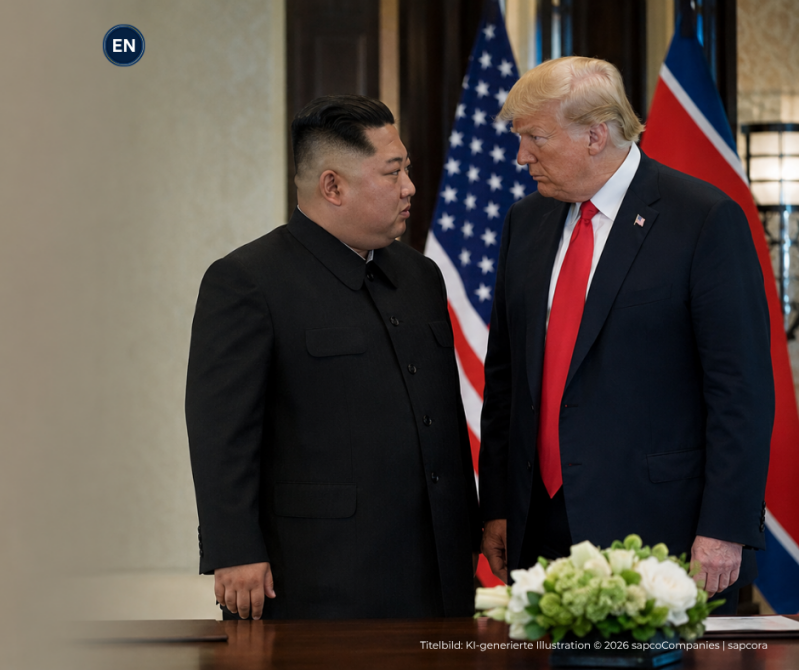
President Donald Trump says he expects to meet North Korean leader Kim Jong Un before the end of 2026. Pyongyang, however, is challenging a crucial part of the emerging diplomatic narrative, with Kim Yo Jong saying she is unaware of the recent communication Trump has described. The contradiction comes as Washington sharply reduces joint military exercises with South Korea and Trump cites an unusually specific figure for North Korea’s nuclear arsenal, creating the appearance of renewed diplomacy before there is evidence of an agreed diplomatic process.
A meeting Trump expects, but North Korea has not agreed to
Donald Trump has moved the prospect of another encounter with Kim Jong Un from speculation into presidential expectation. Asked on August 19 whether he expected to meet the North Korean leader later this year, Trump answered affirmatively, reinforcing an effort to revive the highly personalized diplomacy that defined his first administration’s approach to Pyongyang.
What does not yet exist is equally important. There is no publicly confirmed date, venue, agenda or North Korean acceptance of such a meeting. Trump has stated an intention and an expectation, but those statements do not amount to a jointly announced summit.
That distinction has become more significant because Pyongyang is disputing the apparent diplomatic sequence leading to Trump’s announcement. Kim Yo Jong, the North Korean leader’s influential sister and a senior political figure in her own right, says she is unaware of the recent communication between the two leaders that Trump has suggested took place. The result is an unusual diplomatic asymmetry. Washington is publicly talking about a meeting that could occur within months, while Pyongyang is declining to validate the underlying contact that would ordinarily be expected to precede such an event.
The dispute over contact does not prove deception
Trump said earlier this week that Kim had responded to his outreach, but offered no details about the nature, timing or channel of that response. Kim Yo Jong subsequently said she was unaware of recent communication between the two leaders, while at the same time describing their personal relationship in positive terms and recalling Kim Jong Un’s favorable memories of Trump.
Those statements conflict, but the available evidence does not establish that either side is deliberately giving a false account. Diplomatic communication with North Korea is unusually opaque, exchanges may be tightly compartmentalized, and the two governments may also be using different definitions of what constitutes a response or direct communication.
There is therefore no reliable public basis for concluding that a functioning leader level backchannel currently exists. There is equally no basis for ruling out communications that have not been disclosed. For now, the discrepancy itself is the relevant fact.
The North Korean response also matters for what it did not do. Pyongyang did not use the occasion to launch a categorical personal attack on Trump or declare future talks impossible. The language instead preserved the distinction between what North Korea describes as a favorable personal relationship and what it continues to regard as hostile American security policy.
Washington has already changed the military equation
The most concrete change is not diplomatic. It is military.
The United States and South Korea have shortened this year’s Ulchi Freedom Shield exercise from the planned 11 days to five, bringing the exercise to an end on August 21 rather than August 27. Some field training has also been reduced, canceled or shifted into simulation following Trump’s instruction to substantially scale back the exercises.
For decades, Washington and Seoul have described the drills as defensive and essential to maintaining combined readiness. North Korea has consistently characterized them as preparation for war and has repeatedly cited them as evidence of hostile intent.
Trump has taken a different rhetorical approach from many previous U.S. administrations, arguing that large exercises send an unnecessarily hostile signal to Pyongyang and emphasizing his personal relationship with Kim. The Pentagon maintains that the modified exercise will still meet essential training objectives.
The change is nevertheless politically significant because no reciprocal North Korean security concession has been publicly announced. Washington has altered a visible component of allied military activity before any publicly verified agreement to resume negotiations.
Seoul was presented with a decision, then embraced the diplomatic opening
The manner in which the reduction was initiated adds another layer to the story. South Korean Foreign Minister Cho Hyun told lawmakers that officials in Seoul and Washington had not known in advance about Trump’s initial order. The two militaries subsequently coordinated the practical changes, with South Korea agreeing to adjustments proposed by the United States.
That sequence creates two distinct issues for Seoul. President Lee Jae Myung has welcomed efforts to create conditions for renewed dialogue and has presented the reduction as a potential contribution to peace on the Korean Peninsula. At the same time, his government has stressed the importance of a strong alliance and greater South Korean capacity to provide for its own defense.
Those objectives are not necessarily contradictory. A government can favor diplomatic deescalation while demanding reliable consultation with its principal security partner. The difficulty arises when a concession intended to improve relations with Pyongyang is introduced in a way that raises questions inside the alliance itself.
For South Korea, the central issue is therefore larger than the duration of one military exercise. It is whether future changes in deterrence policy will be negotiated between allies or introduced as instruments of direct diplomacy between Washington and Pyongyang.
The mystery of Trump’s 57 nuclear weapons
Trump added another striking element when he said North Korea possesses 57 “very powerful” nuclear weapons. The precision immediately attracted attention because the United States does not publish an authoritative public inventory of North Korea’s assembled nuclear warheads.
Open source estimates illustrate why caution is necessary. The Stockholm International Peace Research Institute estimates that North Korea may have assembled roughly 60 nuclear warheads and possesses sufficient fissile material for at least 30 more. Other assessments differ because analysts must estimate secret production rates, fissile material stocks, weapon designs and the proportion of available material that has actually been converted into usable warheads.
South Korea added another layer of uncertainty on Thursday. Defense Minister Ahn Gyu back told lawmakers that North Korea was generally estimated to possess roughly 80 to 120 warheads, but later clarified that the range was derived from private research organizations and could not be officially confirmed by the South Korean military.
Trump’s figure of 57 therefore cannot currently be presented as a verified U.S. intelligence assessment. It falls close to some prominent open source estimates of the number of assembled weapons, but there is no public evidence establishing where the president obtained the number or what methodology lies behind it. This distinction matters because estimates of nuclear capability frequently measure different things. The number of assembled warheads is not the same as the theoretical number of weapons that could eventually be produced from an estimated stock of fissile material.
The nuclear problem has become harder since 2019
Any new Trump Kim meeting would take place in a substantially different strategic environment from the summits in Singapore and Hanoi and their later encounter at the Korean Demilitarized Zone. North Korea has continued developing nuclear weapons and missile systems, while its military relationship with Russia has become significantly deeper.
That evolution gives Kim more strategic room than he possessed during the diplomacy of 2018 and 2019. Pyongyang is less isolated, its nuclear capabilities are more advanced, and the North Korean leadership has repeatedly treated its nuclear arsenal as central to national security rather than as a temporary bargaining asset.
The earlier diplomacy ultimately failed to bridge a fundamental disagreement over sequencing. Washington sought meaningful nuclear dismantlement, while Pyongyang sought sanctions relief and a gradual process based on reciprocal steps. The Hanoi summit collapsed without an agreement, and sustained negotiations never recovered. A new meeting would therefore not simply restart the previous process. It would confront a more capable North Korea with stronger external relationships and potentially different expectations about what negotiations are even supposed to achieve.
Denuclearization or nuclear risk management
That question may become the central strategic test of any renewed diplomacy. The United States continues to support the denuclearization of North Korea and does not formally recognize Pyongyang as a nuclear weapons state within the established international framework.
The practical reality, however, is that North Korea possesses nuclear weapons, continues to improve its arsenal and shows no public indication that it is preparing to surrender it. That leaves any future negotiation facing a difficult choice between retaining complete denuclearization as the ultimate objective and pursuing more limited agreements designed to constrain production, testing, deployment or escalation risks.
Such an approach could produce tangible security benefits, but it would also be politically sensitive. An agreement that manages North Korea’s arsenal without eliminating it could be interpreted as tacit acceptance of a nuclear status that Washington, Seoul and Tokyo have long refused to legitimize.
This is why the language surrounding a new summit will matter as much as the meeting itself. A diplomatic process without a clearly defined objective could generate powerful images while leaving the underlying security problem unchanged.
Japan has its own reasons to watch closely
Japan is not a secondary observer in this equation. North Korean ballistic missile development directly affects Japanese security, while Tokyo also considers the unresolved abduction of Japanese citizens by North Korea a central national issue.
Japan, the United States and South Korea have maintained close coordination over North Korea’s nuclear and missile programs. Any significant adjustment in American policy toward Pyongyang will therefore be assessed in Tokyo not only for its potential to reduce tensions, but also for its effect on missile deterrence, trilateral security cooperation and the credibility of U.S. commitments in the region.
A successful diplomatic opening could serve Japanese interests if it produces verifiable limits on North Korean capabilities or reduces the danger of military escalation. A summit driven principally by personal diplomacy, without allied coordination or measurable commitments, would create a very different calculation.
Shenzhen is possible, but there is no agreed venue
One potential opportunity is already visible on the diplomatic calendar. China will host the APEC Economic Leaders’ Meeting in Shenzhen in November, and reports have suggested that Trump has considered using an Asian trip associated with the gathering as an opportunity to meet Kim.
That possibility remains speculative. No Trump Kim meeting in Shenzhen has been jointly announced, North Korea has not publicly accepted such a proposal, and no timetable has been confirmed.
The distinction is particularly important in a story where expectation is running ahead of formal diplomacy. A convenient date on the international calendar can facilitate a meeting, but it does not create one.
A new launch reinforces the uncertainty
The security environment has meanwhile continued to move. South Korea’s military reported on Thursday that North Korea had launched an unidentified projectile toward waters off its east coast, with details still being analyzed at the time of the initial announcement.
Its timing places the launch directly inside the current period of military exercises and diplomatic signaling, but timing alone does not establish motive. Without additional information from military authorities or North Korea, it would be premature to describe the launch as a direct response either to the exercises or to Trump’s diplomatic initiative.
It does, however, illustrate the central problem confronting any renewed diplomacy. Engagement and military pressure are not unfolding in separate phases. They are occurring simultaneously.
Personal diplomacy can open a door, but cannot define the deal
Trump’s relationship with Kim has always been unusual in modern U.S. diplomacy. Their first period of engagement demonstrated that direct presidential contact can rapidly alter the atmosphere surrounding a confrontation that once appeared dangerously escalatory.
It also demonstrated the limitations of personal rapport. The relationship survived even after negotiations failed, but it could not resolve disagreements over sanctions, verification and the future of North Korea’s nuclear arsenal.
The same lesson applies now. A leader level meeting could reopen channels that have remained effectively frozen for years, but its strategic value would depend on what follows: sustained working level negotiations, a defined agenda, coordination with allies and commitments that can be measured rather than merely announced.
The next signal has to come from Pyongyang
For now, Trump has announced an expectation, not an agreement. North Korea has preserved the possibility of personal diplomacy while refusing to validate Washington’s account of recent communication and dismissing the reduction in military exercises as insufficient.
That leaves the initiative suspended between symbolism and substance. A direct confirmation from Kim Jong Un, evidence of working level talks or an agreed date would transform the story immediately. Until then, the most important fact is not that another summit is coming, but that Washington is preparing for one before Pyongyang has publicly said that it is.
Trump and Kim Jong Un: New Summit Push Meets North Korean Skepticism. Trump says he expects another meeting with Kim Jong Un in 2026, but North Korea disputes reports of recent communication as questions grow over military drills, nuclear weapons and the future of diplomacy.
Kommentar hinzufügen
Kommentare