

Section: Energy
Format: Special Report
Author: Sinisa Brkic (sb)
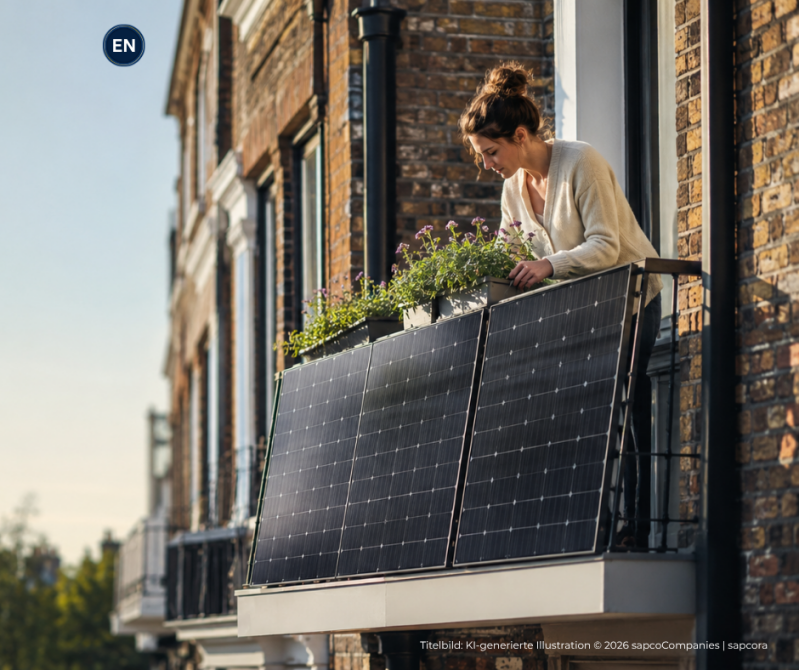
From 27 August 2026, households across England, Scotland and Wales can legally use approved plug in solar systems designed to feed electricity directly into the home. The change opens small scale solar generation to renters, flat dwellers and households for whom conventional rooftop installations have been too expensive or impractical. Britain is entering a market Germany has already pushed into the mainstream, but the crucial question is whether the economics will prove convincing.
A new household energy market begins
A significant change in Britain’s domestic energy market took effect on 27 August 2026. Households in England, Scotland and Wales can now use approved plug in solar systems that supply electricity through a compliant connection to the home’s electrical system.
The technology is already familiar across parts of continental Europe. In Germany, small solar systems installed on balconies, terraces and other limited spaces have developed into a substantial consumer category, commonly known as Balkonkraftwerke. Britain is arriving later, but the regulatory change could open solar generation to millions of households that previously had few practical options. This is therefore more than the arrival of another solar product. It creates a new category between conventional rooftop installations and ordinary household appliances, with the potential to make small scale electricity generation cheaper, simpler and more accessible.
What changed on 27 August
The new framework allows compliant plug in solar systems to operate in Great Britain with an inverter output of up to 800VA. That limit keeps the systems firmly within the small scale generation segment and distinguishes them from conventional rooftop solar arrays, which typically require a more extensive electrical installation.
Government estimates suggest that a suitable system could reduce household electricity costs by as much as about £110 a year. That figure is best understood as a potential upper saving under favourable conditions, not as a guaranteed return for every household. The distinction between Great Britain and the United Kingdom is important. The change applies to England, Scotland and Wales, while Northern Ireland operates under a separate electrical and regulatory framework and is not covered by the new rules in the same way.
Plug in does not mean anything can be connected
The simplicity of the concept risks creating the wrong impression. The new rules do not mean consumers can attach any solar panel to an inexpensive inverter and connect it to a domestic socket.
Systems must meet the relevant technical and safety requirements and be supplied in a compliant configuration. The inverter, electrical connection, mounting arrangement and associated components all form part of the safety case, particularly because domestic circuits have traditionally been designed around electricity flowing from the grid towards household appliances rather than generation feeding into the circuit. Consumers should therefore distinguish sharply between an approved plug in solar system and improvised combinations of components. The entire attraction of the new category depends on simplicity without abandoning electrical safety.
The real advantage is access
An 800VA system will not make the average household energy independent, nor is that its purpose. Its value lies in reducing the amount of electricity that needs to be purchased from the grid during daylight hours. Many homes maintain a permanent background load from refrigerators, routers, computers, ventilation systems and other appliances. Electricity generated by a small solar system while those devices are operating can be consumed immediately inside the home, reducing grid demand in real time.
That model is particularly attractive for households unable to justify the cost of conventional rooftop solar. Renters, people living in flats, households without a suitable roof and consumers with smaller investment budgets suddenly have a route into domestic generation that previously barely existed in Britain.
The £110 saving needs context
The government’s estimate of savings of up to about £110 a year will inevitably become one of the most visible numbers attached to the new market. It should not, however, be treated as a standard annual return. Actual generation depends on location, orientation, shading, seasonal weather and the physical positioning of the panels. A well positioned system receiving strong sunlight can perform very differently from a unit installed in partial shade or on a poorly oriented balcony.
Household behaviour matters just as much. Solar electricity is economically most valuable when it is consumed at the moment it is produced, because every unit used directly can replace electricity that would otherwise have been purchased from a supplier. A household with significant daytime consumption may therefore capture much more value than one that is largely empty until evening. The economics of plug in solar are ultimately shaped by the relationship between generation and consumption, not by panel capacity alone.
Price is the first major test
Legalisation removes the regulatory obstacle, but it does not automatically create a compelling financial proposition. The first generation of compliant systems is entering a market where prices remain relatively high compared with more mature European markets. That matters because payback is extremely sensitive to the initial purchase price. A system costing several hundred pounds can still deliver worthwhile savings over a long operating life, but the calculation becomes much less attractive when purchase costs approach the upper end of the early market.
The government’s £110 estimate therefore needs to be considered alongside the cost of the equipment. Even where a household reaches a strong level of annual savings, recovering the original investment is likely to take several years at current early market prices.
For many consumers, the decisive development will not be the legal change itself but what happens next. If retail competition pushes complete compliant systems down towards the lower hundreds of pounds, plug in solar begins to look much more like an accessible household energy product than a specialist investment.
Retail competition could transform the economics
Major British retailers are already preparing to participate in the new category, a signal that plug in solar is unlikely to remain a niche technical product. Broader retail distribution should increase consumer awareness while placing pressure on manufacturers to compete on price, design and ease of installation. The early British market also starts with a disadvantage. Manufacturers are developing products around a relatively new national framework without yet knowing how large consumer demand will become.
That uncertainty keeps costs higher than they may eventually be. If adoption accelerates, increased volumes and competition could lower prices quickly, just as they have in other European solar markets. The most important number to watch over the coming year may therefore not be installed capacity. It may be the average retail price of a compliant 800VA system.
Germany shows how quickly a niche can become mainstream
Germany offers the clearest indication of what a mature plug in solar market can look like. Balcony solar has moved from a product associated with technology enthusiasts into a widely recognised form of household energy generation.
Hundreds of thousands of new systems are now registered in Germany each year. That scale has helped create a dense consumer market with cheaper equipment, broader availability, mounting solutions for different buildings and much greater public familiarity with the technology.
Britain cannot simply reproduce the German market. Housing stock, electricity prices, regulation, consumer habits and planning conditions differ, and British adoption may develop along a different path. What Germany demonstrates is the effect of scale. Once small solar systems become ordinary consumer hardware rather than specialist equipment, price competition and product standardisation can alter the economics considerably.
Renters finally gain a meaningful option
The strongest structural case for plug in solar may be its ability to widen access. Traditional rooftop solar strongly favours people who own suitable houses, control their roofs and can finance an installation costing thousands of pounds. Renters and apartment residents have often been excluded from that model. A smaller, removable system changes part of the calculation because the equipment does not necessarily need to become a permanent part of the building.
That does not mean every tenant can install panels wherever they choose. Tenancy agreements, landlord consent, leasehold conditions, building safety requirements and planning rules may still affect whether and where equipment can be mounted. Balcony installations require particular care. Electrical approval of a product does not automatically mean a railing, façade or external structure is suitable for carrying solar panels, especially where wind loading, falling objects or access to shared property must be considered.
The new law therefore creates an opportunity, not an unrestricted right. For renters in particular, the electrical rules and the property rules remain separate questions.
Safety remains the reason for Britain’s caution
Britain has taken longer than several European countries to embrace plug in solar, largely because domestic electrical safety has been central to the debate. Feeding electricity into circuits through a simplified connection requires technical controls that protect both the household installation and the wider distribution network.
The new framework attempts to solve that problem by focusing on complete compliant systems rather than informal collections of individual components. That approach should make the technology easier for consumers to understand while placing greater responsibility on manufacturers to meet the required standards. Older properties deserve additional attention. The condition of household wiring, protective devices and circuits varies considerably across Britain’s housing stock, and consumers who are uncertain about their electrical installation should seek professional advice before connecting generation equipment.
Householders must also follow the applicable network notification requirements. Plug in solar may reduce the complexity of installing generation, but it does not remove the relationship between a household generator and the local electricity network.
Batteries remain the missing link
The new framework solves the first part of the small scale solar equation, but not the second. Simple consumer battery storage does not automatically fall under the same streamlined treatment as plug in solar generation.
That matters because solar production and electricity consumption rarely align perfectly. Panels can produce their strongest output around midday, while many households experience their highest demand later in the afternoon and evening. A battery can store some of that unused solar electricity and make it available later. Without storage, households have a stronger incentive to run appliances during daylight hours or otherwise increase their daytime consumption.
For now, consumers should not assume that a battery can simply be added under the same simplified rules. Storage remains a more complicated part of the domestic energy system and is likely to become one of the next areas of regulatory and commercial development.
Small systems can become a large energy resource
An individual 800VA installation is modest. Hundreds of thousands of them are not.
If plug in solar achieves mass adoption, the combined effect could become significant for daytime electricity demand. Large numbers of households producing part of their own electricity would reduce the amount drawn from the grid at certain hours and create a much more distributed pattern of generation. This does not replace utility scale renewables, conventional rooftop solar or investment in electricity networks. Plug in systems operate at another level of the energy transition, one centred on direct household participation.
Their wider importance lies in lowering the threshold for becoming an electricity producer. Solar generation no longer needs to begin with ownership of a detached house, a large roof and a substantial capital budget.
The market will decide whether this becomes a revolution
The regulatory barrier has been removed. The next test is whether manufacturers, retailers and consumers can turn legalisation into a functioning mass market. Prices need to fall, the range of compliant products needs to widen and consumers need clear information about realistic output, installation requirements and savings. Renters need workable permission processes, while regulators need to make sure rapid expansion does not encourage unsafe products or misleading financial claims.
If complete systems become significantly cheaper, plug in solar could develop into one of Britain’s most accessible household energy investments. If prices remain high, the technology may struggle to move beyond environmentally motivated early adopters. Germany has already demonstrated that balcony solar can grow from an enthusiast product into mainstream consumer hardware. Britain has now created the conditions for its own experiment.
The legal argument is largely settled. What happens next will be decided by product prices, household electricity bills and whether millions of consumers conclude that producing a small share of their own power is finally simple enough to be worth doing.
Britain Legalises Plug In Solar: Costs, Savings and Rules Explained. Plug in solar is now legal across Great Britain. We examine the 800VA limit, potential savings, current costs, safety rules and lessons from Germany.
Kommentar hinzufügen
Kommentare