

Section: Geopolitics
Format: Special Report
Author: Sinisa Brkic (sb)
China has urged its citizens to leave Eswatini and advised others not to travel there, citing telecommunications fraud, illegal online gambling and serious security risks. The warning has a documented criminal backdrop, but its political significance reaches much further. Eswatini is Taiwan’s only remaining diplomatic ally in Africa, placing an unusually severe Chinese security advisory directly inside one of Beijing’s most persistent diplomatic campaigns.
Beijing issues an unusually severe warning
China’s warning to its citizens in Eswatini goes well beyond routine advice to exercise caution. Beijing has advised Chinese nationals not to travel to the southern African kingdom for the time being and urged those already there to leave as soon as possible or relocate to what it considers safer areas, including neighboring South Africa. China’s Foreign Ministry describes the security situation in Eswatini as complex, pointing to telecommunications fraud, online gambling and what it characterizes as extremely high safety risks. Beijing presents the advisory as a consular measure intended to protect Chinese citizens abroad.
When Foreign Ministry spokesperson Lin Jian was asked whether Eswatini’s lack of diplomatic relations with China played a role in the decision, he did not establish any such connection. Instead, he repeated the security rationale behind the warning. That distinction is crucial. China has publicly justified its action on security grounds. There is currently no confirmed evidence that the advisory was issued as retaliation for Eswatini’s relationship with Taiwan.
The cybercrime threat is real
The security argument cannot simply be dismissed. Eswatini has recently been the scene of a significant international investigation into organized online fraud and illegal gambling. During INTERPOL’s Operation First Light 2026, authorities in Eswatini arrested 82 people in connection with a network accused of running illegal online gambling, money laundering and sophisticated impersonation scams. Police seized 240 electronic devices, foreign currency and an elaborate replica of a Brazilian police station, including uniforms, signs and other equipment.
According to investigators, the fake police environment was used during video calls to convince victims that they were dealing with legitimate Brazilian law enforcement officers. Victims were allegedly persuaded to transfer money for supposed safekeeping. The scale of the digital evidence was substantial enough for INTERPOL to deploy an operational support team to assist Eswatini authorities with forensic analysis.
There is therefore an independently documented basis for concern about organized cyber enabled crime operating inside the country. The harder question is whether those cases justify portraying Eswatini as presenting an exceptional general security threat to Chinese citizens.
Eswatini rejects Beijing’s assessment
The government in Mbabane strongly disputes that characterization. It accepts China’s sovereign right to issue consular guidance but rejects the suggestion that Eswatini is unusually or generally unsafe. Eswatini argues that recent operations involving foreign nationals demonstrate active law enforcement rather than a breakdown in public security. Authorities say they identified suspected organized criminal activity, conducted raids and brought cases into the legal system.
The disagreement is therefore not about whether serious crime has occurred. It is about what conclusions should be drawn from those cases and whether Beijing’s unusually severe warning accurately reflects the wider security environment. Eswatini’s response has also moved beyond that narrow argument. Its government has emphasized that the kingdom determines its own diplomatic relationships and has rejected attempts to disadvantage or pressure the country because of its foreign policy choices. That language brings the broader China and Taiwan dispute directly into the political context of the warning, even though it does not prove that Taiwan motivated Beijing’s decision.
The Chinese detainees add another layer of tension
The dispute also intersects with the detention of Chinese nationals during Eswatini’s crackdown on suspected illegal online gambling operations. Forty Chinese citizens were among more than 100 foreign nationals arrested during raids earlier this year. Their situation is legally complicated and should not be reduced to a claim that they are convicted cybercriminals.
Local reporting indicates that the group faced immigration related proceedings after being arrested during the wider gambling raids. Lawyers representing the 40 have argued that their clients were convicted and fined for immigration offenses, complied with the relevant court orders and were subsequently detained again while attempting to leave Eswatini.
The group has since sought substantial compensation from the Eswatini government over what its legal representatives describe as unlawful continued detention. Authorities have disputed aspects of their case, and related questions remain subject to legal proceedings. Separate criminal cases involving Chinese nationals have also resulted in convictions connected to illegal online gambling. Those cases cannot automatically be attributed to every Chinese citizen detained during the wider enforcement operation. The distinction is essential. Arrest during a criminal investigation does not establish guilt, and the legal status of the individuals involved varies.
Taiwan gives the dispute geopolitical weight
Without Taiwan, the confrontation might remain a bilateral argument over crime, consular protection and law enforcement. Eswatini’s diplomatic position changes that calculation entirely. The kingdom is the only African country that continues to maintain formal diplomatic relations with the Republic of China, Taiwan. Every other African state has established diplomatic relations with the People’s Republic of China.
Beijing regards Taiwan as part of China and opposes formal diplomatic recognition of Taipei by other governments. Establishing diplomatic relations with Beijing requires countries to end official diplomatic ties with Taiwan.
Eswatini has refused to make that switch. Its relationship with Taiwan dates to 1968, the year the kingdom gained independence, and has survived decades of major shifts in the diplomatic balance between Beijing and Taipei. For Taiwan, Eswatini is consequently much more than a small bilateral partner. It is the last remaining proof of formal Taiwanese diplomatic recognition on the African continent. For China, it is Africa’s final exception.
Lai Ching-te’s visit exposed the pressure
The sensitivity of the relationship became particularly visible only months before the latest dispute. Taiwanese President Lai Ching-te had initially planned to visit Eswatini in April, but the trip was postponed after Taiwan said several African countries withdrew permission for his aircraft to use their airspace. Taipei blamed intense Chinese pressure for the cancellations. Lai ultimately traveled to Eswatini on May 2 after alternative arrangements were made. During the state visit, he met King Mswati III and the two governments reaffirmed a diplomatic partnership that has lasted for more than half a century.
The visit also produced concrete cooperation. Both sides highlighted projects involving energy security, industrial development, agriculture, health care and digital technology. Lai described major initiatives including a strategic oil reserve facility and the Taiwan Industrial Innovation Park as central elements of the relationship. Beijing strongly opposes official exchanges of this kind. The visit therefore reinforced the political reality that Eswatini remains an active battleground in the diplomatic competition between China and Taiwan. It does not follow that China’s August security warning was a response to Lai’s visit. The timing establishes context, not proof of motive.
Economic pressure is already visible
There is, however, clear evidence that Eswatini’s diplomatic choice carries economic consequences. Since May 1, China has applied zero tariff treatment across all tariff lines for African countries that maintain diplomatic relations with Beijing. The policy covers 53 African states.Eswatini is the sole African exception. The distinction follows directly from the structure of the Chinese policy, which limits the preferential treatment to countries that have diplomatic relations with the People’s Republic of China. Because Eswatini recognizes Taiwan instead, its exports do not receive the same access.
This matters because it demonstrates that diplomatic recognition already has measurable economic consequences in relations between Beijing and Mbabane. China presents the tariff program as a major initiative to deepen economic cooperation with its African partners. For Eswatini, remaining outside Beijing’s diplomatic network means remaining outside that particular advantage. That does not prove that the travel advisory belongs to the same pressure strategy. It does explain why Eswatini and outside observers are examining the warning through a geopolitical lens.
Why Eswatini still chooses Taiwan
On economic scale alone, the comparison appears heavily weighted toward China. Beijing offers access to the world’s second largest economy, extensive commercial relationships across Africa and levels of trade and investment that Taiwan cannot match. Eswatini has nevertheless maintained its partnership with Taipei for nearly six decades. The relationship extends beyond formal diplomacy and includes cooperation in health care, agriculture, education, technology, infrastructure and economic development.
Taiwan has deliberately built projects with visible domestic value inside the kingdom. The partnership has also become closely associated with Eswatini’s insistence that it has the sovereign right to choose its international partners. For King Mswati III and his government, abandoning Taiwan would therefore represent more than a technical diplomatic adjustment. It would end one of the kingdom’s longest uninterrupted international relationships and reverse a foreign policy position that Eswatini has repeatedly defended as its own decision.
Beijing’s objective is explicit
China makes no secret of its broader diplomatic objective. It wants Eswatini to end formal relations with Taiwan and establish diplomatic relations with Beijing. Chinese officials regularly describe recognition of the People’s Republic of China as the prevailing international position and portray Eswatini’s continued relationship with Taipei as increasingly isolated.
Taiwan sees precisely the opposite political value in the kingdom. Every remaining formal ally limits Beijing’s effort to eliminate Taiwan’s diplomatic recognition altogether. This gives Eswatini an importance vastly disproportionate to its population, economic weight or geographic size. A kingdom of roughly 1.2 million people has become the final unresolved piece of China’s diplomatic map of Africa.
What is known and what is not
Several elements of the dispute are established. China has issued an unusually strong warning to its citizens. Serious cybercrime and illegal gambling investigations have taken place in Eswatini. INTERPOL has documented a major criminal network operating there. Chinese nationals have been caught up in immigration and criminal proceedings. Eswatini rejects Beijing’s broader assessment of its security situation.
It is equally established that Eswatini is Taiwan’s only diplomatic ally in Africa, that Beijing wants that relationship terminated and that Eswatini’s refusal already has economic consequences under China’s current African tariff policy. What has not been established is that China’s travel warning was issued because of Taiwan. The political interpretation is understandable. The timing, the diplomatic history and Beijing’s openly stated objective all make scrutiny inevitable. But plausibility is not evidence, and context is not proof.
A security warning with consequences far beyond security
The immediate dispute concerns crime, public safety and the treatment of Chinese nationals. The larger story concerns influence, diplomatic recognition and the shrinking international space available to Taiwan. Both realities can exist at the same time. Eswatini has faced serious organized cybercrime, giving Beijing a factual basis for raising security concerns. It is also the last African government maintaining formal relations with Taiwan, giving every major Chinese action toward the kingdom an unavoidable geopolitical dimension.The significance of the episode lies precisely in that overlap.
China says it is protecting its citizens. Eswatini says Beijing is overstating the country’s security risks and insists that its diplomatic choices remain sovereign. Behind both positions stands a much larger contest over whether Taiwan can preserve its remaining formal relationships as China continues its campaign to isolate Taipei internationally. For now, the evidence supports the security warning and the geopolitical context separately. Whether the two are directly connected remains an open question.
That is what makes Eswatini’s case consequential. A dispute involving a small African kingdom has become another test of how far China’s global influence reaches and how much room Taiwan’s remaining diplomatic partners still have to resist it.
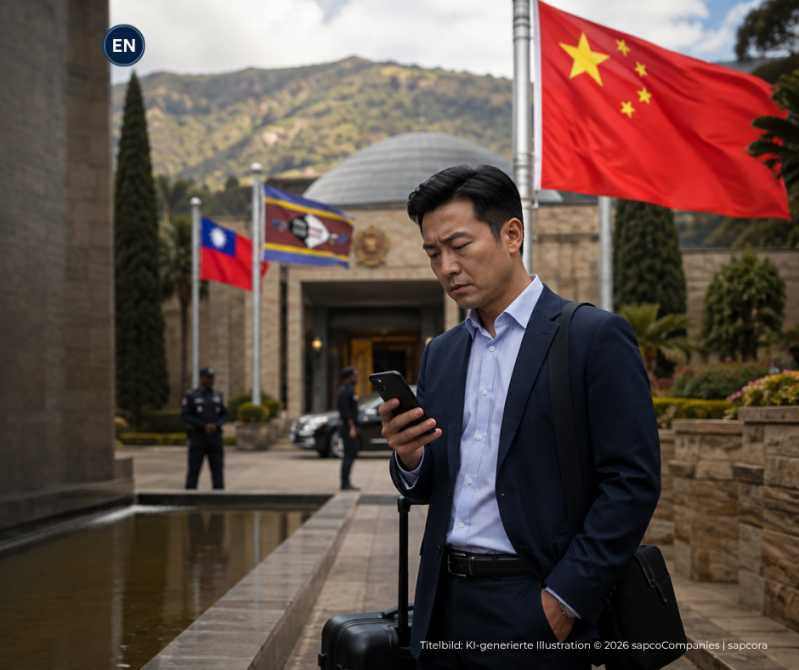
China’s Eswatini Warning and the Taiwan Question. China has urged its citizens to leave Eswatini, citing cybercrime and security risks. The warning is attracting wider scrutiny because Eswatini remains Taiwan’s only diplomatic ally in Africa.
Kommentar hinzufügen
Kommentare