

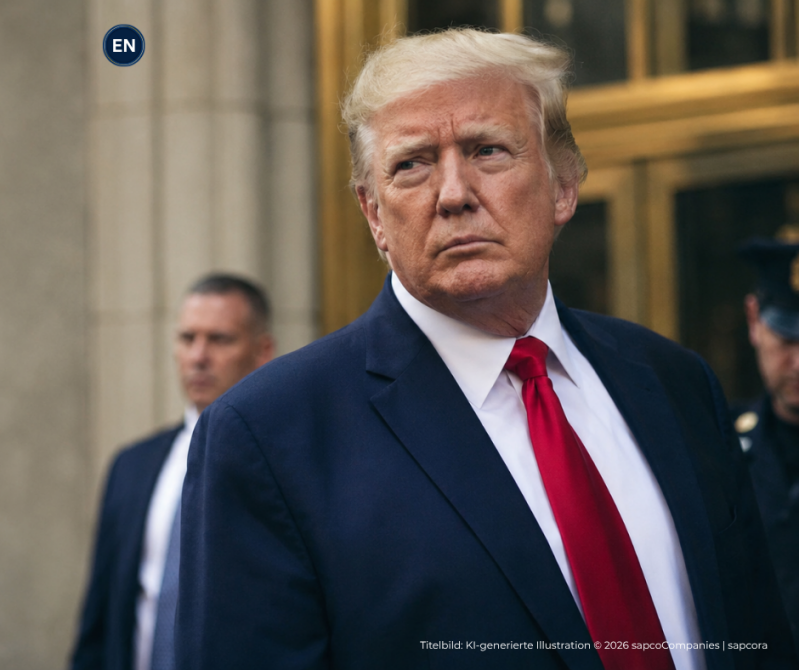
Section: Justice & Law
Format: Special Report
Author: Sinisa Brkic (sb)
President Donald Trump has suffered another setback in his effort to overturn his New York criminal conviction. A federal judge has rejected his renewed attempt to move the case into federal court, leaving the 34 felony convictions in place while challenges continue in both the federal and New York court systems. The decision also brings the limits of presidential immunity back into focus, but it does not exhaust Trump’s remaining legal options.
Another Federal Route Is Blocked
U.S. District Judge Alvin Hellerstein on August 28 rejected Trump’s renewed request for permission to move his New York criminal case into federal court. Trump had been convicted by a Manhattan jury in May 2024 on 34 felony counts of falsifying business records in the first degree.
Hellerstein concluded that the grounds offered for another attempt at removal were neither new nor legally sufficient. He also found that Trump had failed to demonstrate the required good cause and diligence and concluded that federal law did not provide a basis for removal after verdict, sentencing and judgment.The decision therefore represents another setback for Trump, but not the end of the litigation. Trump’s legal team has challenged the ruling, while his direct appeal of the criminal conviction remains pending in the New York court system. The distinction is important. The conviction remains legally in effect. It is not accurate, however, to say that Trump has exhausted every avenue through which he may seek to overturn it.
Why Presidential Immunity Is Part of the Case
Trump’s federal argument draws heavily on the Supreme Court’s 2024 decision in Trump v. United States. In that case, the Court held that a former president has absolute immunity from criminal prosecution for conduct within his exclusive constitutional authority, at least presumptive immunity for other official presidential acts and no presidential immunity for unofficial acts.
Trump has argued that this constitutional protection affects his New York conviction because the prosecution introduced evidence connected to his first presidential term. His attorneys have specifically challenged the use of evidence involving individuals who worked in the White House.
That question became important enough for the U.S. Court of Appeals for the Second Circuit to return the removal dispute to Hellerstein for fuller consideration. The appeals court did not rule that Trump was entitled to have his conviction overturned. It required the district judge to examine more closely whether the disputed evidence related to conduct undertaken under color of the presidency and whether Trump satisfied the requirements for another removal attempt.After that review, Hellerstein again rejected Trump’s position.
Hellerstein Draws a Line Between the Presidency and Private Conduct
A central part of Hellerstein’s reasoning concerns the character of the conduct involved. He concluded that discussions concerning payments connected to Stormy Daniels and the concealment of an alleged personal relationship did not qualify as official presidential acts.
That conclusion matters because presidential immunity does not attach merely because conduct occurs while someone holds the office of president. The Supreme Court expressly distinguished official presidential action from unofficial conduct.
The New York case arose from records concerning reimbursements associated with a $130,000 payment made by Trump’s then attorney Michael Cohen to Daniels shortly before the 2016 election. Daniels has said the payment was made in exchange for her silence about an alleged sexual encounter with Trump. Trump has denied that encounter. The payment itself was not the offense for which Trump was convicted. The criminal charges concerned the falsification of business records. New York prosecutors alleged that records describing reimbursements to Cohen as legal expenses were falsified as part of an unlawful effort to influence the 2016 election. A Manhattan jury found Trump guilty on all 34 counts.
The Evidence Question Is More Complicated
The constitutional dispute does not end with the characterization of the underlying conduct as personal or unofficial. Trump has also argued that evidence introduced at trial involved official presidential activity and should therefore have been excluded under the Supreme Court’s immunity decision. That is a legally distinct issue.
In Trump v. United States, the Supreme Court placed significant restrictions on the use of protected official conduct in a prosecution involving a former president. The implications of that rule for particular testimony and evidence used in the New York trial remain among the issues Trump has sought to raise.
Hellerstein nevertheless concluded that the material at issue did not justify moving the case into federal court. He found, among other things, that a presidential aide can perform personal tasks that do not become official presidential acts merely because the aide works in the White House. That conclusion should not be confused with a definitive resolution of every evidentiary issue available to Trump on appeal. The federal removal dispute and the direct challenge to the New York conviction are separate procedural tracks.
Why Trump Sought Federal Court Review
Trump’s effort to move the proceedings into federal court is significant because federal law allows certain cases involving federal officers to be removed from state court when statutory requirements are satisfied.
Trump has argued that his status as president and his federal immunity defense provide a basis for federal jurisdiction. Hellerstein has repeatedly rejected attempts to transfer the case, first before the conviction and again after the Supreme Court issued its presidential immunity decision.
The latest ruling also focuses heavily on timing. Hellerstein concluded that Trump waited too long to pursue the renewed federal route and had not established sufficient cause for the delay. This procedural point is essential to understanding the ruling. Hellerstein did address the relationship between the disputed conduct and presidential duties, but his decision cannot accurately be reduced to a broad holding that presidential immunity has no relevance to Trump’s conviction. The narrower conclusion is that Trump did not establish a legally sufficient basis to move this state criminal case into federal court through the procedure he pursued.
The Conviction and the Sentence Must Be Kept Separate
Trump was sentenced on January 10, 2025, to an unconditional discharge. He received no jail sentence, probation or fine. An unconditional discharge did not vacate the jury’s verdict. The 34 convictions remained on the books after sentencing and remain subject to appellate litigation. This distinction is particularly important in reporting on the case. A criminal sentence determines the punishment imposed following conviction. An appellate court, by contrast, may be asked to review whether the conviction itself was legally valid.
Trump therefore received a sentence carrying no additional punishment, but that did not eliminate his status as a person convicted in the New York case.
The New York Appeal Remains Crucial
Separate from the federal removal proceedings, Trump is challenging his conviction through New York’s appellate system. That appeal remains an important route through which his attorneys can contest trial rulings, evidentiary questions and constitutional issues. The Manhattan district attorney’s office is defending the conviction. The state appellate courts will determine the issues properly presented to them, and their eventual rulings could preserve the judgment, alter it or lead to further proceedings.
It would therefore be premature to describe the criminal case as finally resolved. Hellerstein’s ruling determines the latest federal removal request. It does not eliminate Trump’s pending state appeal or prevent further review of federal constitutional questions through the appropriate appellate process.
Could the Supreme Court Still Become Involved?
A future path to the U.S. Supreme Court remains possible, but Supreme Court review is not guaranteed. Trump may continue seeking federal appellate review of the removal dispute. Federal constitutional questions arising through the New York appellate proceedings could also ultimately create a route toward Supreme Court review once the necessary lower court proceedings have taken place.
Whether the justices would agree to hear such a case cannot presently be known. The Supreme Court chooses most of the cases it reviews, and the presence of an immunity argument alone does not guarantee that it will intervene. The Court’s 2024 ruling nevertheless remains central because lower courts are still applying its distinction between protected presidential acts and private conduct to factual situations that were not directly decided in that case.
Where Presidential Power Ends
The broader importance of the dispute lies in the boundary it tests. Presidential immunity protects the constitutional functions of the presidency. It does not automatically convert every action undertaken by a president, or every conversation involving a White House employee, into protected official conduct.
Hellerstein has concluded that the conduct underlying the New York case falls on the private side of that boundary and that Trump has not established the procedural and legal grounds necessary to transfer the case into federal court. That conclusion leaves Trump’s conviction standing today, but it does not close every legal avenue available to him.
The precise position is therefore narrower than the political headline may suggest. Trump has lost another attempt to move the case into federal court. His conviction remains in force. His challenges to that conviction, however, continue.
Trump Conviction Stands After Latest Federal Court Ruling. Donald Trump’s New York conviction remains in place after a federal judge rejected his latest removal bid. What the ruling means for presidential immunity and his continuing appeals.
Kommentar hinzufügen
Kommentare