

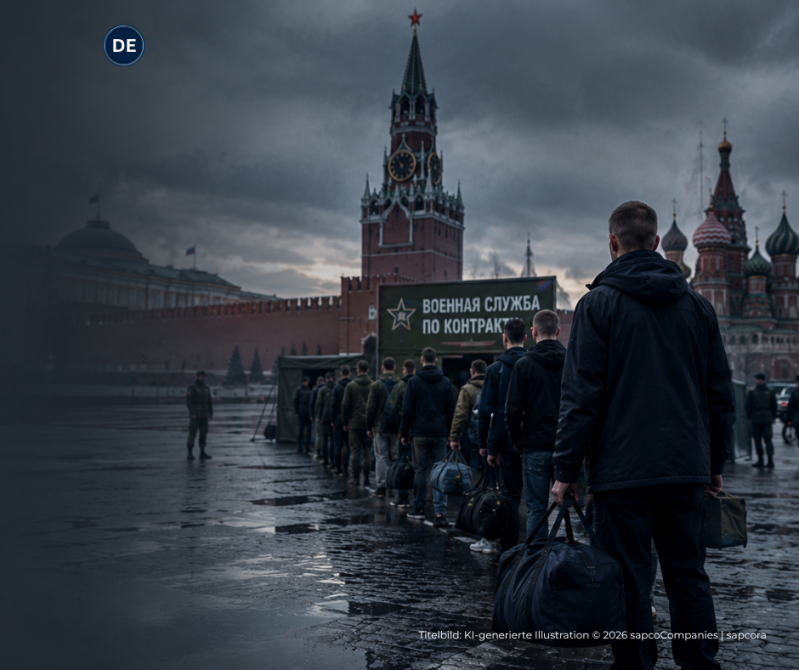
Section: Geopolitics
Format: Special Report
Author: Sinisa Brkic (sb)
Russia insists that no new mobilization is planned. Yet the issue has returned with force inside the country, accompanied by sharply rising search interest, repeated denials from senior officials and competing claims about Russia’s military manpower requirements. Four years after the partial mobilization of 2022, the question is no longer confined to military analysts. For many Russians, it has again become intensely personal.
Mobilization is back in Russia’s political vocabulary
Few political terms carry the same weight in Russia as mobilization. When Vladimir Putin announced a partial mobilization in September 2022, roughly 300,000 reservists were called up and large numbers of military age men sought to leave the country.
The experience changed the meaning of the word for Russian society. Mobilization ceased to be an abstract instrument of military planning and became a direct question about families, employment, borders and personal security. That history now shapes the reaction to every new rumor. In late August 2026, search interest for the Russian phrase “мобилизация 2026” rose sharply, indicating an unusual level of public demand for information about whether another call up could be approaching. Search activity cannot establish that the Kremlin has made such a decision. It does, however, reveal that a substantial question has returned to Russian public life despite repeated attempts by senior officials to close it.
Medvedev says there are no plans
Dmitry Medvedev, deputy chairman of Russia’s Security Council, gave the latest and clearest official response on August 28. He said there were no plans to conduct another mobilization and argued that the number of people voluntarily signing military contracts was sufficient. His statement reinforced a position he had already taken in July. At that time, Medvedev dismissed reports of a possible new mobilization as a provocation and linked them to attempts to destabilize Russia before the September elections.
He also said that approximately 200,000 people had signed military service contracts during the first six months of 2026 and that more than 16,000 others had joined volunteer formations. These are official Russian figures and cannot be comprehensively verified from independent public data. The distinction matters. Moscow’s claim is not merely that no mobilization order exists, but that another compulsory call up is unnecessary because voluntary recruitment is delivering sufficient personnel.
The Kremlin has issued repeated denials
Medvedev is not the only senior official addressing the subject. Kremlin spokesman Dmitry Peskov said on August 25 that reports of preparations for another mobilization were false and accused the Ukrainian side of deliberately spreading them to unsettle Russian society. Russia’s permanent representative to the United Nations, Vasily Nebenzya, had made a similar statement several days earlier. He said that a mass mobilization was neither necessary nor planned according to his knowledge.
Taken together, the statements present a consistent official position. Russia says it does not currently require another mass call up and intends to continue relying on contract recruitment and other voluntary forms of military service. The frequency of those reassurances is nevertheless significant. A subject that required one denial might disappear quickly. A subject repeatedly addressed by senior officials suggests that the underlying public concern has not disappeared with the official answer.
The memory of September 2022 has not faded
The skepticism surrounding today’s assurances cannot be separated from what happened four years ago. On September 21, 2022, Putin announced a partial mobilization following months in which the possibility of a broader call up had repeatedly been played down by Russian officials. The measure produced an immediate domestic shock. Border crossings became congested, flights to accessible foreign destinations sold rapidly and large numbers of Russian men attempted to leave the country.
By late October, the Russian Defence Ministry said the target of approximately 300,000 mobilized reservists had been reached. The government subsequently said no further mobilization measures were planned. That episode created a lasting credibility problem. Even when today’s official statements are accurate, they are being received by a population that remembers how rapidly political assurances could be overtaken by military necessity.
Kyiv makes a very different claim
The most consequential counterclaim comes from Ukraine. President Volodymyr Zelensky has said that Russia intends to draft another 300,000 people after the September parliamentary elections and has connected that figure to Moscow’s longer term military manpower requirements.
There is no independently confirmed public evidence that Putin has approved such a mobilization. The Ukrainian statement should therefore be treated as an intelligence based claim by a country at war with Russia, not as evidence that a Russian mobilization order has already been decided. Moscow rejects the allegation. This leaves two directly opposing narratives in circulation at a moment when neither side can be treated as a neutral source on Russian military manpower. That does not make the question impossible to examine. It means the central line must remain precise: a new mobilization is being discussed, predicted and denied, but it has not been publicly confirmed.
The manpower problem behind the political argument
At the heart of the debate lies a calculation that is exceptionally difficult to verify from outside Russia. The Kremlin must recruit enough soldiers to replace losses, rotate units, sustain current operations and preserve the ability to reinforce the front if military requirements increase.
Russia says contract recruitment is meeting those needs. Medvedev’s figure of roughly 200,000 contracts in the first half of 2026 is central to that argument and is presented by Moscow as evidence that compulsory mobilization is unnecessary. Independent military analysts have been more cautious. Their assessments point to uncertainty over whether present recruitment levels can indefinitely compensate for battlefield losses and meet future force requirements. The problem is that no complete, independently auditable dataset exists. Russian casualty figures, Ukrainian estimates, Western assessments and official recruitment statistics differ substantially, leaving considerable uncertainty around the true balance between intake and attrition.
Why voluntary recruitment matters politically
For the Kremlin, contract recruitment offers advantages that extend well beyond military administration. It allows the state to obtain personnel through financial incentives and regional recruitment campaigns without imposing the immediate social disruption associated with a nationwide compulsory call up.
Another broad mobilization would distribute the cost of the war much more visibly across Russian society. Families that have remained largely insulated from direct military service could suddenly face the possibility of a relative being called up. The economic consequences would also matter. Russia already faces labor pressures in parts of its economy, while military recruitment competes directly with civilian employers for working age men. As long as voluntary enlistment can supply enough personnel, avoiding another mass mobilization is therefore both a military and a domestic political objective.
September has become the critical date
The approaching State Duma elections give the current debate an additional political dimension. Russian officials have explicitly accused opponents of using mobilization rumors to create instability before the vote, while Ukrainian claims place a possible new call up after the election period.
This timing naturally invites speculation, but it does not establish a decision. Governments routinely seek to avoid politically disruptive measures before elections, yet that general logic is not evidence that a mobilization has been scheduled for afterwards. September nevertheless matters because it provides a clear point around which competing narratives have formed. Moscow says the rumors are intended to influence the political climate before the elections. Kyiv argues that the election calendar explains why any major decision would come later. Until there is documentary evidence or an official order, both claims must remain within their proper evidentiary limits.
Search behavior reveals the deeper story
This is where the sudden rise in search interest becomes particularly revealing. Google searches do not prove that Russians expect mobilization with certainty, but they show that large numbers of people want information about the possibility.
That search behavior has its own political significance. People searching for mobilization may be trying to understand who could be affected, what the legal framework allows, whether another call up is imminent or how much confidence they should place in official reassurances. It would be excessive to describe every search as fear or panic. Search data cannot establish motive at an individual level, and public attention can be driven by news coverage, rumors and political statements as much as by personal anxiety. What the data do establish is attention. Mobilization has again become sufficiently relevant for Russians to seek answers in unusually large numbers.
Official assurances face an unusual credibility test
The Kremlin’s position is straightforward. Russia says it has enough personnel entering military service voluntarily and has no current plans for another mobilization. The problem is not that this statement has been disproved. It has not. The problem is that the memory of 2022 means the government is no longer speaking into a political vacuum.
Public confidence is influenced not only by what officials say today, but by what citizens remember from previous decisions. This creates an unusual situation in which repeated reassurance can coexist with continued uncertainty rather than eliminating it. For Russian authorities, that is a political vulnerability. A government may control the timing of a mobilization decision, but it cannot as easily control the private calculations made by millions of households preparing for the possibility that circumstances could change.
What can be established as of August 29
As of August 29, 2026, there is no confirmed public evidence that Vladimir Putin has ordered a new mass mobilization. Senior Russian officials have repeatedly and explicitly denied that such a measure is currently planned. Russia also maintains that voluntary contract recruitment is sufficient for its present military requirements. The numbers presented in support of that claim originate from Russian officials and remain difficult to verify independently in full. Ukraine says Moscow could mobilize hundreds of thousands of additional personnel after the September elections. That claim is politically and militarily significant, but it remains unconfirmed by independent public evidence.
The defensible conclusion is therefore narrower than many of the circulating headlines suggest. Russia may possess the administrative capability to expand recruitment further, but the existence of that capability is not proof that a new mobilization has been ordered.
Russia is searching for an answer Moscow says it has already given
The central story of Mobilization 2026 is not that Russia has begun another compulsory call up. There is currently no verified basis for making that claim. The story is that the possibility has returned strongly enough to produce repeated government denials, competing military assessments and a sharp rise in public search interest. That combination exposes a deeper tension between official reassurance and the uncertainty created by a prolonged war.
Moscow’s answer, for now, is unequivocal: no new mobilization is planned. Yet four years after September 2022, many Russians appear unwilling to treat the question as settled simply because the Kremlin says it is. That may be the most important signal of all. Mobilization has not returned as a confirmed government order, but it has returned as a political reality in the minds of people who know exactly what the word can mean.
Russia: Mobilization 2026 and What Moscow Is Saying. Russia denies plans for a new mobilization as public interest rises sharply. What is confirmed, what remains unproven and why September matters.
Kommentar hinzufügen
Kommentare