

Section: Geopolitics
Format: Special Report
Author: Sinisa Brkic (sb)
The United States has struck two Iranian launchers on Larak Island, returning to direct military action inside Iran after more than a month without known US strikes. Washington says Revolutionary Guard forces were preparing rockets carrying sea mines for deployment into the Strait of Hormuz. Iran has confirmed casualties and promised a response, placing one of the world’s most critical shipping corridors back at the center of the confrontation.
First Known US Strike Inside Iran Since Late July
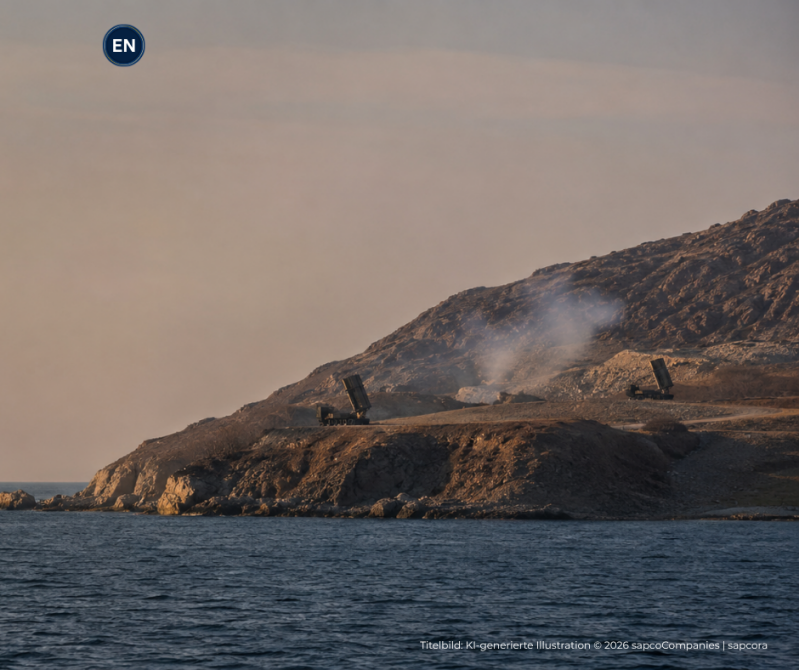
US forces struck two Iranian launchers on Larak Island on Sunday, August 30, marking the first known American attack inside Iran since late July. A US official said forces belonging to Iran’s Islamic Revolutionary Guard Corps had been observed preparing to launch rockets carrying sea mines into the Strait of Hormuz. That allegation forms the central American justification for the operation.
The strike itself is confirmed. The circumstances immediately preceding it are not independently established. At this stage, the claim that Iranian forces were preparing an imminent mining operation rests on the account provided by a US official and must be treated accordingly. That distinction is important because Washington is presenting the attack as a response to an immediate threat to maritime security rather than simply another strike against Iranian military infrastructure.
Larak Island Puts Hormuz Back at the Center
The location gives the operation significance well beyond the destruction of two launchers. Larak Island lies close to the Strait of Hormuz, the narrow maritime passage connecting the Persian Gulf with the Gulf of Oman and the wider global shipping network. Before the current conflict, roughly one fifth of the oil consumed worldwide passed through the strait. Few maritime corridors carry such concentrated importance for global energy supplies.
Military activity in this area therefore has an immediate international dimension. A threat to shipping through Hormuz can affect tanker traffic, insurance costs, freight conditions, energy markets and the calculations of governments far beyond the Middle East. The August 30 strike brings those risks together in a single event. What Washington describes as an operation against an imminent mining threat is also a reminder that control of access through Hormuz remains one of the most consequential pressure points in the conflict.
The Mine Threat Changes the Strategic Calculation
Sea mines are particularly sensitive because they can disrupt maritime traffic without requiring permanent control of the waterway. Their presence, or even a credible threat that new mines are being deployed, can force commercial operators and military planners to reassess whether shipping lanes remain safe. That makes the American account especially significant. If Iranian forces were preparing to introduce new mines into the strait, the operation would have challenged recent efforts to remove those hazards from international shipping routes.
US President Donald Trump said last week that mines in the international waters of the Strait of Hormuz had been detonated or removed and warned that vessels attempting to place new mines would be destroyed. The latest strike shows how rapidly that warning can translate into military action. It also raises a broader question about whether the strait can be kept open without repeated US intervention whenever Iranian forces are believed to be preparing new threats to maritime traffic.
Washington’s Account Requires Careful Distinction
The US version of events is specific. According to the official who confirmed the strike, Revolutionary Guard forces had been observed preparing rockets with sea mines for use in the Strait of Hormuz. There is currently no independent confirmation of those preparations. No publicly available evidence has yet established how advanced the alleged operation was, when the weapons were expected to be used or whether an order to deploy them had already been issued.
That does not make the American account irrelevant. It does, however, place a clear journalistic boundary around what is known. US forces struck the launchers. Iran has acknowledged that Larak Island was attacked. The allegation that the strike prevented an imminent Iranian mining operation remains an American claim. In a conflict where individual military decisions can trigger broader retaliation, maintaining that distinction is essential.
Iran Confirms Casualties and Vows a Response
Iran’s Revolutionary Guards have confirmed the attack and said several Iranian fighters and civilians were killed or wounded. The Guards did not initially provide a precise casualty toll. Tehran also promised a response and said those responsible for the attack would be punished. At the time of publication, Iran had not specified what form that response would take or when it might occur.
That uncertainty now becomes one of the central factors determining whether the Larak Island strike remains a contained military episode or develops into a new round of direct confrontation. Iran has multiple options available, from military retaliation to renewed pressure on maritime activity and regional infrastructure. The scale and location of any response will determine whether Washington faces pressure to strike again. A limited Iranian reaction could leave room for containment. An attack affecting US forces, Gulf infrastructure or commercial shipping would carry a substantially greater risk of escalation.
A Month Without US Strikes Did Not Mean Stability
The absence of known American strikes inside Iran since late July had created a period of reduced direct US military activity. It did not resolve the underlying confrontation. The latest operation makes that clear. The strategic dispute over Hormuz remains intact. Washington wants to prevent Iran from using mines, missiles and other military capabilities to threaten international shipping. Tehran, meanwhile, continues to face US military pressure while retaining the ability to create significant risks around one of the world’s most important waterways.
Those competing objectives leave little room for durable stability. Each side can present its own actions as defensive. Washington can argue that it is protecting international shipping from renewed mining. Tehran can describe strikes on Iranian territory as attacks requiring retaliation. The result is a security environment in which deterrence can quickly become another cause of escalation.
Hormuz Is an Economic Vulnerability as Much as a Military One
The Strait of Hormuz is often discussed primarily in terms of oil, but its importance extends beyond crude prices. Commercial shipping depends on predictable passage. Insurers price geopolitical risk. Tanker operators assess crew safety and vessel exposure. Import dependent economies monitor the reliability of energy supplies. Governments calculate how much disruption their domestic markets can absorb.
None of these actors requires a complete closure of the strait before changing behavior. A renewed mine threat, sporadic attacks or persistent uncertainty can be enough to increase costs and reduce confidence in the security of the route. This is why relatively limited military actions around Hormuz can have consequences far larger than the physical targets involved.
Two launchers on Larak Island are therefore not merely two military assets. In the context of the strait, they sit inside a much wider struggle over whether one of the world’s most important commercial passages can remain reliably usable during an active regional conflict.
The Next Move Belongs to Tehran
The immediate significance of the August 30 strike now depends heavily on Iran’s response. The attack does not by itself establish that the United States is returning to a sustained campaign of strikes inside Iran. It does, however, end the assumption that the pause since late July would necessarily continue.
Washington has demonstrated that it remains prepared to use force when it believes Iranian activity threatens the Strait of Hormuz. Tehran has declared that such action will not go unanswered. That leaves both sides confronting the same dangerous equation. Every attempt to demonstrate deterrence increases the possibility that the other side will feel compelled to respond. The location makes that equation particularly consequential.
Hormuz connects regional military decisions directly to global energy and trade. A launcher, a mine, a drone or a retaliatory strike can rapidly become more than a battlefield event when the confrontation unfolds beside a corridor through which a substantial share of the world’s oil has traditionally moved.
The Larak Island attack therefore matters for more than the return of US strikes inside Iran. It shows how fragile the relative calm of recent weeks was and how quickly the conflict can return to a point where military escalation and global economic risk become inseparable.
US Strikes Larak Island as Strait of Hormuz Tensions Rise. US forces strike two Iranian launchers on Larak Island as Washington accuses Iran of preparing sea mines for the Strait of Hormuz. Tehran confirms casualties and vows a response.