

Section: Security
Format: Report
Author: Sinisa Brkic (sb)
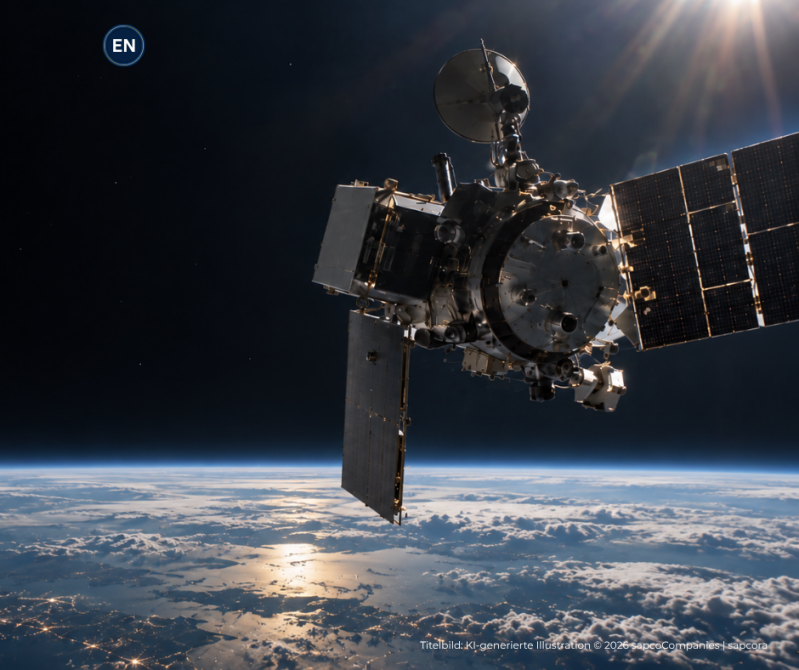
The United States has publicly acknowledged for the first time that it is operating weapons in Earth orbit. The disclosure marks a significant change in how Washington talks about military power in space, ending years of deliberate ambiguity over whether American orbital systems include weapons. China and Russia have responded with warnings about the consequences for strategic stability and the risk of an accelerating arms race beyond Earth.
Washington says the weapons are already there
US Secretary of the Air Force Troy Meink made the disclosure on September 14 at the Air, Space & Cyber Conference in National Harbor, Maryland. He said the United States now possesses “on-orbit space control weapons capable of defending the Joint Force against hostile adversary action.” The significance lies as much in the decision to say this publicly as in the capability itself. American officials have discussed counterspace operations, satellite protection and the growing military importance of orbit for years, but Washington had stopped short of explicitly acknowledging operational weapons already positioned in space. Meink later made clear that the wording was deliberate. The statement was not an accidental disclosure or an improvised answer to a question. It was a calculated decision to tell potential adversaries that the United States possesses capabilities in orbit that it is prepared to describe as weapons.
What the Pentagon has not revealed
Almost everything beyond their existence remains classified. The Pentagon has not disclosed how many systems are in orbit, when they were deployed, what platforms carry them, what targets they are designed to affect or whether their effects are kinetic or non-kinetic.
That distinction matters. An orbital weapon does not necessarily mean a missile or a satellite designed to physically destroy another spacecraft. Space control can include technologies capable of disrupting communications, interfering with sensors, jamming signals, dazzling optical systems or otherwise preventing an adversary from using space assets effectively.
Washington has also declined to say whether the systems have been tested or under what circumstances they might be used. Any claim that the United States has deployed orbital missiles, laser weapons or armed satellites of a particular design would therefore go beyond what has been publicly established. The confirmed fact is narrower, but strategically substantial: US officials now say operational American weapons exist in orbit.
One layer of strategic ambiguity has disappeared
For years, military competition in space developed behind carefully controlled language. Governments spoke of counterspace capabilities, defensive systems, resilience and satellite protection while avoiding explicit descriptions of weapons already deployed in orbit.
Washington has now removed one part of that ambiguity. The question is no longer whether the US government is willing to acknowledge orbital weapons. It is. At the same time, a second layer of ambiguity remains intact. Potential adversaries have been told that the capability exists, but not what it can do, how many systems are available or what actions might trigger their use. That uncertainty may itself be part of the deterrence strategy.
The logic is familiar from other military domains. A capability that remains completely secret cannot easily influence an adversary’s calculations, while a capability described in excessive detail may become easier to counter. The American disclosure appears designed to reveal enough to alter strategic planning without revealing enough to expose the systems themselves.
China warns of an arms race
Beijing responded by urging Washington to halt its military expansion in outer space. Chinese Foreign Ministry spokesperson Guo Jiakun said China opposed the weaponization of space and efforts to turn it into a theater of war. The Chinese reaction places the American disclosure directly inside the wider competition between the world’s major space powers. Beijing has warned that openly deploying weapons in orbit could create a security cycle in which one state’s attempt to strengthen its position drives others to expand their own counterspace capabilities.
That concern is not theoretical. Satellites have become fundamental to communications, navigation, intelligence, missile warning, targeting and military command. A serious confrontation between major powers would therefore involve infrastructure in space long before any dramatic image of conventional warfare in orbit became necessary.
Russia has now responded as well
Moscow has also criticized the American acknowledgment. Russia’s Foreign Ministry warned that deploying orbital weapons without adequately considering the consequences of conflict could threaten the long-term stability of space activity.
The Russian response broadens the issue beyond the already intense strategic rivalry between Washington and Beijing. The United States, China and Russia have spent years developing technologies capable of protecting their own space systems, tracking other spacecraft and interfering with or disabling hostile assets. That competition existed before Meink’s announcement. What has changed is the level of public acknowledgment from Washington and the increasingly explicit language surrounding the possibility of conflict extending into orbit.
Space is already part of terrestrial warfare
Modern militaries do not treat space as an isolated technological frontier. Satellites support operations on Earth continuously, from secure communications and navigation to intelligence collection, missile detection and precision targeting.
That dependence also creates vulnerability. Disabling a relatively small number of critical space assets could disrupt military operations across enormous geographic areas without attacking conventional forces directly. For the United States, whose armed forces rely heavily on sophisticated satellite networks, defending access to space has consequently become an increasingly central military objective. China and Russia have developed counterspace capabilities of their own, while American officials have repeatedly warned that US satellites could become early targets in a major conflict.
The new disclosure should therefore not be understood as the beginning of military competition in space. That competition has been developing for years. What is new is Washington’s decision to openly acknowledge that weapons intended for space control are already operating in orbit.
The legal picture is more complicated than the headline
The 1967 Outer Space Treaty remains the central legal framework governing military activity beyond Earth, but its restrictions are narrower than is sometimes assumed. It prohibits placing nuclear weapons or other weapons of mass destruction in orbit and bars military installations, weapons testing and military maneuvers on celestial bodies such as the Moon.
It does not impose a comprehensive prohibition on every conventional weapon that might operate in Earth orbit. That distinction is essential when assessing the American announcement because Washington has not identified the systems involved or suggested that they carry nuclear or other weapons of mass destruction. The strategic consequences can therefore be serious even without an established violation of the treaty. The larger problem is that technology has advanced considerably faster than the international rules and norms governing military confrontation in orbit.
From secret capability to public deterrence
The most consequential element of the announcement may ultimately be political rather than technological. A secret weapons program changes military capability. A publicly acknowledged weapons program also changes the calculations of allies and adversaries.
Washington is signaling that it does not intend to leave orbital threats unanswered. Beijing and Moscow, meanwhile, are presenting the same disclosure as evidence that the United States is accelerating the militarization of space.
Those positions are likely to reinforce one another. American officials can point to Chinese and Russian counterspace programs as justification for stronger US capabilities, while China and Russia can cite American orbital weapons as justification for further development of their own systems. That is the structure of a classic security dilemma. Measures described by one side as defensive can appear offensive to another, encouraging countermeasures that make every participant feel less secure.
The next threshold will be more important
The United States has crossed a political threshold by acknowledging what it had previously left unspoken. It has not yet crossed the far more consequential threshold of publicly identifying the systems, demonstrating their effects or using an orbital weapon against another country’s space infrastructure. Those distinctions will matter increasingly as military activity in orbit becomes more visible. The next major development could come through technical identification of the American systems, deployment of additional capabilities by China or Russia, clearer rules governing their possible use or an operational demonstration that reveals what “space control weapons” actually means in practice.
For now, Washington has deliberately changed the language of space security. The debate is no longer centered on whether the United States might eventually place weapons in orbit. According to its own government, they are already there.
US Confirms Weapons in Orbit as China Warns of Space Arms Race. The United States has publicly confirmed weapons in Earth orbit for the first time, prompting warnings from China and Russia over a new space arms race.