

Section: Geopolitics
Format: Report
Author: Sinisa Brkic (sb)
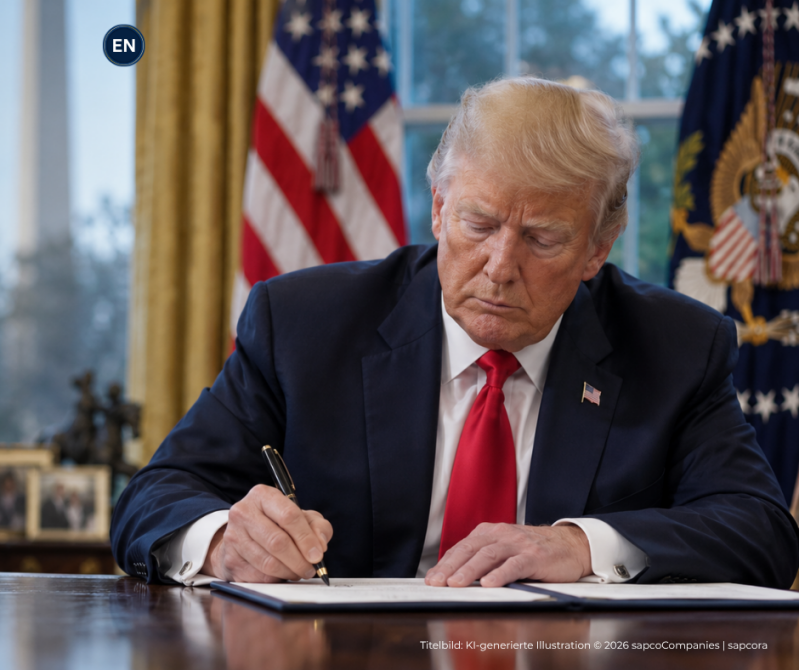
President Donald Trump has signed a major new Russia sanctions package into US law, giving Washington additional powers to target countries that remain among the largest buyers of Russian oil and natural gas. The legislation allows tariffs of up to 100 percent on goods from qualifying countries, placing India and China at the center of a measure with potentially significant consequences for energy markets and global trade.
From legislation to US law
Trump signed the Lindsey O. Graham Sanctioning Russia and Iran Act of 2026 on September 18, completing a legislative process that had already secured approval in both chambers of Congress. The law expands the statutory framework for sanctions targeting Russian officials, financial institutions, the energy and defense sectors, and networks involved in sanctions evasion. The signing marks an important change in status. Measures that until now existed as congressional legislation have become federal law, providing the administration with additional tools to increase economic pressure on Russia and on foreign actors that remain closely connected to its energy trade. The legislation also targets vessels and structures associated with Russia’s shadow fleet, which has become an important component of Moscow’s efforts to maintain oil exports despite Western restrictions. Existing US sanctions relating to Iran are also extended, giving the legislation a broader strategic scope.
Tariffs of up to 100 percent
The most consequential provision concerns countries purchasing large volumes of Russian crude oil or natural gas. Under the new law, the United States can impose additional tariffs of up to 100 percent on goods imported from countries that fall within the statutory criteria. The distinction is crucial. Trump did not impose an immediate blanket 100 percent tariff on India, China or any other country by signing the legislation. The law creates the legal authority and framework for such tariffs to be applied, while the actual rate and implementation depend on subsequent decisions under the legislation. The measure focuses on the five largest purchasers of Russian crude oil or natural gas by volume, as well as major countries facilitating the evasion of sanctions on Russian energy. The relevant rankings can change as international trade flows shift.
India and China face the greatest attention
India and China are particularly exposed because both have become major destinations for Russian crude since Western sanctions reshaped global energy flows following Russia’s invasion of Ukraine. For Washington, the issue reaches beyond individual Russian producers or financial institutions. As long as Russia retains large international customers for its oil and gas, energy exports continue to generate substantial revenue for the Russian economy.
The new law extends US pressure further into that commercial chain. Countries buying large quantities of Russian energy can now face consequences affecting their broader access to the American market, rather than sanctions being confined to the Russian entities directly involved in the transactions. That makes the legislation substantially more far reaching than a conventional sanctions package.
Energy policy meets trade policy
The potential impact is considerable because tariffs imposed under the law would not necessarily be limited to energy products. Duties on goods from a qualifying country could affect a much wider range of exports to the United States. For India and China, the consequences would therefore extend beyond the price of Russian crude. Manufacturing, industrial goods, technology supply chains and consumer products could all become relevant if Washington chooses to activate the tariff powers at a high rate. This also changes the calculation for Moscow’s customers. Buyers must increasingly weigh the economic benefits of Russian energy against the potential cost of maintaining access to the US market. For Russia, the objective of the law is clear: increase the cost of maintaining the international customer base that supports its energy revenues.
Oil markets limit Washington’s room for maneuver
The United States gains considerable leverage from the new legislation, but implementation carries economic risks of its own. Russia remains a major supplier to global energy markets, while China and India rank among the world’s largest energy consumers. A sharp reduction in Russian exports to major Asian buyers could redirect crude flows and tighten available supplies elsewhere. At a time of elevated geopolitical tension in global energy markets, that could affect oil prices, transport costs and inflation far beyond the countries directly targeted.
Washington therefore faces a difficult balance. Stronger measures could increase pressure on Russian revenues, but aggressive implementation could also produce consequences for American consumers, international supply chains and allied economies. The difference between a limited tariff and the maximum rate allowed by law would consequently be substantial.
Europe is not completely outside the equation
Although India and China are receiving most of the attention, the legal framework is not restricted to those two countries. Other major purchasers of Russian energy could also come under scrutiny depending on import volumes, future rankings and the administration’s implementation of the law. The legislation includes provisions intended to distinguish between countries maintaining significant dependence on Russian energy and those taking meaningful steps to reduce it. That distinction is particularly relevant in Europe, where several countries remain more dependent on Russian supplies than others. For the European Union, the legislation adds another dimension to an already complex energy and sanctions environment. Russian energy purchases are increasingly connected not only to European policy toward Moscow, but also to US trade policy and Washington’s wider use of secondary economic pressure.
Washington now has a stronger instrument
The signing changes the geopolitical equation because Congress has moved beyond debating whether the United States should possess these powers. The legal framework is now in place. The next questions concern implementation. Washington must determine which countries meet the statutory criteria, what tariff levels should apply and whether the threat of additional duties is sufficient to change purchasing behavior without their full use.
That distinction will shape the law’s international consequences. If the tariff mechanism remains primarily a source of negotiating leverage, it could alter energy purchasing decisions without producing the maximum trade disruption permitted by the legislation. If Washington chooses broader implementation, the measure could develop into a much larger confrontation involving Russia, India, China and some of the world’s most important trade relationships. Either way, US sanctions policy toward Russia has entered a new phase. Pressure on Moscow can now extend more directly to the countries that continue buying its energy.
Trump Signs Russia Sanctions Law With Tariffs of Up to 100%. Donald Trump signs a new Russia sanctions law allowing tariffs of up to 100 percent on major buyers of Russian oil and gas, putting India and China under increased US pressure.
Kommentar hinzufügen
Kommentare