

Section: Geopolitics
Format: Analysis
Author: Sinisa Brkic (sb)
France will send troops, radar systems and additional defense capabilities to Saudi Arabia to protect Yanbu, a strategic Red Sea hub for the kingdom’s oil exports. At the same time, Saudi Arabia, Türkiye and Pakistan are intensifying military coordination as Houthi attacks place growing pressure on Saudi territory and critical infrastructure. The convergence of these developments is giving the conflict a broader international security dimension, with energy routes increasingly becoming part of the military equation.
France moves to protect Yanbu
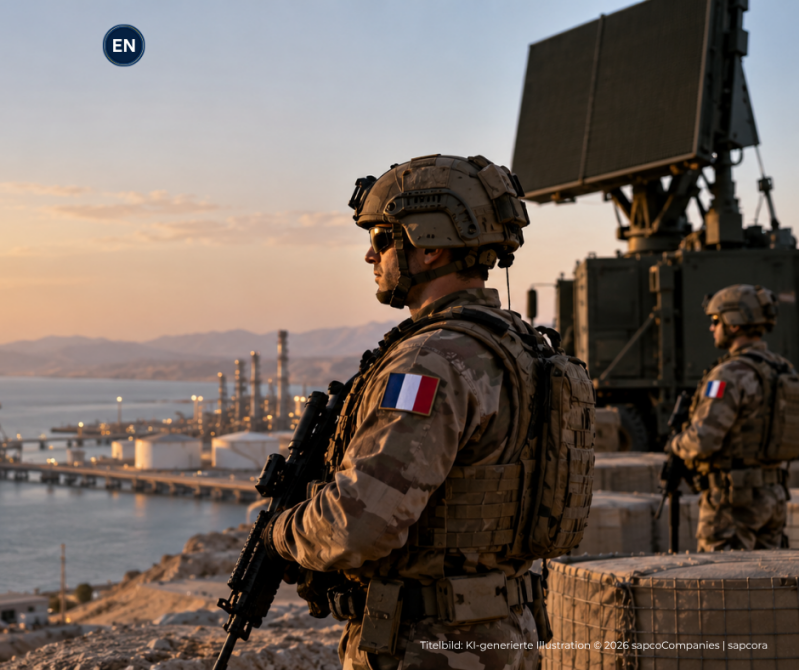
French President Emmanuel Macron has confirmed that France will send military personnel, radar systems and defense systems to Saudi Arabia to help protect Yanbu. The Red Sea port has become increasingly important to Saudi energy exports as instability places pressure on other routes through the region. Macron presented the mission as defensive and specifically focused on protecting the site. France is not announcing participation in offensive operations against the Houthis, but it is committing French military personnel and equipment to the protection of critical Saudi infrastructure. That distinction is central to understanding the move. Paris is seeking to protect a strategically important energy corridor without presenting the deployment as entry into the wider regional conflict. Even within those limits, the decision represents a significant expansion of direct European military involvement in the security of Saudi energy infrastructure.
Yanbu has become a critical energy corridor
Yanbu sits at the western end of Saudi Arabia’s East West Pipeline, which allows crude oil produced in the kingdom’s eastern regions to reach the Red Sea without relying entirely on routes through the Strait of Hormuz. The pipeline has recently carried roughly four million barrels of crude per day toward Yanbu, equivalent to about four percent of global oil supply. Its maximum capacity is considerably higher, giving Saudi Arabia one of its most important alternatives when conventional Gulf export routes are disrupted or restricted. That strategic value has increased sharply as regional warfare has affected both the Strait of Hormuz and shipping near the southern entrance to the Red Sea. Saudi Arabia can reduce its exposure to the Gulf by directing crude westward, but that advantage depends on Yanbu and the infrastructure feeding it remaining operational. This is why the security of one Saudi port now carries implications well beyond the kingdom. Any sustained disruption can affect export capacity, tanker routes, supply expectations and global energy prices at a time when alternative transport corridors are already under strain.
Houthi attacks increase pressure on Saudi defenses
The French decision follows a renewed series of Houthi attacks against Saudi targets. Saudi authorities said air defenses intercepted six ballistic missiles on Thursday, while the Houthis claimed to have launched numerous missiles and drones against targets inside the kingdom. Saudi Arabia also issued emergency warnings for several areas, including Yanbu, Jeddah and Mecca. The attacks have reinforced concerns that infrastructure connected to Saudi energy exports is becoming an increasingly prominent part of the conflict. For Riyadh, the strategic challenge is no longer confined to defending individual facilities. The kingdom must protect an interconnected energy system stretching from its eastern oil fields across the country to Red Sea export terminals, while instability simultaneously affects maritime routes on both sides of the Arabian Peninsula. The vulnerability of those routes helps explain why external military support is assuming greater importance.
Saudi Arabia turns to Türkiye and Pakistan
Alongside the French deployment, Saudi Arabia is deepening defense coordination with Türkiye and Pakistan. The three countries are preparing high level talks involving their military chiefs to discuss possible support for the kingdom under the Mecca Joint Defence Agreement. The agreement, signed in August, establishes a collective defense principle under which an attack against one member is considered an attack against all parties. Foreign ministers from the three countries have already discussed the deteriorating security situation and condemned attacks against Saudi civilian and economic targets. Türkiye’s defense ministry said Chief of General Staff General Selcuk Bayraktaroglu would travel to Saudi Arabia to meet his Saudi and Pakistani counterparts. Ankara has also indicated that it could assist Riyadh with military requirements, particularly in technical areas. The talks should not, however, be interpreted as evidence that Turkish or Pakistani forces are entering the conflict. No such combat deployment has been announced. Türkiye has also not yet completed parliamentary ratification of the joint defense agreement, meaning any immediate Turkish assistance would at this stage largely depend on bilateral arrangements rather than the fully implemented trilateral pact.
Two different forms of military support are emerging
The developments around France, Türkiye and Pakistan are closely connected by timing, but they are not identical. France has announced a concrete deployment of military personnel and defense systems for a defined protective mission at Yanbu. Saudi Arabia, Türkiye and Pakistan are meanwhile moving into a more operational phase of military consultation, but have not announced a comparable trilateral deployment. That difference is important. The current situation does not amount to the formation of a single multinational force against the Houthis. It shows instead that Saudi Arabia is drawing on several security relationships at the same time as attacks threaten territory, infrastructure and export routes. The result is a layered defense architecture. French capabilities are being assigned directly to the protection of Yanbu, while Riyadh is testing how its newer regional defense arrangements can function under actual military pressure.
Energy security is becoming military security
The broader significance of the French decision lies less in the number of personnel involved than in what they are being sent to protect. Yanbu is no longer simply a major Saudi export terminal. Under current conditions, it is part of a strategic route that helps keep Saudi crude moving when other channels are constrained. That changes the calculations of governments dependent on stable global energy supplies. Protecting oil flows increasingly requires protection of pipelines, ports, radar coverage, air defenses and maritime corridors. Infrastructure that was once primarily an economic asset is becoming an increasingly explicit component of regional military planning. France is attempting to maintain a clear boundary by describing its mission as defensive protection rather than participation in the conflict. Whether that distinction remains sustainable will depend on the intensity and direction of future attacks. The same uncertainty surrounds Saudi Arabia’s partnership with Türkiye and Pakistan. Military consultations can remain consultations, or they can become the basis for equipment transfers, technical assistance, air defense support or more direct deployments if the security situation deteriorates.
For now, the shift is already significant. The defense of Saudi Arabia’s energy infrastructure is moving beyond a purely national task and drawing foreign military capabilities into the protection of routes that matter to the global economy. What happens at Yanbu will therefore be watched not only as another front in the regional conflict, but as a test of how far states are prepared to go to secure energy flows under sustained military pressure.
France to Send Troops to Protect Saudi Arabia’s Yanbu Oil Route. France will send troops, radar and defense systems to Yanbu as Saudi Arabia, Türkiye and Pakistan deepen military coordination amid Houthi attacks.
Kommentar hinzufügen
Kommentare