

Section: Politics
Format: News Report
Author: Sinisa Brkic (sb)
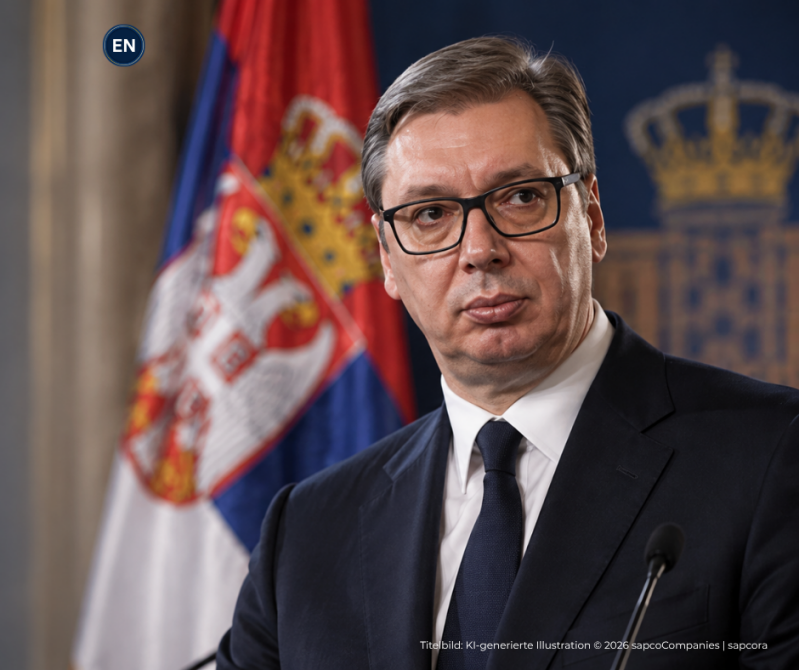
Serbian President Aleksandar Vučić is set to submit his resignation on Sunday evening, bringing his presidency, which began in 2017, toward an early conclusion. Vučić has said the resignation is expected at around 8 p.m., when he also plans to explain his decision. The move will not mark his departure from Serbian politics. He intends to seek the office of prime minister in the snap parliamentary election on October 25.
Vučić Prepares to Leave the Presidency
Aleksandar Vučić is expected to submit his resignation as president of Serbia on Sunday evening. He has said the step will most likely come at around 8 p.m., accompanied by an explanation of his decision. Until the resignation is formally submitted and takes effect, Vučić remains president of the Republic of Serbia. His political plans, however, are already clear. Leaving the presidency will not amount to leaving Serbian politics. Earlier Sunday, Vučić appeared on Serbia’s public broadcaster RTS and reflected on his years as head of state. He presented peace and stability as central priorities of his presidency and spoke about his record before the expected resignation later in the day.
From the Presidency Back to Government
The significance of the expected resignation extends beyond the presidency itself. Vučić plans to seek the office of prime minister following Serbia’s snap parliamentary election on October 25. The position is familiar to him. Vučić served as prime minister from 2014 to 2017 before becoming president. For more than a decade, he has occupied a central position in Serbian politics, first at the head of government and then as head of state. A return to the premiership would therefore represent a change of institutional role rather than a withdrawal from political leadership. It would also place renewed attention on how political authority is distributed between the presidency, government and parliament after the election.
Putin Call on the Eve of the Resignation
One of Vučić’s final major diplomatic contacts before the expected resignation was a telephone conversation with Russian President Vladimir Putin on Saturday. Vučić described the call as lengthy and substantive, saying the two leaders discussed bilateral relations, the war in Ukraine and developments in the Balkans. Energy was a central part of the conversation. Serbia’s current gas arrangement with Russia expires on September 30, and Vučić said after the call that he expected it to be extended. He also said he expected Serbia to maintain favorable terms for Russian gas supplies. The two presidents discussed Naftna Industrija Srbije, or NIS, Serbia’s main oil company, which has been at the center of sanctions concerns because of its Russian ownership. Vučić said the talks were aimed at finding a solution acceptable to both sides. The timing of the conversation is notable. It came one day before Vučić’s planned resignation and underlined the continuing importance of Serbia’s relationship with Moscow at a moment of political transition in Belgrade. There is no basis, however, to suggest that the Putin conversation and Vučić’s decision to resign were causally connected.
Political Pressure and an Early Election
The resignation comes after an extended period of domestic political pressure. Serbia has experienced sustained protests since the collapse of a concrete canopy at Novi Sad railway station in November 2024, which killed 16 people. The response to the disaster developed into a broader protest movement in which university students have played a prominent role. Demonstrators have demanded political accountability, greater transparency, stronger institutions and more effective action against corruption. The protests have presented Vučić and Serbia’s political leadership with one of their most significant domestic challenges in recent years. Questions of institutional responsibility, corruption and public trust have consequently moved to the center of the country’s political debate. Vučić dissolved parliament on September 9 and called a snap parliamentary election for October 25. The vote will take place more than a year before the regular electoral timetable and against the backdrop of continued political tensions.
A Different Center of Political Authority
A move by Vučić from the presidency back to the premiership would have consequences beyond a change in title. Serbia is a parliamentary republic in which the president and government perform distinct constitutional functions. The government, headed by the prime minister, conducts state policy and exercises executive authority within Serbia’s constitutional framework. The president holds separate constitutional and representative responsibilities. If Vučić returns to the premiership after the October election, attention will therefore turn to the distribution of political authority across the presidency, government and parliament. The composition of the next government and the eventual succession at the presidency will be central to understanding the new balance.
A Transition, Not a Political Exit
Vučić’s expected resignation will close his tenure as president, but it is not intended to close his political career. His plan to seek the premiership means Serbia is facing a change in political roles rather than the straightforward departure of the country’s most prominent political figure. That distinction matters. Leaving the presidency changes the institutional position from which Vučić can exercise political influence, but it does not in itself determine whether the broader balance of power in Serbia will change. The next test comes on October 25. The parliamentary election, the formation of a new government and the succession at the presidency will determine the institutional shape of Serbia’s next political phase. For now, attention is on Sunday evening. Vučić’s expected resignation at around 8 p.m. will mark the end of his presidency and the beginning of a new political chapter in Serbia, with the former head of state already preparing to contest another of the country’s most powerful offices.
Vučić Set to Announce Resignation at 8 P.M. - Serbian President Aleksandar Vučić is set to submit his resignation at around 8 p.m. Sunday as Serbia prepares for a snap parliamentary election on October 25.
Kommentar hinzufügen
Kommentare