

Rubric: Geopolitics
Format: News Analysis
Author: Sinisa Brkic (sb)
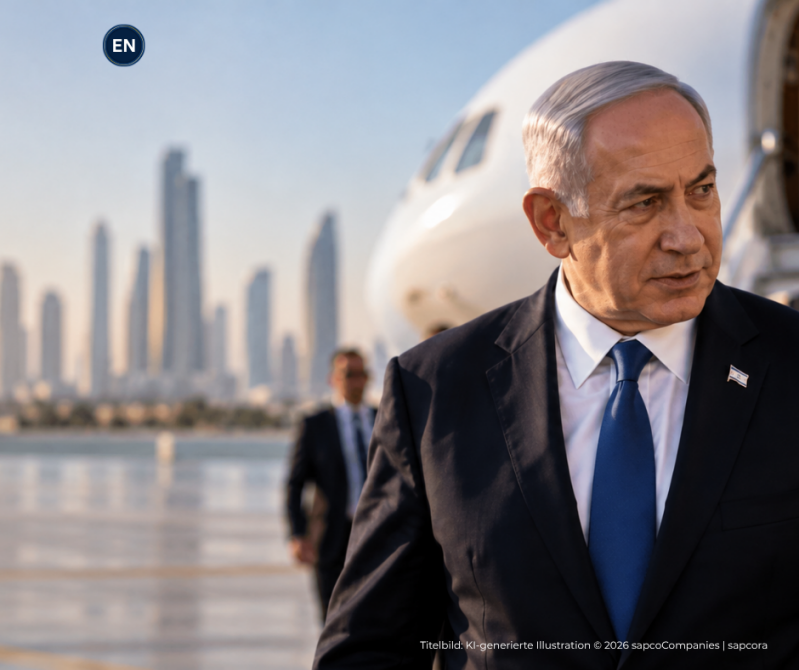
Israeli Prime Minister Benjamin Netanyahu made an unannounced visit to Abu Dhabi on Sunday, September 27, where he met United Arab Emirates President Sheikh Mohamed bin Zayed Al Nahyan. Neither government has disclosed what was discussed, leaving the purpose of the meeting officially unexplained at one of the most sensitive moments in the region since the outbreak of the Iran war. Iran is the most obvious strategic backdrop, but not a confirmed agenda. The risk of further attacks, security across the Gulf, the Strait of Hormuz and the uncertain course of negotiations between Washington and Tehran all provide plausible reasons for direct contact between the Israeli and Emirati leaders. For now, the significance lies as much in the timing of the meeting as in what may have been said behind closed doors.
A confirmed meeting with no public agenda
A senior Israeli government official confirmed that Netanyahu visited Abu Dhabi on Sunday and met Mohamed bin Zayed. Israeli media reported that the prime minister traveled aboard a private aircraft, remained in the UAE for several hours and returned to Israel the same day. Neither Netanyahu’s office nor the UAE Foreign Ministry initially provided details of the meeting. There has been no official statement identifying the subjects discussed or announcing an agreement between the two governments. That distinction is essential. The meeting happened. Its agenda remains undisclosed, leaving the regional circumstances to provide context rather than proof of what was discussed.
Iran is the unavoidable question
The most obvious issue is Iran. The UAE has been directly exposed to the consequences of the Iran war, while Israel remains one of the central military and political actors in the confrontation. Against that background, it would be unsurprising if Netanyahu and Mohamed bin Zayed discussed Iran and the possibility of further escalation. Possible subjects could include the risk of additional attacks against Gulf states, Israeli assessments of Iranian military capabilities and the consequences of another phase of hostilities. None of those subjects has been officially confirmed as part of Sunday’s conversation. They do, however, form the immediate security environment in which the meeting took place and help explain why direct contact between the two leaders carries particular weight.
The Gulf faces a wider security problem
The question extends beyond Israel and Iran. The war has exposed the vulnerability of Gulf states that have spent years balancing close security relationships with Washington against efforts to avoid becoming direct participants in a confrontation with Tehran. For Abu Dhabi, the central concern is therefore likely to extend beyond the outcome of any individual Israeli operation. The UAE has a direct interest in preventing another cycle of attacks from spreading across the Gulf and threatening critical infrastructure, aviation, trade and energy flows. Israel approaches the situation from a different strategic position. Netanyahu’s government is focused on limiting Iran’s military capabilities and preventing Tehran from rebuilding threats Israel considers unacceptable. Those interests are not identical. They nevertheless intersect around the need to manage a regional security environment in which another escalation could rapidly spread beyond the principal combatants.
Hormuz changes the calculation
The Strait of Hormuz is another issue that sits at the center of the wider strategic equation. Any prolonged disruption to one of the world’s most important energy corridors would have consequences extending far beyond the countries directly involved in the conflict. For the Gulf states, Hormuz is not an abstract geopolitical issue. Disruption affects energy exports, commercial shipping, insurance costs and the economic security of the wider region. The UAE therefore has powerful reasons to favor an outcome that restores predictable maritime traffic without triggering another military escalation. Israel, meanwhile, has an interest in how any arrangement involving Iran might affect Tehran’s leverage, regional security and Washington’s broader negotiating position. Whether Netanyahu and Mohamed bin Zayed discussed the strait specifically is unknown. Strategically, however, it belongs to the same set of pressures surrounding their meeting.
Washington is the third actor in the equation
There is another reason Abu Dhabi matters: the United States. The UAE maintains a close security relationship with Washington, while its ties with Israel have created an additional channel of regional communication since the Abraham Accords established formal relations between the two countries in 2020. At the same time, Washington and Tehran have not abandoned diplomacy. President Donald Trump rejected Iran’s latest proposal, but subsequently indicated that further US Iranian talks could take place this week. That raises several questions around Netanyahu’s visit. Israel may want close coordination with regional partners as Washington considers its next diplomatic steps. Abu Dhabi, meanwhile, has a direct interest in understanding how Israeli calculations could affect the risk of renewed conflict across the Gulf. A more ambitious possibility would be some form of Emirati diplomatic role between the competing positions. There is currently no evidence, however, that Netanyahu carried an American proposal, that Mohamed bin Zayed offered to mediate or that a new negotiating initiative emerged from Sunday’s meeting.
Abu Dhabi has reasons to contain another escalation
The UAE’s broader regional position offers additional context. Abu Dhabi has repeatedly emphasized de escalation and regional stability while maintaining direct channels of communication with Israel. Those priorities do not reveal what Mohamed bin Zayed told Netanyahu on Sunday. They do, however, help define the strategic interests the Emirati leadership brings to such a meeting. Abu Dhabi has little interest in seeing the Gulf become the enduring battlefield of an Israeli Iranian confrontation. Its economic model depends heavily on stability, connectivity, investment, aviation and secure trade routes. Another major escalation would place each of those interests under pressure. Regional containment would therefore be a logical Emirati concern in any strategic discussion with Israel, even if the precise subjects addressed on Sunday remain unknown.
Security coordination may matter as much as diplomacy
The meeting may also have involved a more immediate question: what happens if the conflict intensifies again. Israel and the UAE occupy different positions in relation to Iran, but both have an interest in intelligence concerning missiles, drones and other threats capable of crossing national borders. Questions involving early warning, intelligence exchange and the protection of critical infrastructure have become more important as the conflict has expanded beyond the territory of its principal participants. The UAE has previously acknowledged that relevant intelligence can be exchanged with Israel through established channels when necessary. Whether Sunday’s meeting produced additional security coordination has not been disclosed. After the attacks experienced during the Iran war, however, preparedness for another escalation is one of the strategic issues surrounding any senior Israeli Emirati contact.
The October 7 dispute remains in the background
The visit also comes amid a separate and politically sensitive dispute concerning reported communications between Mohamed bin Zayed and Netanyahu before the Hamas attack of October 7, 2023. Haaretz reported that the Emirati president had warned Netanyahu shortly before the attack that Hamas was preparing a major operation. Netanyahu has rejected the report and threatened legal action. The UAE has not confirmed the reported conversation and has said it does not comment on media speculation concerning discussions between government leaders. There is no established evidence that this controversy prompted Sunday’s visit or formed part of the talks. It remains relevant background, but should remain separate from the current meeting unless further information establishes a connection.
What the silence leaves open
The absence of an official account creates an obvious temptation to assign a specific purpose to Netanyahu’s journey. At this stage, that would go beyond the available evidence. What is known is significant enough. Israel’s prime minister traveled personally to Abu Dhabi without prior public announcement and met one of the Gulf’s most influential leaders at a moment when Iran, the possibility of further attacks, the security of the Gulf, the future of Hormuz and renewed US Iranian diplomacy are converging. Any one of those issues could justify direct communication between Netanyahu and Mohamed bin Zayed. Several may have been discussed. None has yet been confirmed as the purpose of the visit. The next indication of what Netanyahu’s quiet mission was ultimately about may therefore come not from an official account of Sunday’s conversation, but from what Israel, the UAE, Iran or the United States does next.
Netanyahu’s Quiet Mission to Abu Dhabi. Benjamin Netanyahu made an unannounced visit to Abu Dhabi for talks with UAE President Mohamed bin Zayed as Iran, Gulf security and renewed US Iranian diplomacy dominate the region.
Kommentar hinzufügen
Kommentare