

Category: International
Format: News Report
Author: Sinisa Brkic (sb)
Date: 10 October 2026
Indian authorities have imposed sweeping security restrictions across New Delhi as protests over the country's electoral system intensify. Thousands of security personnel have been deployed, hundreds of demonstrators detained and major transport services disrupted. At the centre of the confrontation is a controversial revision of voter registers involving approximately 130 million deleted entries, raising profound questions about electoral transparency, institutional accountability and the right to peaceful protest.
Delhi Under Extraordinary Security Restrictions
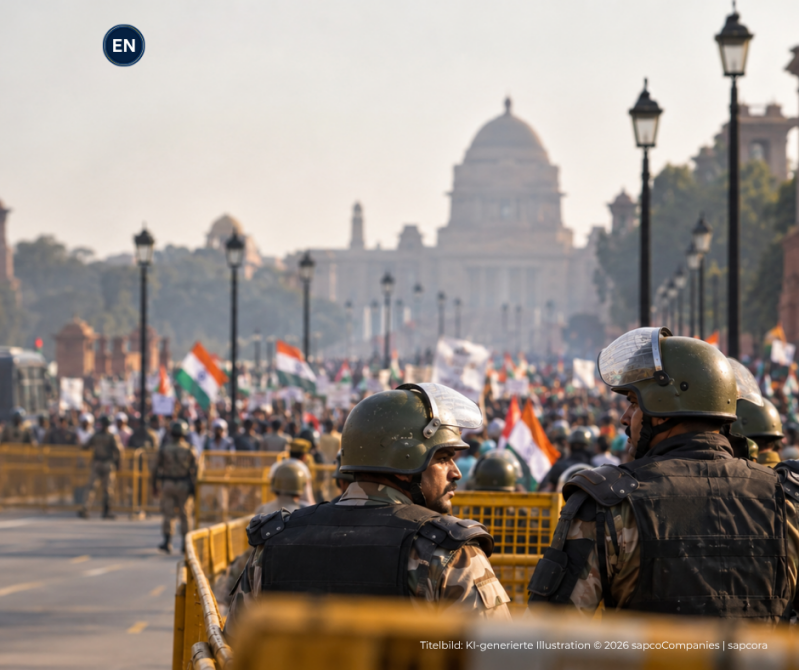
India's capital has been placed under an extensive security operation as authorities attempt to prevent a major demonstration demanding the resignation of Chief Election Commissioner Gyanesh Kumar. Police and paramilitary forces have established barricades, restricted access to central districts and detained protesters attempting to reach the planned gathering at Jantar Mantar. The operation, involving tens of thousands of security personnel, has disrupted public transport, commercial activity and movement across several parts of New Delhi. Entry and exit restrictions were imposed at 45 Delhi Metro stations, while at least 245 railway services originating from or terminating in the capital were cancelled. Mobile internet services were suspended within a four kilometre radius of the Janpath and Kartavya Path intersection for 24 hours, beginning late on Friday.
The restrictions have been accompanied by preventive detentions across the city. Police sources reported approximately 200 protesters detained in central Delhi on Saturday, while separate accounts indicated that at least 1,000 people had been taken into preventive custody overnight across the wider capital. The figures concern different locations and stages of the security operation and should not be treated as a single consolidated total. Delhi Police denied permission for the demonstration, citing procedural requirements and concerns about public order. Organisers rejected the decision and maintained that their supporters were entitled to assemble peacefully to challenge the conduct of the Election Commission.
The Electoral Controversy Behind the Protests
The confrontation follows growing public criticism of India's Special Intensive Revision, a programme intended to verify electoral registers and remove entries that no longer meet registration requirements. According to Election Commission figures, approximately 130 million names have been removed or flagged for deletion during the exercise, an extraordinary number even in a country with one of the world's largest electorates. The commission maintains that the revision is necessary to ensure accurate voter lists. Its figures identify millions of entries associated with deceased individuals, people who have relocated and registered voters who could not be traced during verification. Electoral authorities also insist that the process remains subject to correction and that eligible citizens whose names were removed can seek registration again. Opposition parties dispute the fairness and implementation of the exercise. They argue that documentation requirements, administrative errors and inadequate verification procedures may have excluded legitimate voters, including people from economically disadvantaged communities and religious minorities. The allegations have become particularly contentious because opposition politicians accuse the ruling Bharatiya Janata Party of benefiting politically from the changes. The Election Commission and the BJP reject accusations of electoral manipulation, and no conclusive evidence has established that the approximately 130 million deletions were deliberately designed to favour the governing party. Nevertheless, the scale of the revision has created a substantial challenge for electoral administrators. The central issue is no longer simply how many names have been removed, but whether the authorities can demonstrate that the process is transparent, accurate and capable of correcting wrongful exclusions.
A Youth Movement Confronts the Election Commission
The planned demonstration has been spearheaded by the Cockroach Janta Party, a youth movement that emerged from online political satire and developed into a wider platform for protests over government accountability. Its founder, Abhijeet Dipke, has become a prominent figure in youth mobilisation, particularly following earlier campaigns over examination irregularities. The movement is demanding the resignation of Gyanesh Kumar and greater scrutiny of the Election Commission's handling of voter registration. Its campaign has also attracted support from student organisations and opposition groups that have independently challenged the electoral revision process. The latest confrontation follows several days of demonstrations and detentions involving opposition politicians and activists. Congress leader Rahul Gandhi and other lawmakers were detained during earlier attempts to protest against the election authorities, adding to an increasingly prominent political dispute. For the government, the protests present a difficult public order challenge at a time when scrutiny of electoral institutions is intensifying. For the demonstrators, the restrictions have strengthened an argument that extends beyond voter registration to include the ability of citizens to challenge state institutions through peaceful assembly.
Supreme Court Questions the Scale of Restrictions
The extraordinary measures imposed in Delhi have also attracted scrutiny from India's Supreme Court. During proceedings on 9 October, judges questioned the proposed disruption of metro and railway services and emphasised that security precautions must remain proportionate to the threats they are intended to address. The court made clear that public order considerations should not result in a complete prohibition on essential transport services. It called for restrictions to be limited to what was necessary and warned against imposing excessive inconvenience on ordinary citizens who were not participating in the demonstrations. Following the intervention, the initial plan affecting 57 metro stations was revised to restrictions on entry and exit at 45 stations. Interchange facilities remained available at most affected locations, although access restrictions continued to interfere with normal journeys across the network. The judicial intervention highlights a fundamental tension in the authorities' response. Police have a responsibility to prevent violence and protect public safety, but restrictions on movement, communication and assembly also affect constitutional rights. Their legality and proportionality become especially important when the measures are introduced to prevent political demonstrations. The consequences extend beyond the protesters themselves. Commuters, railway passengers, businesses and residents have faced disruptions resulting from decisions intended primarily to control access to central Delhi.
Election Commission Moves to Address Excluded Voters
Amid mounting criticism, the Election Commission has introduced additional measures intended to address concerns about eligible voters missing from electoral registers. A special enrolment drive has been ordered in states and union territories where the intensive revision process has already been completed. The initiative allows eligible citizens who were left out of revised rolls to apply for registration through existing electoral procedures. It represents an important administrative response to the controversy, although its effectiveness will depend on whether affected voters are informed, can provide the necessary documentation and have sufficient time to complete the process. The measures also underline a crucial distinction in the public debate. Removal from a draft electoral register does not automatically establish permanent disenfranchisement, and the existence of registration or appeal procedures does not, by itself, prove that every eligible voter can successfully regain their place on the rolls. The credibility of the exercise will ultimately depend on the accuracy of the underlying records, the accessibility of corrective procedures and the ability of electoral authorities to demonstrate that the rules have been applied consistently.
Political Implications Beyond the Capital
The controversy has acquired national significance ahead of major state elections scheduled for 2027, including in Uttar Pradesh, India's most populous state. Questions about voter eligibility and electoral administration are particularly sensitive when parties are preparing for contests in which even relatively small changes to voter registration can become politically consequential. Opposition parties argue that the deletions have undermined confidence in electoral procedures and demand greater transparency concerning the reasons for removing individual entries. The BJP maintains that accusations of systematic manipulation are unfounded and rejects claims that its electoral success depends on interference with voter registration. The distinction between political criticism and established wrongdoing remains essential. Allegations concerning electoral bias require verifiable evidence, while the administrative exercise itself must be assessed against the legal safeguards intended to protect eligible voters. The growing confrontation also places renewed attention on the Election Commission's institutional independence. Its credibility depends not only on its formal constitutional status but also on its ability to explain controversial decisions, respond to legitimate complaints and demonstrate procedural fairness.
A Security Operation Cannot Resolve an Electoral Dispute
The restrictions imposed across New Delhi have transformed a dispute over voter registers into a broader confrontation over the relationship between public authority and democratic participation. The deployment of security forces, restrictions on communication and preventive detention of demonstrators have introduced questions that go beyond the immediate controversy surrounding Gyanesh Kumar. For the authorities, the challenge is to demonstrate that extraordinary security measures are necessary, lawful and proportionate. For the Election Commission, the more enduring task is to establish public confidence that the revision of electoral registers protects legitimate voting rights while maintaining the accuracy of the electoral system. Neither objective can be achieved solely through restrictions on public demonstrations. Electoral transparency requires verifiable procedures, accessible remedies and institutional decisions that can withstand independent scrutiny.
The events in Delhi have therefore brought two fundamental democratic obligations into direct focus: the state's responsibility to maintain public order and its duty to protect political participation. How India's institutions reconcile those obligations will matter long after the barricades are removed from the capital.
India Locks Down Delhi as Election Protests Intensify. India locks down central Delhi amid election protests, mass detentions and transport restrictions as controversy grows over 130 million deleted voter entries.
Kommentar hinzufügen
Kommentare