

Category: Mobility
Format: News Report
Author: Sinisa Brkic (sb)
At least 69 people have died after two high-speed passenger trains collided in central Spain. Investigators are examining why railway controllers authorized one train to continue despite an active stop signal and a stationary train farther ahead. Newly disclosed communications have raised serious questions about the decisions made inside the control center before one of Europe's deadliest railway disasters in more than a decade.
Deadly Collision on Spain's High-Speed Rail Network
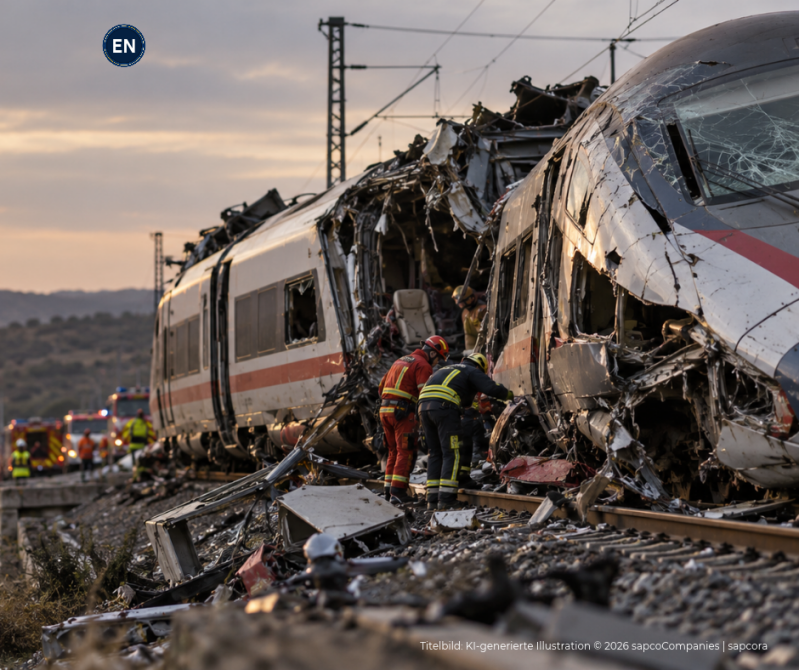
A high-speed train operated by Spain's state-owned railway company Renfe collided with a stationary Iryo passenger train near Urda, in the province of Toledo, on October 28, 2026. The collision occurred on the Madrid-Seville high-speed corridor, leaving several carriages derailed and triggering a major emergency response. Approximately 544 people were traveling on the two trains, including 397 aboard the Renfe service and 147 on the Iryo train. Several carriages were severely damaged, with parts of the wreckage scattered down an embankment. By Thursday, October 29, the confirmed death toll had risen to at least 69, while more than 100 people had been injured. Authorities reported that 57 people remained hospitalized as emergency crews continued searching the wreckage. Rescue teams used cranes, specialized equipment and search dogs to examine damaged carriages. Officials warned that additional victims could still be found as recovery operations continued. The collision is Europe's deadliest railway accident since the 2013 derailment near Santiago de Compostela, Spain, which killed 80 people.
A Safety System Failure Preceded the Collision
The circumstances surrounding the disaster have placed Spain's railway traffic management procedures under intense scrutiny. According to Transport Minister Óscar Puente, a computer communications malfunction occurred at approximately 8:30 a.m., disabling the LZB train protection system along a section of the Madrid-Seville corridor. The failure affected six trains, automatically bringing them to a halt. The LZB system is designed to regulate train movements and help prevent dangerous situations involving trains operating on the same track. When the system became unavailable, responsibility for coordinating movements shifted to railway controllers at Madrid's Atocha control center, operated by infrastructure manager Adif. Technical failures are anticipated in railway operating procedures. Alternative safety measures are intended to ensure that trains can continue operating only under conditions that maintain adequate protection. The decisions made after the automatic system stopped functioning are now at the center of the investigation.
The Control Center Authorized Normal Operations
At approximately 8:36 a.m., a controller authorized Renfe train AVE 2080 to resume its journey under normal operating conditions. Communications between the train driver and the control center indicate that the driver explicitly sought confirmation of the instruction. The controller confirmed that normal movement was permitted. The authorization was issued despite an active stop signal associated with an occupied section of track. Puente subsequently acknowledged that the instruction was inconsistent with the operating precautions required under the circumstances. The train should not have continued under normal conditions while the automated protection system was unavailable and another train remained stationary ahead. Instead, the applicable procedures required either continued suspension of movement or restricted operation under conditions allowing the driver to stop when an obstruction became visible. The restricted procedure, known as marcha a la vista, limits movement to a speed appropriate for the available visibility, with a maximum of approximately 25 mph. The Renfe service was instead permitted to continue under normal operating conditions along a section of railway where speeds of approximately 124 mph were possible. Its precise speed at the moment of impact remains a matter for investigators.
Communications Reveal Warnings About the Stationary Train
Recordings disclosed on October 29 provide further insight into the sequence of events leading to the collision. At approximately 8:41 a.m., the driver of Iryo train 6076 informed the Atocha control center that the service remained stopped near the entrance to Urda station because of a transmission problem. A further communication, placed at approximately 8:48 a.m. in the reported chronology, indicated that the Iryo train was still unable to resume its journey. The exact timing of the collision remains disputed. Renfe has placed the impact at approximately 8:53 a.m., while sources close to Iryo have described an earlier sequence. Despite this discrepancy, the available communications raise a fundamental question about how information concerning the stationary train was handled. The control center had been informed of difficulties affecting the Iryo service, while the Renfe train had been authorized to continue toward the same area. Investigators must establish whether the relevant information was properly assessed, whether the approaching driver received adequate warnings and why the available safeguards did not prevent the collision.
Investigators Examine Possible Human Error
The Spanish government has identified a possible human error in the decision to authorize normal train movements following the technical failure. Puente has characterized the circumstances as difficult to explain, particularly because established operating procedures were intended to provide protection when the automated system was unavailable. Nevertheless, the complete cause of the disaster has not been established. Investigators are examining the technical malfunction, the instructions issued by railway controllers, communications with train drivers and the operational conditions immediately before the collision. Onboard data recorders and control center recordings are expected to provide important evidence about train speeds, movements and the actions taken during the disruption. The investigation must also determine whether additional technical or procedural safeguards should have prevented an incorrect authorization from creating an immediate danger. No individual criminal responsibility has been conclusively established. The distinction between an apparent operational error and legally attributable responsibility will depend on the findings of the relevant investigations.
Spain Faces Its Second Major Rail Disaster This Year
The catastrophe comes just nine months after another deadly high-speed railway collision in Spain. On January 18, 2026, an Iryo train derailed near Adamuz in the southern province of Córdoba and collided with a Renfe service traveling in the opposite direction. Forty-six people died in that disaster. Both accidents occurred on the Madrid-Seville high-speed corridor and involved the same two railway operators. However, investigators have not established any common technical cause between the two incidents. Preliminary findings concerning the January collision pointed toward possible problems involving railway infrastructure, including track components or a defective weld. The October disaster has instead focused attention on automated train protection and traffic management decisions. Prime Minister Pedro Sánchez has indicated that the causes of the two accidents appear to be unrelated. Nevertheless, the occurrence of two major railway catastrophes within the same year has intensified scrutiny of Spain's high-speed rail network.
Railway Safety and Infrastructure Under Pressure
Spain operates one of the world's largest high-speed railway networks, extending approximately 2,500 miles across the country. The system has been a major component of Spain's transportation infrastructure and an important alternative to domestic air travel. The latest disaster has renewed questions about railway maintenance, modernization and the effectiveness of operational safeguards. European Commission data has previously highlighted differences between Spain and other major European countries in the proportion of railway investment allocated to maintenance and infrastructure renewal. However, there is currently no established evidence connecting broader investment patterns directly to the collision near Urda. The investigation must therefore distinguish between the immediate circumstances of the crash and wider concerns about the condition and management of Spain's railway infrastructure. The continued use of the LZB protection system on the Madrid-Seville corridor, alongside plans to replace it with the European Rail Traffic Management System, is also attracting attention. Modern train protection technology is designed to reduce operational risks, but the effectiveness of railway safety ultimately depends on the interaction between automated systems, established procedures and human decision-making.
National Mourning and Political Consequences
Spain declared three days of national mourning following the collision, with Prime Minister Sánchez promising a thorough investigation and measures to address any safety deficiencies identified. The disaster has also disrupted political campaigning ahead of the country's November 29 election. Leaders of major political parties suspended scheduled campaign activities as the country confronted the scale of the tragedy. Meanwhile, Spanish train drivers proceeded with a previously planned strike demanding greater investment in railway safety and improvements to the system's operational structure. Rail traffic along the affected Madrid-Seville corridor has been interrupted, forcing operators to introduce alternative transportation arrangements for passengers traveling between Madrid and southern Spain. The government's immediate priorities include supporting victims and their families, maintaining emergency operations and establishing the circumstances that allowed the collision to occur. The longer-term challenge will be restoring confidence in a railway system that has suffered two catastrophic accidents within a single year.
The Investigation Must Explain Why the Safeguards Failed
The disaster near Urda has exposed a sequence of events that raises serious concerns about the resilience of railway safety procedures. An automated protection system failed, traffic controllers assumed responsibility for train movements, and a passenger train was authorized to continue despite conditions that required additional precautions. Information about another stationary train was communicated to the control center, yet the two services ultimately collided. The investigation must establish precisely how these circumstances developed and whether failures in communication, operational judgment or safety procedures contributed to the disaster. For European railway operators, the findings may have implications beyond Spain. High-speed railway safety depends on multiple protective measures designed to prevent a technical malfunction or individual mistake from escalating into a catastrophic accident. The central question is therefore not simply why the automated protection system failed, but why the remaining safeguards did not prevent two passenger trains from occupying the same section of track. For the families of those killed, establishing the facts is essential to determining responsibility. For Spain's railway authorities, the investigation will be a decisive test of whether the existing safety framework can provide adequate protection when critical systems stop working.
Spain Train Crash: 69 Dead After High-Speed Rail Collision. A high-speed train collision in Spain has killed at least 69 people. Investigators are examining a controversial control center order and possible safety failures.
Kommentar hinzufügen
Kommentare