

Category: Geopolitics
Format: Analysis
Author: Sinisa Brkic (sb)
The U.S. armed forces remain the world's most formidable military establishment. Yet the prolonged confrontation with Iran is exposing vulnerabilities that American military superiority can no longer conceal. Depleted missile inventories, overstretched naval forces, industrial production bottlenecks, and the redeployment of critical assets from the Pacific reveal an increasingly consequential gap between Washington's global military commitments and its capacity to sustain them.
The Strategic Limits of American Military Dominance
Military superiority is measured not only by the ability to defeat an adversary, but also by the capacity to sustain operations, replenish losses, and remain prepared for simultaneous threats. For the United States, that distinction has become increasingly important as the confrontation with Iran places considerable demands on naval forces, missile defense systems, logistics, and military production. Washington continues to possess an extraordinary concentration of military capabilities, from nuclear-powered aircraft carriers and strategic bombers to advanced submarines and global intelligence infrastructure. Nevertheless, the intensity of operations earlier this year and the continued military commitment to the Middle East are exposing weaknesses that technological superiority alone cannot resolve. The issue is not an imminent collapse of American military power. It is the increasingly visible difficulty of maintaining sufficient operational strength across several strategically important regions without exhausting critical resources or compromising readiness elsewhere.
The Pacific Is Losing Forces to the Middle East
The redeployment of the USS George Washington from the western Pacific to the Middle East illustrates the growing tension between American strategic priorities and operational requirements. Permanently forward-deployed in Yokosuka, Japan, the aircraft carrier occupies a particularly important position in the U.S. Navy's ability to respond rapidly to developments involving China, Taiwan, and North Korea. In August 2026, the carrier was transferred to the Arabian Sea to relieve the USS Abraham Lincoln, whose exceptionally prolonged deployment had placed considerable pressure on its personnel and operational schedule. The Lincoln eventually returned to San Diego on October 8 after a 321-day deployment, including more than 260 consecutive days at sea without a port call. The transfer of the George Washington was not an isolated adjustment. By early November, five of the ten American guided-missile destroyers based in Yokosuka were also supporting operations in the Middle East. These vessels provide essential air defense, ballistic missile interception, surveillance, and strike capabilities that are equally relevant to military contingencies in the Indo-Pacific. For Washington's regional allies, the consequences extend beyond the movement of individual warships. American deterrence in the Pacific depends partly on the credibility of a sustained military presence, and the temporary diversion of major naval assets raises questions about force availability during an unexpected regional crisis.
Another Carrier Reinforces the Pressure
The arrival of the USS Theodore Roosevelt carrier strike group in Singapore on November 6 added another dimension to the situation. After operating in the western Pacific and participating in military exercises with regional partners, the carrier and its accompanying warships were expected to continue toward the Middle East. The Theodore Roosevelt is expected to relieve the George Washington, although the precise timing and duration of any overlapping deployments remain uncertain. The USS George H.W. Bush is also operating in the region, illustrating the substantial concentration of American naval aviation capabilities around the Iranian confrontation. Deploying multiple aircraft carriers demonstrates considerable military strength. At the same time, repeated rotations across distant theaters expose the operational burden required to maintain that presence, particularly when ships must undergo maintenance, crews need recovery periods, and replacement formations are already committed to other missions. The strategic significance lies in the redistribution of limited high-value assets. Every carrier strike group sent to the Middle East remains unavailable for other operational requirements during its deployment, while the Navy must preserve sufficient forces for contingencies that cannot be predicted with certainty.
Missile Stockpiles Reveal a More Serious Problem
The pressure on American missile inventories may prove more consequential than the movement of aircraft carriers. The conflict with Iran has required extensive use of precision-guided weapons and advanced interceptors, particularly those employed by Patriot and Terminal High Altitude Area Defense systems. These weapons are essential to protecting military installations, deployed forces, and regional partners against ballistic missile attacks. Their effectiveness, however, comes with substantial financial and industrial costs, while production cannot immediately respond to the exceptional consumption rates associated with intensive combat operations. In September 2026, the Congressional Budget Office estimated that the United States had probably expended between one-half and two-thirds of its inventories of certain missile interceptors. The assessment did not imply that American forces had exhausted their overall missile arsenal, but it identified a significant reduction in weapons whose availability is critical to several potential conflict scenarios. The Pentagon's inspector general also documented strategic inventory shortfalls and industrial bottlenecks resulting from the conflict. These findings stand alongside official assurances that sufficient weapons remain available for current military operations, revealing an important distinction between the ability to continue fighting today and the ability to sustain another major confrontation tomorrow.
The Industrial Capacity Gap
The United States possesses an extensive defense industrial base, but the production of sophisticated weapons remains dependent on specialized suppliers, highly skilled personnel, complex manufacturing processes, and components that cannot be produced in unlimited quantities. The problem is particularly acute for missile defense interceptors. Unlike relatively inexpensive conventional ammunition, these systems require elaborate production and testing procedures, creating substantial delays between the expenditure of a weapon and its replacement. Congressional assessments indicate that replenishing certain interceptor inventories could take at least five years, even with expanded production. Additional funding can support manufacturing capacity, but financial appropriations cannot immediately create new factories, qualified workers, specialized components, or mature supply chains. The consequences extend to American allies. Countries relying on U.S. weapons deliveries face potential competition with the Pentagon's own replenishment requirements, while expanding production capacity must accommodate both domestic military needs and international security commitments. The resulting challenge is structural. American military operations can consume critical weapons at a pace that existing manufacturing capacity cannot readily match, creating vulnerabilities that may persist long after individual combat operations have ended.
Naval Readiness Is Already Paying a Price
The U.S. Navy's difficulties are not limited to the current confrontation with Iran. Maintenance delays, aging infrastructure, constrained shipyard capacity, and prolonged operational commitments have affected the availability of major naval assets for years. An August 2026 assessment by the U.S. Government Accountability Office found that maintenance delays and periods of inactivity had deprived the American attack submarine fleet of more than 15,000 operational days between fiscal years 2016 and 2025. The associated cost of maintaining submarines and crews that could not perform operational missions was estimated at $3.4 billion. The findings expose a fundamental weakness in military readiness calculations. A vessel may formally remain part of the fleet while being unavailable for deployment, training, or operational assignments. The numerical strength of a navy therefore does not necessarily reflect the number of ships and submarines capable of responding to an immediate crisis. Extended deployments can further complicate this situation by increasing maintenance requirements and limiting opportunities for scheduled repairs. Although American naval forces have demonstrated considerable endurance, operational availability cannot be maintained indefinitely without adequate investment in maintenance infrastructure, personnel, and recovery periods.
The Iran Conflict's Expanding Financial Burden
The financial consequences of the conflict are becoming increasingly substantial. According to a U.S. Central Command estimate provided to Congress, the war with Iran had cost approximately $47.1 billion by October 16, 2026, an increase of $3.5 billion compared with early September. Approximately $29 billion of the estimated expenditure was associated with replacing expended munitions, while additional operational costs accounted for about $11.9 billion and equipment losses for approximately $6.1 billion. The assessment did not include the full cost of damage inflicted on American military installations in the Middle East. These figures demonstrate the extraordinary expense of maintaining intensive military operations against an adversary whose overall military capabilities are considerably smaller than those of the United States. They also reveal how quickly even an exceptionally large defense establishment can encounter financial and logistical pressures when military commitments extend over many months. The larger strategic issue is that expenditure alone does not guarantee restored combat readiness. Replacing destroyed equipment, replenishing depleted missile inventories, and repairing military infrastructure involve processes that can continue long after the immediate operational costs have been incurred.
Washington's Indo-Pacific Strategy Faces a Contradiction
The Pentagon's 2026 National Defense Strategy identifies homeland defense and deterrence in the Indo-Pacific as central military priorities. The strategy emphasizes preventing Chinese military aggression, strengthening the ability of American and allied forces to defend strategically important areas, and expanding the industrial capacity necessary to sustain military operations. Yet the continuing confrontation with Iran requires capabilities that are also essential to a potential conflict in the western Pacific. Aircraft carriers, guided-missile destroyers, precision weapons, integrated air defenses, and logistical resources cannot be committed to separate theaters simultaneously without limitations. China has spent years expanding its naval forces, missile capabilities, and military infrastructure in the region. Any serious confrontation involving Taiwan would place exceptional demands on American naval aviation, missile defense, intelligence, and logistics, making the availability of reserves and replacement weapons especially important. The diversion of military assets to the Middle East does not mean that the United States has abandoned the Indo-Pacific or lost the ability to operate there. American forces continue to maintain extensive regional capabilities, supported by military installations, allied armed forces, submarines, and land-based aviation. Nevertheless, the redistribution of resources exposes an underlying strategic contradiction. Washington's military planning seeks to preserve deterrence across multiple regions, while the demands of one prolonged confrontation can reduce the forces and munitions available to support that objective elsewhere.
Military Superiority Does Not Guarantee Strategic Endurance
The vulnerabilities now emerging should not be confused with the disappearance of American military superiority. The U.S. armed forces retain exceptional capabilities in strategic aviation, submarine warfare, carrier operations, intelligence, precision strikes, and global logistics. The ability to transfer major naval formations between the Pacific and the Middle East is itself evidence of operational reach that few other military powers can replicate. American forces have also demonstrated considerable effectiveness in intercepting incoming attacks and conducting sustained operations across geographically dispersed areas. The weakness lies in the relationship between operational performance and strategic endurance. A military can remain technologically advanced, tactically effective, and superior to individual adversaries while facing increasingly serious difficulties sustaining prolonged operations across multiple theaters. This distinction is central to assessing the future of American military power. Strategic supremacy depends not simply on defeating an adversary in a particular engagement, but on preserving sufficient reserves, industrial capacity, and operational flexibility to respond to subsequent challenges. The greater the demands placed on those resources, the more consequential the trade-offs become.
The Global Implications of an Overstretched Military
For American allies in Europe, the Middle East, and the Indo-Pacific, the emerging constraints introduce questions about the reliability and timing of military support. Security guarantees depend not only on political commitments but also on the availability of forces, equipment, and ammunition when those commitments must be fulfilled. For potential adversaries, the same developments provide information about the limits of American operational capacity. Military planners can observe deployment patterns, industrial constraints, and the time required to restore expended capabilities, even when precise inventories and readiness levels remain classified. None of this establishes that the United States would be incapable of responding decisively to another major crisis. It does, however, illustrate why military strength must increasingly be evaluated in terms of sustainability rather than the sheer scale of an arsenal. The confrontation with Iran has exposed a central vulnerability in the American military system: Washington's global responsibilities can generate demands that exceed the capacity of particular forces and industrial supply chains to respond without delay. The U.S. armed forces remain extraordinarily powerful. What is increasingly uncertain is whether their existing structure, production capacity, and operational reserves are sufficient to sustain the full range of Washington's military commitments under conditions of prolonged and simultaneous pressure. American military supremacy has not disappeared. But the assumption that it can be exercised almost everywhere, for as long as necessary, without significant strategic consequences is becoming progressively harder to defend.
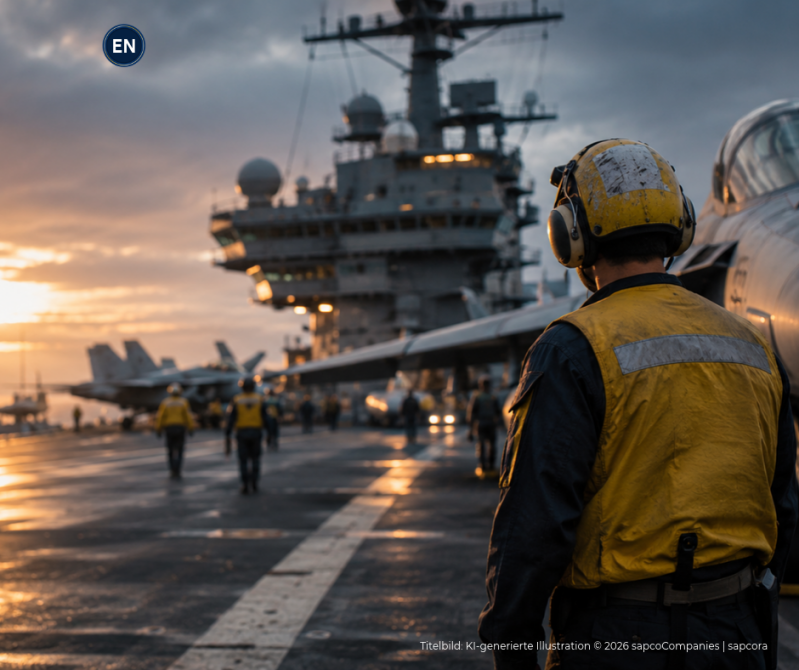
U.S. Military Supremacy Under Strain: Naval Deployments and Missile Shortages. U.S. military supremacy faces mounting pressure as missile shortages, prolonged naval deployments, and industrial constraints expose the limits of global military power.
Kommentar hinzufügen
Kommentare