

Category: Geopolitics
Format: Special Report
Author: Sinisa Brkic (sb)
When Chinese President Xi Jinping welcomed U.S. President Donald Trump and Russian President Vladimir Putin to Shenzhen on November 19, 2026, the encounter marked an extraordinary moment in international diplomacy. Three of the world's most influential leaders came together to discuss strategic stability, international security, and the foundations of global cooperation. Their meeting produced a joint declaration and opened the possibility of continued dialogue among countries whose interests do not always align. Beyond the immediate outcomes, Shenzhen raises a far-reaching question: Could direct cooperation among major powers help shape a more stable international order?
A Historic Encounter in Shenzhen
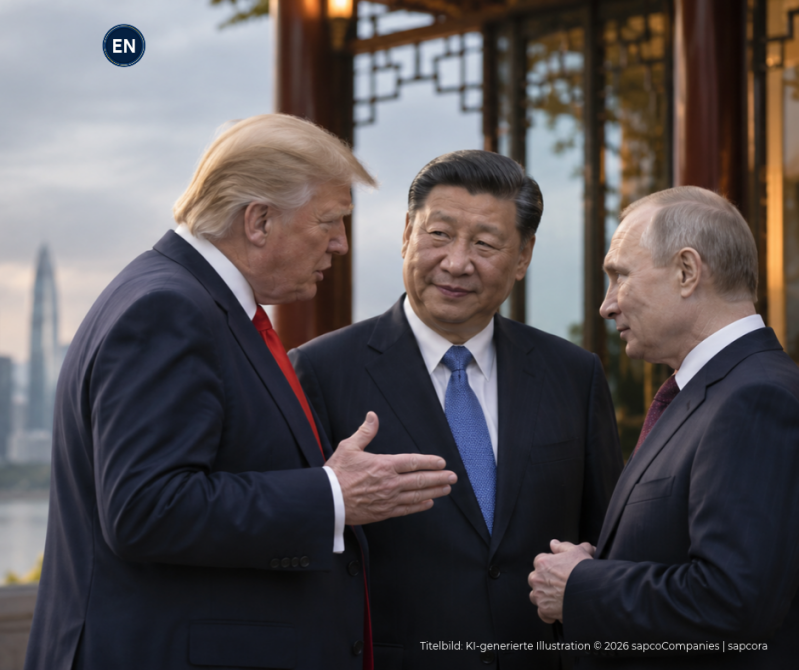
On November 19, 2026, Chinese President Xi Jinping hosted U.S. President Donald Trump and Russian President Vladimir Putin at Kylin Villa in Shenzhen for an unprecedented trilateral summit. Held alongside the Asia-Pacific Economic Cooperation gathering, the meeting brought together the leaders of three countries whose decisions influence international security, economic stability, and diplomatic relations across the world. China, the United States, and Russia represent distinct political systems, economic structures, and strategic priorities. Their relationships combine cooperation with competition, particularly in areas involving trade, technological development, regional security, and international institutions. Yet the three presidents chose direct dialogue, a decision that carries significance during a period in which geopolitical tensions have complicated relations among major powers. Diplomatic engagement does not require governments to abandon their positions or resolve every disagreement before negotiations begin. It provides an opportunity to clarify intentions, identify shared interests, and establish communication channels that may prove essential in moments of international uncertainty. The willingness to maintain such channels can itself contribute to stability, particularly when the countries involved possess substantial military and economic capabilities.
The meeting also demonstrated an essential characteristic of international relations: countries with differing interests can recognize shared responsibilities. Managing nuclear risks, maintaining economic stability, and preventing military escalation are objectives whose importance extends well beyond the governments directly involved. Shenzhen therefore deserves examination not only as an exceptional diplomatic encounter, but also as a possible starting point for more structured cooperation. Whether it develops into something lasting will depend on the decisions and negotiations that follow, as well as the willingness of the three governments to translate general principles into practical commitments.
What the Three Presidents Actually Agreed Upon
The summit concluded with a joint statement officially titled the U.S.-Russia-China Heads of State Declaration toward Peace. Its provisions addressed four areas: reform of the United Nations, international energy stability, principles of state sovereignty, and the reduction of nuclear risks. The presidents committed themselves to advancing reforms intended to improve the United Nations' ability to respond to global challenges. The declaration did not specify particular institutional changes, new decision-making procedures, or a timetable for implementation. It therefore established a general political objective rather than a detailed program of institutional reform. On energy policy, the three countries expressed their intention to increase the production and supply of refined petroleum products while reaffirming the importance of stable international energy flows. Given the relationship between energy availability, industrial production, transportation, and economic growth, this commitment could have implications for international markets if followed by practical measures. Its actual economic impact will depend on production decisions, market conditions, and the implementation of subsequent arrangements. Another provision concerned the relationship between state sovereignty and international criminal jurisdiction. The three presidents emphasized state consent, respect for the immunities of state officials, and concerns about the misuse of jurisdiction by international judicial bodies. These questions form part of a broader discussion concerning the relationship between international institutions and the sovereign authority of governments. The most directly security-related commitment concerned nuclear weapons. The countries reaffirmed the principle that a nuclear war cannot be won and must never be fought. They also announced their intention to conduct dialogue on reducing nuclear risks and preventing the proliferation of nuclear weapons. These declarations are diplomatically relevant, but their scope must be understood precisely. Shenzhen did not produce a new nuclear arms reduction treaty, binding reductions in nuclear arsenals, or a comprehensive international security framework. It also did not establish a settlement of the major regional conflicts discussed in connection with the summit. The declaration established common positions on selected principles and expressed an intention to continue cooperation. Its practical importance will depend on whether those commitments lead to sustained negotiations, institutional mechanisms, and measurable results.
The Diplomatic Value of Meeting Face to Face
One of the summit's most important dimensions is the willingness of the three leaders to communicate directly despite differences in national interests and strategic priorities. International relations have repeatedly demonstrated that communication becomes particularly valuable when relations between states are difficult. The absence of dialogue can increase uncertainty, while reliable diplomatic contacts may help prevent misunderstandings from developing into larger disputes. Diplomatic engagement provides opportunities to clarify intentions, identify possible compromises, and reduce uncertainty. It can also help governments distinguish between issues on which their positions remain incompatible and areas in which cooperation is achievable. Such distinctions are essential when international relationships involve several overlapping security, economic, and political concerns. History offers relevant examples. During the Cold War, the United States and the Soviet Union negotiated arms control agreements despite profound ideological disagreements and competing military interests. These agreements did not eliminate their rivalry, but they established mechanisms for limiting certain risks and maintaining communication. The contemporary international environment is substantially more complex. China has developed into a central economic and strategic actor, international production networks are deeply interconnected, and technological developments have introduced additional security challenges. A dialogue involving China, the United States, and Russia could therefore address questions that earlier bilateral arrangements were not designed to manage. Nuclear security, military crisis communication, energy stability, and the functioning of international institutions are among the areas where such cooperation may prove useful. Progress would not necessarily require comprehensive agreement on every disputed issue, provided that the governments identify specific objectives and develop credible mechanisms for pursuing them. The significance of direct diplomacy should neither be exaggerated nor underestimated. A summit cannot resolve longstanding disagreements through symbolism alone, but the absence of dialogue can make those disagreements more difficult to manage. In this respect, Shenzhen represents an opportunity to establish a more dependable foundation for future discussions.
China: Hosting a Conversation of Global Significance
China's role as host was one of the defining characteristics of the summit. By welcoming the presidents of the United States and Russia to Shenzhen, Xi Jinping placed Beijing at the center of a diplomatic exchange involving three major international powers. The encounter highlighted China's increasing presence in discussions concerning international security and the future of global institutions. China's position in global affairs reflects decades of industrial development, economic expansion, technological investment, and growing involvement in international institutions. Its extensive commercial relationships connect Chinese businesses and consumers with markets across Asia, Europe, Africa, and the Americas. These relationships make developments in the international economy particularly relevant to Beijing's diplomatic priorities. International stability carries considerable economic significance for China. Disruptions to shipping routes, energy supplies, financial markets, or global production networks can affect Chinese economic activity as well as the economies of its trading partners. Maintaining dependable international commercial relationships is therefore closely connected to the country's long-term development objectives. China also maintains important security interests in the Asia-Pacific region, including relations with neighboring countries and questions involving Taiwan. These considerations influence Beijing's diplomatic priorities and its approach to regional and international cooperation. They also illustrate why China's international relationships cannot be understood exclusively through economic considerations. Hosting the trilateral summit enabled Xi to demonstrate China's ability to convene leaders whose governments maintain different strategic positions. The encounter highlighted Beijing's role as a participant in discussions about global security and international governance, without implying that China had resolved the disagreements between Washington and Moscow. For China, the longer-term significance of Shenzhen will depend on whether the meeting develops into a sustained diplomatic process. Equally important will be how that process interacts with established international institutions and the interests of other countries.
The United States: Strategic Interests and Direct Engagement
The United States remains a central actor in international finance, technological innovation, military alliances, and global security arrangements. Its network of economic relationships and international commitments extends across multiple continents, giving American foreign policy substantial influence over developments far beyond its national borders. For President Donald Trump, direct discussions with Xi Jinping and Vladimir Putin provide an opportunity to address major international questions at the highest political level. These include nuclear security, economic relations, energy markets, and regional conflicts affecting international stability. Such exchanges can establish a political foundation for further discussions involving diplomats, security officials, and technical experts. Presidential diplomacy can facilitate direct exchanges between governments whose decisions carry substantial strategic consequences. It may also allow leaders to identify areas of agreement that could subsequently be developed through established diplomatic channels. The effectiveness of this approach depends on whether preliminary understandings are translated into detailed policies and sustainable agreements. American foreign policy also operates within a broader framework of national institutions, international commitments, and relationships with partner countries. Any understandings concerning European security would necessarily have implications for European governments, while discussions involving security in the Asia-Pacific region would need to take account of the positions and interests of countries directly affected. The challenge for Washington is therefore to explore cooperation with Beijing and Moscow while maintaining consistency with its broader international responsibilities. Shenzhen demonstrated the possibility of direct engagement among the three presidents, although its long-term significance for American foreign policy will depend on the substance of subsequent negotiations.
Russia: Strategic Stability and International Dialogue
Russia occupies an important position in international security because of its extensive territory, substantial energy resources, permanent membership of the United Nations Security Council, and major nuclear capabilities. Its geographical location also connects Russian security interests to developments in Europe, Asia, and several strategically important regions. Its relations with numerous Western governments remain complicated by disagreements over European security, sanctions, and the ongoing conflict in Ukraine. These developments have affected diplomatic cooperation, economic relationships, and regional security arrangements, making discussions about future stability particularly complex. For President Vladimir Putin, the Shenzhen summit offered an opportunity to discuss strategic questions directly with the leaders of China and the United States. Russia maintains extensive political and economic relations with China, while its relationship with Washington remains particularly important in matters involving nuclear deterrence, arms control, and broader strategic stability. The meeting provided an international forum in which Moscow could present its positions and explore possibilities for cooperation on questions of shared concern. Direct communication between Russia and the United States remains especially relevant because the two countries possess the world's largest nuclear arsenals. The Ukraine conflict was discussed during bilateral exchanges involving Trump and Putin, although no publicly documented peace settlement emerged from those talks. Questions involving security arrangements, territorial disputes, implementation mechanisms, and the participation of directly affected parties remain central to any lasting resolution. Diplomatic communication can help establish conditions for further negotiations, but agreements addressing such complex questions require sustained discussions and the involvement of the parties whose interests are directly affected. For Russia, as for China and the United States, the summit's long-term significance will depend on whether the political dialogue develops into practical arrangements.
Nuclear Security: A Shared Global Responsibility
Among the topics addressed in Shenzhen, nuclear risk reduction offers one of the clearest areas in which cooperation could contribute to international stability. Nuclear weapons remain central to the security policies of several major powers, and the consequences of a military misunderstanding involving such weapons could extend far beyond the countries concerned. China, the United States, and Russia possess nuclear forces with different historical foundations, operational requirements, and strategic doctrines. Their approaches to deterrence and arms control reflect their respective security environments, creating both opportunities and challenges for negotiations. The United States and Russia maintain the world's largest nuclear arsenals, while China possesses a smaller but expanding nuclear force. These differences create challenges for negotiations involving numerical limits, verification requirements, and strategic obligations. Any future framework would therefore need to account for the different capabilities and security priorities of the three countries. For decades, nuclear arms control focused primarily on Washington and Moscow. China's growing capabilities have intensified discussions about whether future arrangements should involve all three countries, although the precise structure of such a framework remains unresolved. Such negotiations would require careful consideration of national security interests, differences in arsenal size, missile defense systems, emerging technologies, and the relationship between nuclear and conventional military capabilities. These questions are technically demanding and politically sensitive, making gradual progress a more realistic initial objective than an immediate comprehensive agreement. Arms control does not necessarily need to begin with numerical reductions. Initial cooperation could focus on improving communication, increasing transparency, and establishing procedures intended to reduce the danger of unintended military escalation. Even limited progress in these areas could contribute to a more predictable international security environment. The Shenzhen declaration provides a political basis for further discussion, but it does not yet establish a negotiating framework, a timetable, or specific disarmament obligations. An important measure of progress would be the creation of regular consultations supported by technical experts and clearly defined objectives. Successful cooperation in this area would have implications extending far beyond the three participating countries. Reducing the risk of nuclear confrontation is a global security interest, including for nations that do not possess nuclear weapons.
Could Three Powers Influence the Future World Order?
The possibility of closer coordination among China, the United States, and Russia raises fundamental questions about international decision-making. The international system established after the Second World War combines principles of sovereign equality with institutions that recognize the particular responsibilities and powers of certain states. The United Nations reflects this arrangement. Its General Assembly provides representation to all member states, while its Security Council assigns special responsibilities and veto powers to five permanent members. China, the United States, and Russia occupy three of those seats, with France and the United Kingdom holding the remaining two. Greater coordination among three permanent members could improve the prospects for agreement on certain international security questions. It could also support initiatives intended to strengthen the effectiveness of existing institutions, particularly where cooperation among major powers is necessary for collective action. However, closer cooperation among three governments would not automatically establish a new international order. The contemporary international system consists of sovereign countries, international treaties, regional organizations, trade relationships, and established legal principles. Its development is influenced by many states and institutions beyond the three participants in Shenzhen. The distinction between diplomatic consultation and decision-making authority is essential. Major powers can discuss international challenges and develop proposals, but those discussions do not remove the rights of other sovereign governments. Any lasting arrangement would need to account for the interests, responsibilities, and legal positions of the countries affected. A constructive outcome would involve using major-power cooperation to facilitate wider international negotiations rather than creating an exclusive mechanism for determining global affairs. The summit's importance lies in the possibility of that broader cooperation, not in evidence of an already completed transformation.
Why Shenzhen Is Not Another Yalta
The historic Yalta Conference of February 1945 is frequently referenced when major powers meet to discuss international affairs. At Yalta, the leaders of the United States, the United Kingdom, and the Soviet Union negotiated during the final stages of the Second World War, addressing questions concerning the future of Germany, arrangements in postwar Europe, and the foundations of international security. The circumstances surrounding Shenzhen are fundamentally different. China, the United States, and Russia did not announce a territorial settlement, establish new spheres of influence, or agree to reorganize the political map of the world. Their meeting occurred within an established international framework that includes the United Nations, regional institutions, extensive economic interdependence, and numerous legal obligations. The historical comparison can help illustrate the significance of high-level diplomacy among influential states. It becomes misleading, however, if it suggests that the three presidents have already established an exclusive arrangement governing international affairs. No publicly documented agreement from Shenzhen supports such a conclusion. The more relevant question is whether regular consultations among Beijing, Washington, and Moscow could become a complementary mechanism for managing strategic relationships and supporting existing international institutions. Such a development would be significant, but its character would depend on the commitments adopted and the participation of other countries.
The United Nations and the Possibility of Institutional Reform
The declaration's reference to United Nations reform deserves particular attention because it concerns an institution central to the international system. Since its establishment in 1945, the United Nations has provided a framework for international cooperation on security, humanitarian affairs, economic development, and legal questions. Its effectiveness has periodically been limited by disagreements among permanent Security Council members. The use of veto powers, difficulties in implementing certain resolutions, and questions concerning regional representation have generated longstanding debates about institutional reform. Countries including India, Brazil, Germany, and Japan have advocated changes to Security Council representation. African governments have also repeatedly called for greater representation within the institution, reflecting concerns about the relationship between its existing structure and the contemporary distribution of political and economic influence. Any substantial reform would therefore require negotiations extending beyond China, the United States, and Russia. Changes to the UN Charter involve demanding legal procedures, including broad support among member states and ratification requirements involving all five permanent Security Council members. An agreement among three permanent members could facilitate reform, but it would not be sufficient to implement it. Shenzhen may provide an opportunity to reopen discussions and explore areas of common interest, although the participating governments have not yet presented a detailed collective reform program. The central question is whether their cooperation will strengthen multilateral institutions and improve their effectiveness. A successful process would need to reconcile the interests of major powers with the legitimate expectations of the wider international community.
Sovereignty and International Legal Institutions
Another important element of the declaration concerns the relationship between state sovereignty and international criminal jurisdiction. China, the United States, and Russia are not parties to the Rome Statute establishing the International Criminal Court, although their respective positions toward international judicial institutions have developed through different historical, political, and legal circumstances. The three presidents emphasized state consent and the immunities of state officials while expressing concern about the potential misuse of jurisdiction by international judicial bodies. These questions form part of a longstanding debate about the relationship between sovereign authority and international legal accountability. International law recognizes state sovereignty as a foundational principle. At the same time, international criminal law establishes procedures intended to address particularly serious offenses under defined legal conditions. The relationship between these principles requires careful consideration of treaties, jurisdictional rules, and the obligations of states. The International Criminal Court's jurisdiction depends on specific provisions concerning territory, nationality, acceptance of jurisdiction, and certain referrals by the United Nations Security Council. The fact that a country is not a party to the Rome Statute does not automatically eliminate every possible legal basis for the Court to exercise jurisdiction. The Shenzhen declaration does not itself change those legal arrangements. It does, however, demonstrate that the three governments regard questions of sovereignty and judicial authority as relevant to future diplomatic discussions. A stable international order requires legal clarity, credible institutions, and predictable procedures. How these principles are interpreted and reconciled will remain an important subject of international diplomacy.
Europe in a Changing Diplomatic Environment
The Shenzhen summit also has implications for Europe, whose economic and security interests are closely connected to all three participating countries. The United States remains a central security partner for many European governments, China is a major economic partner, and relations with Russia are directly connected to questions of European security. Nuclear stability, energy availability, international trade, and the Ukraine conflict therefore have considerable relevance for European countries. Decisions concerning these issues can influence economic development, security planning, investment, and diplomatic relations throughout the continent. European representatives did not participate in the trilateral meeting. Their absence reflects the format of the summit and does not establish that Europe has been excluded from future diplomatic discussions. Nevertheless, the encounter highlights the importance of effective European participation in international decision-making. The European Union represents a major economic market and possesses considerable commercial, regulatory, and diplomatic influence. Its member states maintain extensive international relationships and participate in important security institutions, providing substantial opportunities to influence international developments. France holds a permanent seat on the United Nations Security Council, while the United Kingdom remains a significant European and international security actor outside the European Union. These relationships and institutional positions demonstrate that Europe retains meaningful influence within the existing international system. The principal challenge concerns coordination and the ability to communicate shared positions effectively when major international questions require timely diplomatic engagement. Any future arrangements affecting European security would need to account for the interests and legal rights of the states concerned. Greater cooperation among China, the United States, and Russia could facilitate wider negotiations. Its contribution to stability would be strongest when those negotiations included the governments directly affected.
A World Shaped by More Than Three Powers
The international system is not defined exclusively by China, the United States, and Russia. India, Brazil, Japan, Indonesia, Türkiye, Saudi Arabia, South Africa, and numerous other countries possess significant economic, political, and regional influence, contributing to an increasingly complex international environment. Many of these governments pursue diversified international relationships rather than maintaining exclusive alignment with a single major power. Their diplomatic strategies often reflect national development priorities, regional security considerations, trade interests, and a desire to preserve independent decision-making. India, for example, maintains extensive economic and security relationships with Western countries, longstanding ties with Russia, and a complex relationship with China that combines economic interaction with strategic competition. This approach illustrates how contemporary international relationships frequently involve cooperation and disagreement simultaneously. Countries across Southeast Asia, Africa, Latin America, and the Middle East likewise seek opportunities to strengthen trade, attract investment, support national development, and preserve political independence. Their interests will remain relevant regardless of how the relationship among the three Shenzhen participants develops. An agreement reducing nuclear risks or improving international energy stability could benefit countries far beyond those directly involved in negotiations. Conversely, international arrangements that fail to consider the interests of affected governments may encounter political resistance or difficulties during implementation. The effectiveness of major-power diplomacy will therefore depend not only on the ability of influential states to reach understandings, but also on the degree to which those understandings contribute to broader international cooperation.
Four Possible Scenarios for the International Order
The long-term consequences of the Shenzhen summit remain uncertain. Its declaration provides a basis for diplomatic analysis, but not enough evidence to determine which direction international relations will ultimately take. Four possible scenarios illustrate the principal developments that could follow, although elements of several scenarios could emerge simultaneously.
Scenario One: A Permanent Framework for Strategic Dialogue
China, the United States, and Russia could establish regular consultations concerning nuclear risk reduction, crisis communication, and strategic stability. Such a framework would not require the three countries to become allies or adopt identical political positions. Its purpose would be to maintain reliable communication while allowing each government to preserve its respective national interests. Regular working groups could address transparency, military communication, and procedures for preventing dangerous misunderstandings. Over time, such arrangements might improve predictability in strategic relations and reduce the possibility of unintended escalation. A meaningful indication of progress would be the establishment of scheduled meetings, defined negotiating mandates, and practical agreements capable of implementation. The durability of the framework would depend on whether it continued to function during periods of political disagreement.
Scenario Two: Broader Multilateral Cooperation
The three governments could use their initial understanding to support wider initiatives within the United Nations and other international organizations. Additional countries would participate in negotiations involving institutional reform, international security, and economic stability. This approach would combine the diplomatic influence of major powers with broader participation by the international community. It could also strengthen existing institutions by reducing disagreements among states whose cooperation is often necessary for effective decisions. Evidence of progress would include joint reform proposals, wider consultations, and agreements supported by other governments. In this scenario, Shenzhen would become the starting point for a larger diplomatic process rather than the foundation of an exclusive arrangement.
Scenario Three: More Direct Coordination Among Major Powers
Another possibility involves more frequent consultations among Beijing, Washington, and Moscow before major international negotiations. Such coordination could accelerate discussions in areas where their interests overlap, particularly when rapid communication is necessary to manage international tensions. Its limitations would become apparent when decisions concerned the sovereignty, security, or legal rights of states not participating in those initial consultations. Regional conflicts would be particularly sensitive because durable arrangements generally require the involvement and consent of the parties directly affected. This scenario would raise important questions about transparency, participation, and the relationship between informal coordination and established international institutions. Its long-term sustainability would depend on whether resulting agreements were accepted more broadly and remained consistent with applicable international law.
Scenario Four: A Significant Meeting With Limited Structural Consequences
Shenzhen may also remain an important diplomatic event without producing substantial institutional changes. The three governments could continue their existing policies while cooperating on selected issues where agreement proves relatively straightforward. Differences concerning regional security, trade, military capabilities, and international governance could limit the scope of future arrangements. The declaration would then retain political and symbolic significance without fundamentally changing the international system. Even under these circumstances, the meeting would not necessarily be without value. Direct communication can contribute to mutual understanding and preserve opportunities for further discussions, even when comprehensive agreements remain difficult to achieve.
What Will Determine the Summit's Historical Significance?
The practical consequences of Shenzhen will become clearer through the decisions taken after the meeting. The most important indicators will concern nuclear risk reduction, institutional reform, energy cooperation, regional diplomacy, and the continuity of communication among the three governments. The first significant measure will be whether the announced dialogue on nuclear risk reduction develops into a structured diplomatic process. Regular consultations, technical participation, and clearly defined objectives would demonstrate progress beyond the initial declaration. Another indicator will concern United Nations reform. Specific proposals would provide a clearer understanding of the changes the three governments intend to pursue and whether their positions can be reconciled. Energy cooperation will offer an additional measure of practical progress. Actual production, supply arrangements, transportation conditions, and international market developments will determine whether the stated objectives produce measurable results. Regional conflicts will remain a demanding test. Diplomatic initiatives that help reduce tensions or create opportunities for negotiations would provide evidence of constructive engagement, particularly if they involve the governments and populations directly affected. Continuity will also matter. International cooperation depends on procedures, institutions, and sustained political commitment rather than individual encounters alone. A summit can establish a channel for communication, but maintaining that channel requires further decisions and a willingness to address difficult questions over time.
Beyond Shenzhen: The Responsibility of Global Leadership
The international system has undergone profound changes since the institutions of the postwar order were established. Economic influence has become more widely distributed, technological developments have transformed strategic relationships, and global security challenges have grown increasingly interconnected. China, the United States, and Russia remain central actors within this environment, but they are not its only participants. Their capacity to communicate and cooperate can contribute meaningfully to international stability, while their differences will continue to require careful management. The Shenzhen summit demonstrates that strategic competition and diplomatic engagement are not mutually exclusive. Governments can maintain different positions, defend national interests, and still recognize circumstances in which cooperation serves a shared purpose. Such engagement can be particularly valuable when the issues under discussion involve risks extending far beyond national borders. The willingness of Xi Jinping, Donald Trump, and Vladimir Putin to meet does not establish a new world order. Nor does it resolve the complex conflicts and competing interests that shape international relations. It does, however, create an opportunity to explore whether sustained dialogue can improve strategic predictability, strengthen international institutions, and reduce shared security risks. The long-term value of the meeting will depend on practical cooperation, respect for sovereign rights, and the ability to translate diplomatic intentions into agreements that can withstand changing political circumstances. International stability is not determined solely by the power countries possess, but also by how that power is exercised and whether competing interests can be managed through credible diplomatic processes. Shenzhen may eventually be remembered as the beginning of a more structured relationship among three major powers, or as an exceptional meeting whose immediate achievements remained limited. The distinction will become clear only through subsequent developments, as the declared intentions of the three governments are tested against diplomatic realities.
For now, the central achievement is that three influential leaders chose dialogue rather than allowing their differences to prevent direct engagement. Whether that dialogue contributes to a more stable international order will depend on what they build from it, how consistently they pursue their commitments, and whether the benefits of cooperation extend beyond the three countries represented at the table.
Three Giants. A New World Order? Xi, Trump, and Putin in Shenzhen. Xi Jinping hosts Donald Trump and Vladimir Putin in Shenzhen. An in-depth analysis of global diplomacy, strategic stability, and the future world order.
Kommentar hinzufügen
Kommentare