

Rubric: Geopolitics
Format: Special Report
Author: Sinisa Brkic (sb)
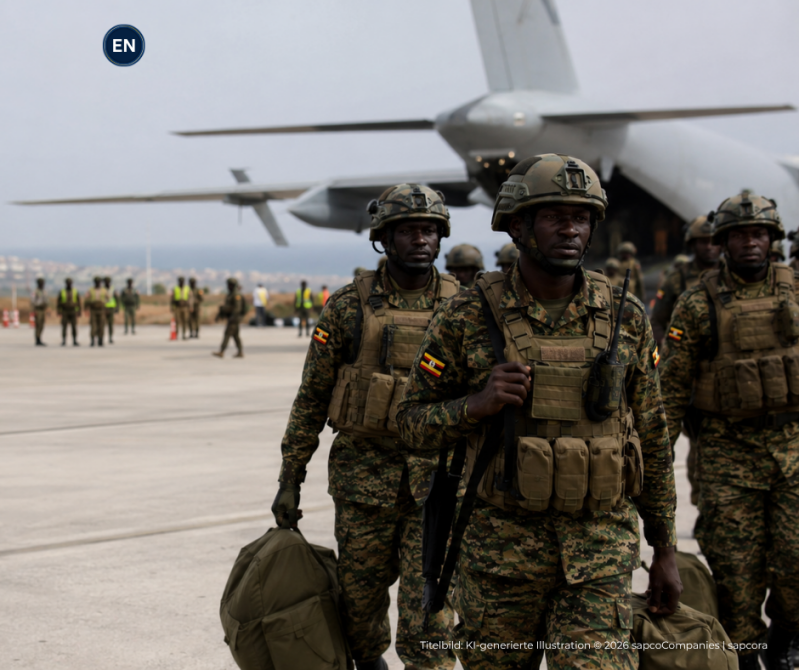
Uganda has approved the deployment of national troops to the Gaza Strip as part of an international stabilization mission, placing the East African country inside one of the most sensitive security arrangements currently taking shape in the Middle East. Kampala describes the mission as neutral and focused on stabilization, civilian protection and the implementation of security arrangements. Yet the mandate also raises difficult questions over disarmament, military authority and the circumstances under which Ugandan forces could be required to use force.
Uganda enters the security architecture of postwar Gaza
Uganda has formally approved the deployment of members of the Uganda Peoples’ Defence Forces to the Gaza Strip as part of a planned international stabilization mission. The parliamentary decision provides the domestic political and legal basis for Kampala to contribute troops to a security structure intended to operate during the transition toward a new order in Gaza.
The decision does not mean that Ugandan forces have already entered the territory. Rather, parliament has authorized the government to proceed with a deployment once the operational framework, command arrangements and timing of the mission are finalized. The size of Uganda’s contingent and the precise schedule for its deployment have not been publicly specified.
The move is nevertheless significant. It would place Uganda directly inside an international effort to manage the security consequences of the Gaza conflict and contribute to a transition that is expected to involve the withdrawal of Israeli forces, the demilitarization of armed groups and the establishment of new Palestinian security institutions.
Washington sought Uganda’s participation
Uganda’s involvement follows a request from the United States for Kampala to contribute forces to the proposed International Stabilization Force. The Ugandan government has presented the mission as part of a broader international framework rather than as an independent military intervention.
That distinction is central to understanding Uganda’s position. Kampala is not declaring itself a combatant on Israel’s side, nor is it entering Gaza as a bilateral military partner of the Israeli government. Its stated role is to participate in an international security structure intended to stabilize the territory during a highly sensitive political and military transition.
The decision also reflects Uganda’s growing willingness to use its military experience as an instrument of foreign policy. Ugandan forces have accumulated extensive operational experience in peace support and security missions elsewhere in Africa, particularly in environments where conventional peacekeeping has frequently overlapped with counterterrorism and stabilization operations.
A mission that extends beyond traditional peacekeeping
The planned force is not conceived merely as an observer mission. Its responsibilities are expected to include maintaining security, supporting the protection of civilians, monitoring agreed security arrangements and assisting with the wider demilitarization of the Gaza Strip.
That last element is politically and militarily significant. The transition framework envisages the removal or decommissioning of weapons held by armed groups and the dismantling of military infrastructure that could sustain renewed conflict. At the same time, the plan links the creation of a new security structure to a phased withdrawal of Israeli forces and the transfer of civilian responsibilities to Palestinian institutions.
The mission therefore occupies territory far beyond traditional ceasefire monitoring. Its effectiveness will depend on whether the major actors accept the underlying political framework and whether international forces are given a mandate that is sufficiently clear to operate in an environment where authority, sovereignty and security remain deeply contested.
Kampala insists on political neutrality
Uganda has formally stated that its forces are expected to remain neutral, comply with international humanitarian law and protect civilians. The government has also indicated that Ugandan personnel would operate under defined rules of engagement and within the command structure established for the international mission.
This makes it inaccurate to describe Uganda simply as joining Israel’s military campaign against Hamas. Kampala’s declared position is that its forces would serve an international stabilization framework rather than operate under Israeli military command.
Neutrality, however, does not necessarily mean operational passivity. An international force tasked with supporting demilitarization, preventing renewed armed activity and protecting civilians could encounter situations in which the use of force becomes unavoidable. The central question is therefore not merely whether Uganda declares itself neutral, but how that neutrality would function once its soldiers are operating in Gaza.
The most sensitive question concerns disarmament
The potential disarmament of Hamas and other armed groups represents the most difficult part of the mission’s mandate. Any effort to remove weapons, dismantle military infrastructure or prevent armed organizations from reestablishing control would involve considerable political and military risk.
If armed groups accepted a negotiated demobilization process, the international force could largely perform a stabilization and monitoring function. If they resisted, however, foreign troops could find themselves facing armed opposition despite their formal status as neutral peace and security personnel.
Uganda has not publicly provided detailed rules governing the circumstances in which its troops could use force. It would therefore be premature to claim that Ugandan soldiers have been assigned specifically to fight Hamas or any other Palestinian organization.
What can be established is that Uganda is prepared to participate in a mission whose objectives may include enforcing security arrangements that armed groups could oppose. That distinction is essential for both political and legal accuracy.
Israel’s acceptance does not amount to Israeli command
Israel has indicated that Uganda is among the countries it considers acceptable as contributors to the international stabilization force. That approval is politically relevant because any international deployment into Gaza will inevitably require coordination with Israeli authorities during the transition period.
It does not, however, establish that Ugandan forces would become part of the Israel Defense Forces or operate under Israeli military command. The planned mission is intended to function under a separate international command structure, with responsibilities defined through the broader stabilization framework.
Uganda’s position is therefore more complex than a simple alignment with one side of the conflict. Kampala is participating in a security architecture supported by Washington and accepted by Israel, while formally presenting its own forces as politically neutral and committed to an eventual Palestinian security administration.
Parliament confronted the risks directly
The debate in Kampala reflected concern over the extraordinary complexity of the mission. Ugandan lawmakers raised questions over the legal status of deployed soldiers, the mission’s command structure and the risks involved in sending troops into a densely populated territory marked by prolonged conflict and unresolved political authority.
Such concerns extend far beyond normal military planning. Any foreign force operating in Gaza would have to navigate questions of jurisdiction, civilian protection, detention authority, accountability and relations with multiple political and security actors.
The legal framework governing the presence of Ugandan soldiers will therefore be central to the credibility of the mission. Formal agreements defining their status, responsibilities and protections will be as important as military planning itself.
Uganda is taking on a wider geopolitical role
The decision also reflects a broader evolution in Uganda’s international position. Kampala has long played an important security role in East Africa, but participation in Gaza would move the country into a geopolitical arena with global diplomatic consequences.
For Uganda, the mission offers the opportunity to present itself as an experienced contributor to international security and as a state capable of operating beyond its immediate region. It also brings substantial reputational and political exposure.
Any international force deployed to Gaza will be judged not only by whether it can maintain security, but also by whether it is perceived as legitimate by Palestinians, Israelis and the wider international community. Uganda’s soldiers could therefore become representatives not only of their own government, but of an entire international attempt to establish a security order after one of the most destructive conflicts of recent years.
A deployment defined by what comes next
Uganda’s decision is important precisely because it reaches beyond the immediate question of troop deployment. It marks the beginning of a far more difficult debate over who will enforce security in Gaza, who will control weapons, who will protect civilians and which institutions will ultimately govern the territory.
Kampala has chosen to participate in that process, but the political meaning of its role will depend on how the mission develops in practice. The distinction between stabilization and enforcement, between neutrality and coercion, and between international support and foreign intervention will be tested on the ground rather than in parliamentary language.
For Uganda, the decision is therefore more than an overseas military commitment. It is an entry into the emerging struggle over Gaza’s postwar order, with consequences that could extend well beyond the battlefield and well beyond the Middle East.
Uganda Approves Troop Deployment to Gaza Stabilization Mission. Uganda has approved the deployment of troops to Gaza as part of an international stabilization mission. The decision places Kampala inside a complex postwar security framework involving demilitarization, civilian protection and an eventual Israeli withdrawal.
Kommentar hinzufügen
Kommentare