

Section: Geopolitics
Format: Special Report
Author: Sinisa Brkic (sb)
President Donald Trump was secretly transferred from Air Force One to a smaller U.S. military aircraft after the NATO summit in Turkey because American officials were responding to what was described as a credible Iranian assassination threat. The extraordinary security operation concealed the president’s actual departure from journalists and even some members of the White House traveling party, turning the visible presidential aircraft into an effective decoy.
A presidential departure designed to deceive
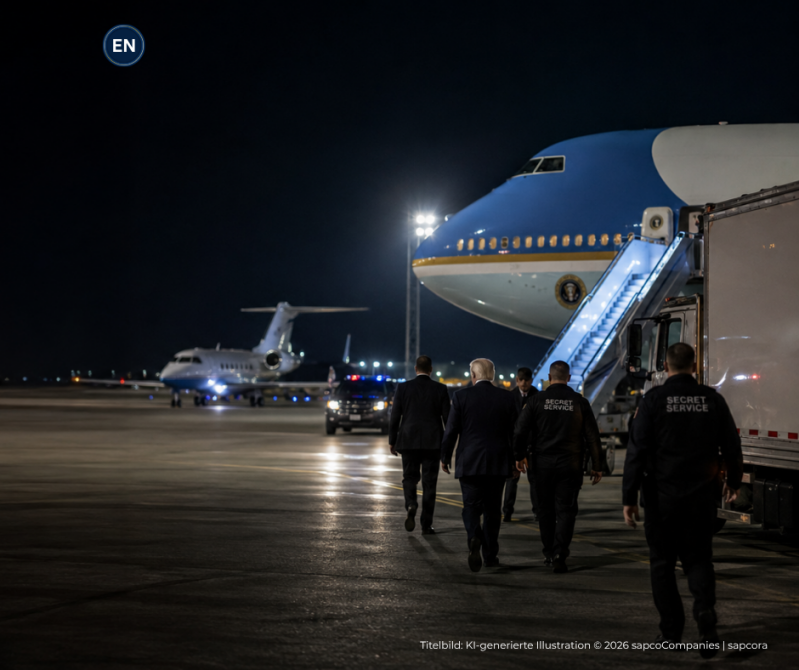
What appeared to be a routine presidential departure from Ankara on July 8 was anything but routine. After attending the NATO summit in the Turkish capital, Trump publicly boarded the older Air Force One in view of cameras, creating the impression that he would continue his journey to Britain aboard the aircraft normally associated with the presidency.
Minutes later, according to reporting by The Washington Post that was subsequently corroborated by Reuters and the Associated Press, the president was secretly moved away from the aircraft. Trump and a small group traveling with him were transported using an airport catering vehicle before he boarded an Air Force C-32A, a smaller military aircraft commonly used for senior U.S. government travel.
The original aircraft then departed with journalists and some White House personnel aboard. Many of them reportedly believed the president was still traveling on the same plane. In practical terms, the highly visible Air Force One had become a decoy while Trump traveled separately under far tighter secrecy.
The operation stands out not because presidents are unfamiliar with classified travel arrangements, but because of the level of deception used during an official departure from a NATO ally. It required those responsible for presidential security to obscure not merely Trump’s route, but the aircraft carrying him.
An Iranian threat changed the security calculation
The decisive factor was a reported assassination threat linked to Iran. U.S. officials considered the danger sufficiently credible to justify changing the president’s aircraft and concealing his actual movements, according to the accounts published on August 10 and 11.
That distinction is critical. The reports do not establish that Iran launched an attack on Trump in Turkey, nor do they demonstrate publicly that an assassination attempt was already underway at Ankara airport. They describe intelligence about a threat that American security officials treated seriously enough to trigger exceptional protective measures.
There is also no publicly established evidence in the reporting available so far that Iran’s political leadership personally authorized a specific operation against Trump during the NATO summit. The severity of the U.S. response indicates how officials assessed the risk, but it does not by itself prove the precise origin, operational maturity or chain of command behind the reported threat.
The White House has not publicly disclosed the underlying intelligence. It has, however, defended the security response, saying that numerous adversaries have targeted the president and that the administration uses the tools available to protect him. The Pentagon referred questions about the operation to the White House.
The threat did not emerge in a vacuum
Concerns about Iranian threats against Trump have a documented history that predates the Ankara operation. In November 2024, the U.S. Justice Department charged an alleged Islamic Revolutionary Guard Corps asset in a murder for hire case and said he had been tasked by the Iranian government with surveilling and plotting to assassinate Trump before the presidential election.
Separately, a federal jury in March 2026 convicted Asif Merchant, whom the Justice Department described as an operative of the IRGC, on terrorism and murder for hire charges connected to a foiled assassination scheme. Those cases provide important context for American security concerns, but they do not establish that the same individuals or networks were responsible for the threat that prompted Trump’s secret flight from Turkey.
That distinction matters because the emerging story sits in an unusually fertile environment for speculation. A documented history of Iranian linked assassination plotting makes the July security response more intelligible. It does not make every allegation about a new plot automatically true.
Air Force One became part of the deception
The symbolism of the operation is difficult to miss. Air Force One is intended to make the American presidency unmistakably visible wherever it travels. In Ankara, that visibility appears to have been deliberately exploited.
By allowing the familiar aircraft to depart while Trump traveled separately, security officials created uncertainty over the president’s location at precisely the moment when his movements were considered sensitive. Reporters and some government personnel were themselves kept outside the information circle, according to the published accounts.
The technique was unusual, although presidential travel deception is not without precedent. Reuters noted that a comparable decoy strategy was used during President Bill Clinton’s trip to Pakistan in 2000, when security concerns similarly required an effort to disguise presidential movements.
The Ankara episode nevertheless carries particular weight because it occurred during an active confrontation between the United States and Iran and immediately after a major NATO summit. The security operation therefore intersects directly with a wider geopolitical conflict rather than standing as an isolated protective maneuver.
The Qatar aircraft raises a separate question
Trump had traveled to Turkey aboard the newly upgraded Boeing 747 originally provided by Qatar and converted for presidential use. His subsequent transfer to the C-32A inevitably raises questions about whether security concerns surrounding the newer aircraft played any role in the decision.
The available reporting does not support the conclusion that the Qatar sourced aircraft was considered unsafe. The White House has said the aircraft meets the security requirements necessary for presidential travel. The decision to use another plane in Ankara should therefore not be presented as evidence of a technical or protective failure without further information.
The more significant issue is operational unpredictability. When intelligence indicates that an adversary may be tracking a president’s movements, changing the expected aircraft and obscuring the route can itself become a protective measure, regardless of the security capabilities of the original plane.
A revelation arriving at a dangerous moment
The details have become public while relations between Washington and Tehran remain acutely unstable. The United States and Iran are still locked in a conflict that has lasted for months, while negotiations over de-escalation and the Strait of Hormuz have repeatedly stalled. Fresh disagreements in recent days have again weakened expectations of a diplomatic breakthrough.
Iran has also warned of further regional consequences if Washington resumes major strikes, while Trump has alternated between threats of renewed military action and calls for an agreement. The dispute has become inseparable from energy security, Gulf shipping and the wider strategic contest between the two governments.
Against that background, the secret Ankara flight provides a revealing measure of how the confrontation is being assessed inside the American security apparatus. Political rhetoric between Washington and Tehran has long been severe. Moving a president covertly from one aircraft to another is a different category of response.
What remains unknown
The central unanswered question is how specific the intelligence was. Public reporting has not established whether U.S. officials had identified particular suspects, a defined method of attack or an immediate operational plan. Those details would determine whether the Ankara operation was a response to a general but credible threat or to intelligence indicating something substantially more advanced.
It is also unclear how widely the operation was known inside the U.S. government and which agencies made the final decision to alter Trump’s departure. Presidential protection involves multiple institutions, but the classified nature of such planning means the public account remains incomplete.
What is now clear is narrower, but still significant. American officials believed the threat was serious enough to abandon the expected presidential travel pattern, conceal Trump’s location and allow the world’s most recognizable government aircraft to leave without him.
That is the real importance of the episode. There is no verified evidence of a new Iranian attack on the United States and no public proof that an assassination attempt against Trump was underway in Ankara. What has emerged instead is evidence of how seriously Washington believed the danger had become, serious enough to turn presidential travel into a carefully staged deception at the end of a NATO summit.
Iran Threat Forced Trump to Secretly Switch Planes After NATO Summit. Donald Trump secretly switched from Air Force One to a U.S. military aircraft in Turkey after officials received a reported Iranian assassination threat.
Kommentar hinzufügen
Kommentare