

Rubric: Security
Format: Special Report
Author: Sinisa Brkic (sb)
Japan has raised the volcanic alert for Mount Aso in Kumamoto Prefecture to Level 3 after monitoring showed a sharp increase in volcanic tremor and sulfur dioxide emissions. Authorities are warning of a possible eruption capable of affecting an area within roughly two kilometers of Nakadake First Crater, but no new eruption has been confirmed.
Volcanic activity intensifies at Mount Aso
Japan’s Meteorological Agency raised Mount Aso’s volcanic alert from Level 2 to Level 3 on August 14 after detecting a further escalation in activity at one of Japan’s most closely monitored volcanoes. The higher level imposes restrictions on entering dangerous areas around the mountain and reflects a materially greater assessment of eruption risk.
Volcanic tremor has been elevated since the evening of August 12. Shortly after 3 p.m. local time on August 14, the one minute average amplitude measured at the Nakadake western flank monitoring station exceeded four micrometers per second, according to the agency’s latest assessment.
The increase was accompanied by a substantial rise in volcanic gas emissions. Field measurements conducted Friday showed sulfur dioxide emissions at approximately 2,700 metric tons per day, more than double the roughly 1,200 tons measured on August 6.
The danger zone expands to roughly two kilometers
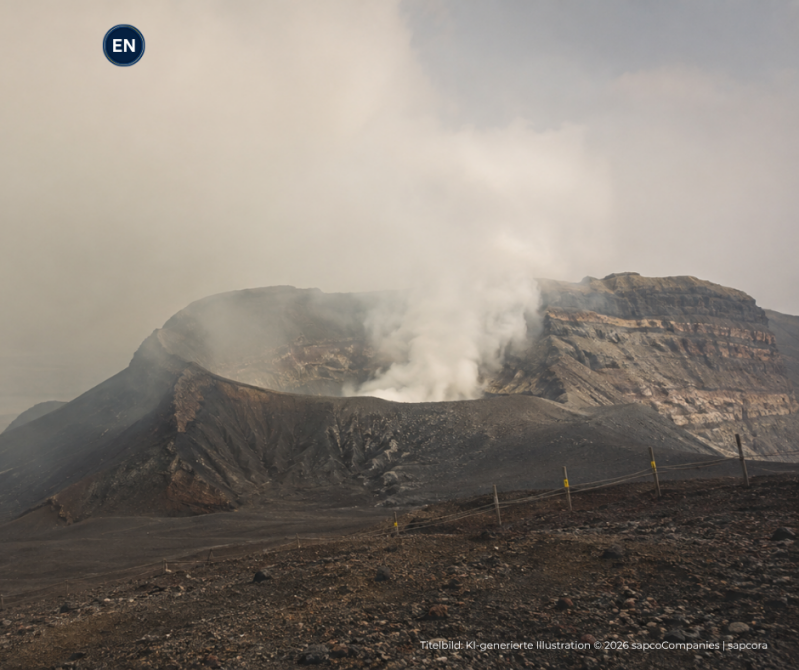
The central concern is Nakadake First Crater. Authorities now consider an eruption capable of affecting an area within approximately two kilometers of the crater to be possible.
Within that zone, the principal hazards include large volcanic rocks thrown from the crater and pyroclastic flows. People downwind may also face ash, smaller volcanic rocks carried farther by the wind and elevated exposure to volcanic gases.
The warning applies to areas involving Aso City, Takamori and Minamiaso. Local authorities have instructed people not to enter the restricted zone and to follow official access controls around the volcano.
Level 3 is serious, but its meaning must be stated precisely. It is primarily a restriction on climbing and entering hazardous areas around the volcano. It is not, at this stage, a general evacuation order for the wider population of Aso or Kumamoto Prefecture.
No new eruption has been confirmed
The distinction between heightened eruption risk and an eruption already underway is critical. The latest official information reviewed by newsmedia.report does not confirm that Mount Aso has newly erupted.
What has changed is the assessment of the volcano’s behavior. Rising tremor, a rapid increase in sulfur dioxide emissions and other monitoring signals have reached a point at which authorities believe stronger protective restrictions are justified.
A white plume was observed rising as high as approximately 800 meters above the crater rim on August 14. Continuous satellite based ground deformation measurements have also shown changes since around May that authorities say may indicate magma accumulating in a reservoir thought to lie beneath the Kusasenri area.
None of those observations alone establishes that a major eruption is imminent. Together, however, they show why the alert level has been raised and why access around Nakadake is now more tightly controlled.
What Level 3 means for travelers
For visitors, the immediate issue is not whether travel to all of Kumamoto must stop. The relevant question is whether a planned route, viewpoint, hiking area or attraction enters a zone subject to volcanic restrictions.
Travelers heading toward Mount Aso should treat local closures as operational safety measures rather than recommendations. Conditions around an active volcano can change quickly, and restrictions may be adjusted if monitoring indicates either further escalation or a decline in activity.
There is currently no official basis for describing the situation as a broad evacuation of the Aso region. Equally, visitors should not interpret the absence of such an order as evidence that the crater area is safe. The two kilometer hazard zone is precisely where authorities are warning of potentially dangerous volcanic projectiles and pyroclastic flows.
No established link to the Kumamoto earthquake
The renewed volcanic concern comes while Kumamoto is still dealing with the aftermath of the powerful earthquake that struck the prefecture on July 28. That timing is likely to fuel speculation about whether the two developments are connected.
The current volcanic assessment, however, does not establish the earthquake as the cause of Mount Aso’s increased activity. The signals driving the Level 3 decision are observations made directly at the volcano, including tremor, gas emissions and ground deformation. Temporal proximity alone is not evidence of a causal connection.
That distinction matters in a fast moving situation. Earthquakes and volcanic systems can interact under certain geological conditions, but any claim of a direct connection requires evidence that has not been established in the current official assessment.
The next hours will matter
Mount Aso is now in a phase that demands close monitoring rather than speculation. The most important indicators will be whether volcanic tremor continues to strengthen, whether sulfur dioxide emissions remain elevated or rise further and whether monitoring detects additional changes around the crater or deeper magma system.
Japan’s Meteorological Agency plans another regular assessment on August 15, while retaining the ability to issue new information sooner if conditions change. Until then, the essential facts are clear: the alert has been raised to Level 3, access around Nakadake has been tightened, and the risk of an eruption affecting the immediate crater area has increased.
What has not happened is equally important. There is no confirmed new eruption and no official basis for claims that a catastrophic eruption is imminent. For residents and travelers, the correct response is therefore neither complacency nor alarm, but strict attention to the expanding safety restrictions around Mount Aso.
Japan Raises Mount Aso Volcano Alert to Level 3 as Activity Intensifies. Japan raises Mount Aso to volcanic alert Level 3 after sharp increases in tremor and sulfur dioxide emissions. No new eruption has been confirmed
Kommentar hinzufügen
Kommentare