

Section: Europe
Format: Special Report
Author: Sinisa Brkic (sb)
Britain’s rail network is facing urgent questions after two passenger trains derailed in southern England within less than 24 hours. The incidents at Lewes and Wickford occurred during a period of extreme heat, but investigators have not established a common cause, and there is currently no evidence that temperature alone was responsible for either derailment.
Two derailments, one rapidly widening safety question
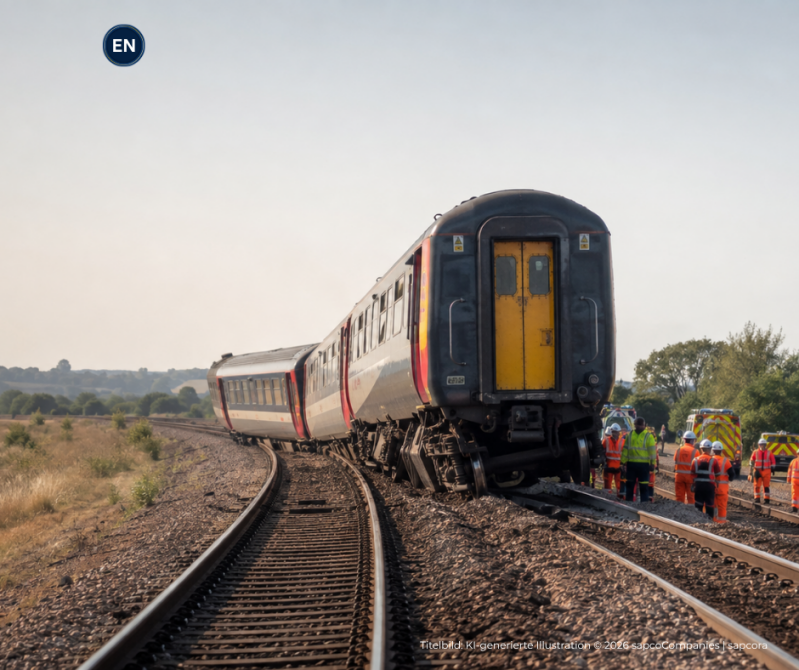
Britain was confronting a second passenger train derailment on Friday after a Greater Anglia service came off the rails near Wickford in Essex, less than 24 hours after a far more serious accident near Lewes in East Sussex. The rear carriages of the Wickford train left the track but remained upright, and no injuries were reported.
The timing immediately transformed what had been a major regional rail accident into a broader question about the resilience of the British railway. Two passenger trains had derailed in different parts of southern England within the space of a day. That fact is established. Whether the incidents share anything beyond their timing is not.
At Wickford, emergency services attended the scene and rail traffic between Wickford and Southend Victoria was disrupted while officials began examining what had happened. The derailment affected services towards London Liverpool Street and added a second major operational problem to a network already dealing with the consequences of the Lewes accident.
Lewes was the more serious warning
The first derailment occurred on Thursday near Lewes, where a Southern service travelling from London Victoria to Eastbourne left the tracks with about 150 people on board. Three carriages overturned, prompting a major emergency response and leaving passengers trapped before the train was fully evacuated.
Two people suffered severe injuries which police later said were not considered life threatening. Early official reporting counted nine other passengers with less serious injuries, while subsequent updates indicated that another 18 people had received hospital treatment and had since been discharged.
The physical severity of the accident was striking. Carriages ended up on their sides and emergency crews worked around the train as passengers were brought to safety. For a railway system in which passenger train derailments remain unusual events, Lewes alone was serious enough to demand close examination. The arrival of Wickford less than a day later changes the context, but it does not yet change the evidence.
The temptation to connect the accidents
Both derailments occurred during exceptionally hot weather, which inevitably places heat at the centre of public attention. High temperatures are a recognised operational challenge for railways because steel rails can become substantially hotter than the surrounding air. Under certain conditions, thermal expansion can increase the risk of track deformation, which is why monitoring, inspection and temporary speed restrictions form part of railway heat management.
That makes the weather relevant. It does not make it the cause. No investigation has established that heat caused either derailment. Nor has any authority established that the two incidents resulted from the same type of infrastructure failure, maintenance problem or operational condition. Treating the accidents as technically connected at this stage would therefore go beyond the available evidence.
This distinction is particularly important because images, eyewitness accounts and the coincidence of two derailments can create a powerful impression of an obvious explanation. Accident investigation depends on something more demanding: examination of the track, rolling stock, signalling data, train speed, maintenance records, inspection history and the precise sequence of events before the wheels left the rails.
Britain already knows that extreme heat tests the railway
The wider question of heat resilience is not speculative. Network Rail has spent years examining how increasingly severe weather affects infrastructure and operations. After the record temperatures of 2022, it established an Extreme Heat Task Force to examine how the railway could perform more reliably and safely during periods of intense heat.
The resulting work identified weaknesses that went beyond individual incidents. Among the concerns were the need for more proactive responses to heat forecasts, stronger engineering and asset management oversight, and better rail specific thresholds for extreme conditions. Network Rail also uses weather forecasting and operational controls to determine when additional precautions, including reduced services or speed restrictions, may be necessary.
None of this proves what happened at Lewes or Wickford. It does, however, establish why investigators will be expected to examine weather exposure alongside the mechanical and infrastructure evidence.
The crucial questions are now specific. What were the rail temperatures at the two locations? What inspections had taken place before each incident? Were any temporary speed restrictions in force? Did either section of track show signs of deformation or another defect before the derailment? And did the operating conditions at Wickford bear any meaningful resemblance to those near Lewes? Until those questions are answered, the heat remains part of the context rather than the verdict.
The Lewes investigation will be decisive
The Rail Accident Investigation Branch has begun work to determine the cause of the Lewes derailment. Its role is critical because the investigation can move beyond the immediate visual evidence and reconstruct the technical sequence that produced the accident.
That process matters not only for identifying what failed, but for determining whether the failure was isolated or exposed a wider vulnerability. If the investigation finds a track defect, investigators will need to establish why it developed, whether it should have been detected and whether existing controls were sufficient. If extreme heat played a part, the focus will turn towards how the infrastructure was monitored and what mitigation measures were in place.
The same discipline must apply to Wickford. The fact that the rear carriages derailed without overturning and without reported injuries does not make the event insignificant. It does mean that the physical circumstances appear different from Lewes, and those differences could prove crucial when determining whether the incidents belong in the same technical category at all.
Rail safety is now under scrutiny, not indictment
Two passenger train derailments in less than 24 hours are enough to justify intense scrutiny. They are not, by themselves, evidence that Britain’s rail network has suddenly become unsafe or that a systemic failure has been established.
That distinction will matter in the coming days. The strongest evidence may ultimately show a connection between the incidents, or it may show two unrelated failures occurring during the same period of difficult operating conditions. Either outcome would carry important consequences for regulators, infrastructure managers and train operators.
For passengers, the immediate question is simpler and more urgent: whether the railway is capable of identifying risk before it becomes an accident. Britain’s rail system already has procedures for extreme weather, track inspection and operational restrictions. The investigations now have to establish whether those safeguards worked as intended at Lewes and Wickford.
Until then, the most significant fact is also the one that requires the greatest restraint. Britain has suffered two passenger train derailments in less than a day. The causes remain open, and determining whether that extraordinary sequence was coincidence or warning is now the central question.
Two UK Passenger Trains Derail Within 24 Hours as Rail Safety Comes Under Scrutiny. Two passenger trains have derailed at Lewes and Wickford within less than 24 hours, intensifying scrutiny of UK rail safety and heat resilience as investigators examine the causes.
Kommentar hinzufügen
Kommentare