

Section: International
Format: Report
Author: Sinisa Brkic (sb)
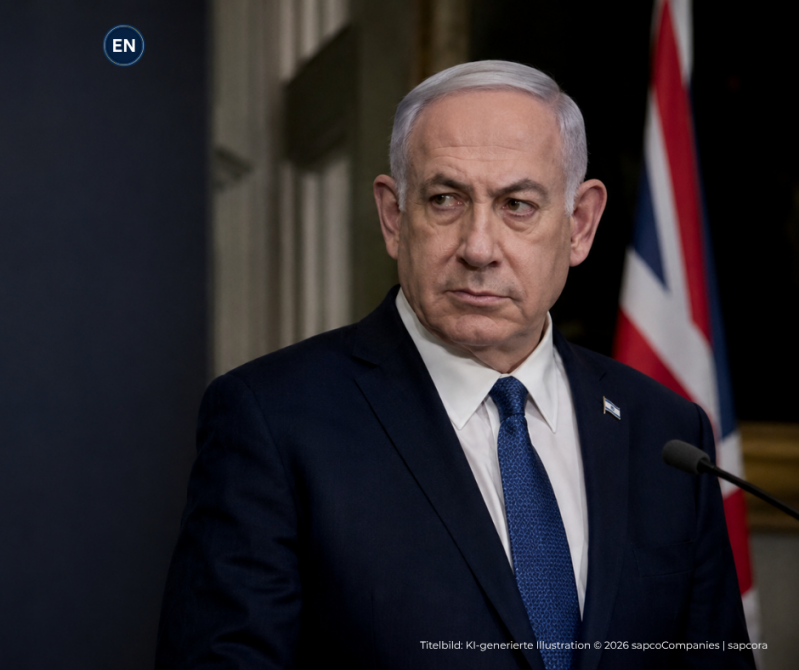
Israeli Prime Minister Benjamin Netanyahu has described the United Kingdom as the “Islamic Republic of Britain”, turning an increasingly bitter political dispute with London into a pointed attack on the country itself. The remark was delivered with humour, but its political meaning was unmistakable and has prompted a sharp response in Britain.
A joke carrying a serious political message
Israeli Prime Minister Benjamin Netanyahu has referred to the United Kingdom as the “Islamic Republic of Britain” during an interview broadcast this week, using the phrase while contrasting contemporary British attitudes towards Israel with those he associated with an earlier generation. His words were not a formal description of the British state, but a deliberate political provocation aimed at a country whose relationship with his government has deteriorated substantially.
The comment came during a conversation in which Netanyahu discussed Randolph Churchill and Winston Spencer Churchill, both journalists and descendants of wartime Prime Minister Winston Churchill. Netanyahu praised their treatment of Israel during the 1967 Six Day War before saying that such an attitude would be difficult to find in Britain today, a country which, he suggested, could be called the “Islamic Republic of Britain”.
Netanyahu delivered the phrase with a chuckle, but the formulation was more than a passing joke. It placed Britain’s Muslim population, the policies of the British government and criticism of Israel within the same rhetorical frame, transforming a foreign policy dispute into a broader judgement about the political and social direction of the country.
The interview then went further. Netanyahu referred to a remark that the first Islamic republic with nuclear weapons would be Britain and added that Israel was making sure there would not be another one in Iran. His wording echoed a controversial comment made by JD Vance in 2024, when Vance suggested that Britain under Labour might become the first “truly Islamist” country to possess nuclear weapons.
There is an obvious factual problem with the comparison. Pakistan is formally the Islamic Republic of Pakistan and has possessed nuclear weapons for decades. SIPRI lists Pakistan among the nine states possessing nuclear weapons at the beginning of 2026, which means the nuclear element of the rhetorical comparison cannot withstand a literal reading.
Britain rejects the characterisation
The British government has reacted sharply. A government spokesperson described Netanyahu’s remarks as “completely unacceptable” and said the matter had been raised with the Israeli government, signalling that London does not regard the comments as harmless political theatre.
Criticism has also emerged within the British Jewish community. Leaders of Progressive Judaism rejected the language as dangerous and divisive, arguing that inflammatory rhetoric directed at British Muslims risks aggravating social tensions at a time when both antisemitism and anti Muslim hatred remain serious concerns.
The significance of the episode therefore lies not simply in whether Netanyahu intended the phrase literally. Political language at this level rarely requires literal intent to carry consequences. When the head of government of an allied state describes Britain in explicitly religious and ideological terms, the words inevitably become part of the diplomatic relationship.
Relations with London were already under pressure
Netanyahu’s intervention comes against the backdrop of a profound deterioration in relations between the Israeli government and Britain. The United Kingdom formally recognised the State of Palestine in September 2025, presenting the decision as an effort to preserve the viability of a two state solution and create a path towards lasting peace.
London has also taken measures against individuals and organisations linked to settler violence in the occupied West Bank. In June 2026, Britain joined international partners in announcing further sanctions against entities and an individual accused of financing, enabling or carrying out such violence.
These decisions have moved the disagreement well beyond diplomatic irritation. Britain continues to affirm Israel’s right to exist and the security of its population, while increasingly challenging policies pursued by Netanyahu’s government. For Jerusalem, British recognition of Palestine and pressure over settlements represent evidence of a Western political shift that Netanyahu has repeatedly portrayed as dangerously indulgent towards Israel’s adversaries.
From criticism of policy to criticism of a country
That distinction makes the latest language particularly consequential. Netanyahu was not merely attacking a British decision on Gaza, Palestinian statehood or sanctions. By invoking an “Islamic Republic of Britain”, he attached his criticism to Britain’s national character and implicitly to the presence and political influence of Muslims within the country.
Such rhetoric has an established political resonance in parts of the European and American right, where demographic change, immigration, Islam and the direction of liberal democracies are frequently presented as elements of the same political struggle. Netanyahu’s use of similar language therefore places his criticism of Britain within a much wider ideological debate, rather than confining it to the specific disagreements between London and Jerusalem.
It also creates a difficult contradiction. Israel has long sought to distinguish opposition to particular Israeli policies from hostility towards Israel itself. Britain can make a comparable demand in reverse: criticism of British foreign policy is legitimate, but portraying the country as having effectively become an Islamic republic is a different proposition altogether.
A relationship entering harsher territory
Diplomatic relationships can absorb strong criticism. Britain and Israel have disagreed before, including on settlements, Palestinian statehood and the conduct of military operations, without abandoning the deeper strategic and historical relationship between the two countries.
Netanyahu’s latest intervention, however, illustrates how far the tone has shifted. A disagreement once expressed principally through diplomatic statements and policy decisions is increasingly being fought through cultural and ideological language, where governments are no longer merely accused of pursuing the wrong policy but of representing a fundamentally different political order.
That is why the phrase matters beyond the controversy of the day. Netanyahu did call Britain the “Islamic Republic of Britain”, even if the remark was delivered as a provocation rather than a constitutional assertion. What might once have been dismissed as an extravagant aside now lands in a relationship already burdened by Gaza, Palestinian recognition, settlements and deep disagreement over the direction of Israeli policy.
The most important question is therefore not whether Britain has suddenly become what Netanyahu called it. It plainly has not. The more consequential question is what it says about relations between two longstanding partners when the language of diplomacy gives way to language designed to wound.
Netanyahu calls UK ‘Islamic Republic of Britain’ amid growing tensions. Benjamin Netanyahu has described the UK as the “Islamic Republic of Britain”, prompting criticism and adding another layer of tension to relations between Israel and London.
Kommentar hinzufügen
Kommentare