

Section: International
Format: Special Report / Live Ticker
Author: Sinisa Brkic (sb)
A magnitude 7.7 earthquake off the Indonesian island of Flores has killed at least two people, damaged buildings, triggered landslides and forced hospitals to move patients into outdoor treatment areas. A tsunami warning issued after the powerful offshore quake has been lifted, but dozens of aftershocks and an incomplete assessment of remote communities mean the scale of the disaster is still developing.
LIVE TICKER
5:18 a.m. CEST: International attention surges as damage assessment continues
International interest in the Flores earthquake is accelerating sharply while Indonesian authorities continue assessing casualties and infrastructure damage. Search activity connected to the Indonesia earthquake has risen rapidly in both the United States and Japan, reflecting a second major international wave of attention several hours after the initial shock.
The increase does not correspond to a newly confirmed surge in fatalities. At least two deaths remain confirmed at this stage. The renewed global attention appears instead to be driven by growing reports of damage, continuing aftershocks, concerns about tsunami activity and questions over the geographic extent of the disaster.
Latest confirmed toll remains at least two dead
At least two people have been confirmed dead following the magnitude 7.7 earthquake. The casualty figure remains provisional because assessments are continuing across Flores, including areas where communications and access may be more difficult.
There is currently no confirmed basis for significantly higher casualty claims. In the first hours after a major earthquake, initial figures frequently remain incomplete until emergency teams can reach affected communities, inspect damaged buildings and establish contact with local authorities.
Dozens of aftershocks recorded
The main earthquake has been followed by dozens of aftershocks. Their continued occurrence is a serious operational concern because buildings, slopes and other infrastructure may already have been weakened by the initial shaking.
Aftershocks can vary considerably in strength. Their presence does not provide a reliable basis for predicting that another earthquake of similar or greater magnitude is imminent, and no such prediction should be inferred from the current seismic sequence. For residents and emergency services, however, continued shaking complicates rescue operations and structural inspections. Hospitals, public buildings and homes that appear intact can require further evaluation before they are considered safe for normal use.
Hospital patients moved outside in Ende
Patients at a hospital in Ende were moved into outdoor areas as a safety precaution following the earthquake. The measure reflects concern that further shaking could pose a risk inside buildings that may have sustained structural stress.
Temporary outdoor treatment areas are also being used as authorities and medical teams evaluate the safety of hospital structures. Maintaining medical capacity is particularly important after a major earthquake because injuries can continue to emerge as damaged communities become accessible. The situation also raises broader questions about the resilience of local health infrastructure. If hospitals themselves are affected, emergency response becomes more difficult precisely when demand for medical care can rise sharply.
Building damage reported in Maumere
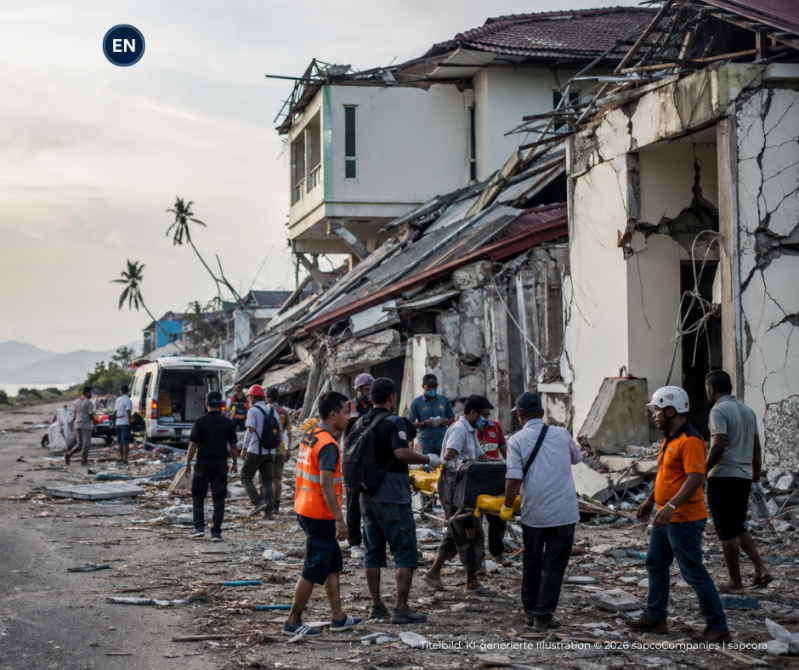
Serious structural damage has been reported in Maumere on Flores. Parts of buildings collapsed during or after the earthquake, adding to concerns that further damage may be discovered as inspections expand.
The condition of residential buildings, schools, public facilities and commercial structures remains an important part of the developing assessment. Early visual reports can provide indications of local destruction, but they do not yet establish the full geographic scale of the damage. Authorities will also need to determine whether damaged buildings remain habitable. Even structures that remain standing can become dangerous after a major seismic event if foundations, walls or supporting elements have been compromised.
At least one landslide reported
At least one landslide has been reported following the earthquake. Landslides are an important secondary hazard in mountainous or unstable terrain because strong shaking can loosen soil, rock and slopes.
The threat is not limited to direct casualties. Landslides can block roads, isolate communities and make it harder for rescue teams to reach areas where damage may not yet have been assessed. Transport access will therefore be one of the key indicators to watch as the emergency develops. A relatively limited number of major road disruptions can significantly slow relief operations on an island where some communities are separated by difficult terrain.
Tsunami warning lifted
The tsunami warning issued following the earthquake has been lifted after roughly three hours. Monitoring indicated that the immediate tsunami threat had diminished. Small tsunami waves measuring less than one meter were recorded at several locations. There is no confirmed evidence of a destructive tsunami resulting from the earthquake.
The distinction between a tsunami warning and a destructive tsunami is essential. A warning is issued when the location, depth and magnitude of an earthquake create conditions that could generate dangerous waves. It is a preventive measure intended to give coastal communities time to respond before the actual scale of the threat is known.
No tsunami threat reported for Australia
Australian authorities reported no tsunami threat to Australia following the Flores earthquake. This helped narrow the geographic scope of immediate concern across the region.
The earthquake nevertheless drew rapid attention across the wider Pacific, particularly in countries with strong public awareness of tsunami risks. In Japan, the event has generated intense search activity related to the Indonesian earthquake and possible tsunami effects. For residents outside the immediate warning zone, official tsunami bulletins remain the appropriate basis for assessing risk. The occurrence of a powerful offshore earthquake does not mean every coastline in the region faces the same threat.
Flores, not Bali, is the center of the current disaster
The confirmed damage is concentrated on Flores in East Nusa Tenggara. Bali is not the center of the current earthquake emergency, and there is no evidence from the confirmed situation that the entire Indonesian archipelago has suffered comparable effects.
This geographic distinction is particularly important for international audiences. Indonesia is a vast island nation stretching across thousands of miles, and major events affecting one region do not automatically produce the same conditions elsewhere. Travelers should therefore avoid treating the earthquake as a uniform nationwide emergency. Any changes to travel plans should be based on local conditions, official warnings, transport disruptions and instructions issued by Indonesian authorities.
Sikka reports at least one injured person
At least one person has been reported injured in Sikka. The number of injured could change as emergency teams receive more information from affected communities. Injury figures can remain incomplete for longer than initial fatality reports because people may seek treatment at different facilities or in temporary medical areas. Some communities may also face delays in reporting casualties if telecommunications have been disrupted. The condition of hospitals and transport routes will influence how quickly authorities can establish a clearer medical picture.
Infrastructure assessment becomes the next major test
The next phase of the emergency will depend heavily on the condition of essential infrastructure. Roads, ports, power networks, telecommunications systems and health facilities are critical to determining how effectively relief operations can proceed.
Damage to a major transport link can isolate communities even where the number of collapsed buildings is relatively limited. Power and communications failures can also delay casualty reports and make it difficult for families to contact relatives. Ports are especially relevant on an island such as Flores because maritime transport can become essential when road connections are interrupted. Any disruption affecting fuel, medical supplies or emergency equipment could increase the consequences of the disaster.
Remote communities remain a central concern
One of the largest uncertainties is the situation in communities outside the first reporting centers. Major earthquakes often produce an uneven pattern of destruction, with some locations suffering severe damage while nearby areas experience considerably less. That makes the first casualty and damage figures inherently incomplete. Remote settlements may require physical inspection before authorities can determine whether homes have collapsed, roads remain open or residents require evacuation. Until that process is further advanced, the confirmed death toll should be treated as a minimum figure rather than a final assessment.
Why Indonesia faces persistent earthquake risk
Indonesia lies in one of the world’s most seismically active regions, where several major tectonic systems interact. Powerful earthquakes are therefore a recurring national hazard, particularly across areas close to active plate boundaries.
That geological reality does not mean every earthquake will produce catastrophic consequences. The severity of an event depends on factors including its depth, location, distance from populated areas, building resilience and whether secondary hazards such as tsunamis or landslides are triggered. For Flores, the combination of strong shaking, aftershocks, structural damage and difficult terrain makes the developing infrastructure assessment particularly important.
No basis for predicting another major earthquake
The large number of aftershocks is likely to remain one of the most closely watched aspects of the disaster. Further earthquakes following a major seismic event are normal, but their precise strength and timing cannot be forecast reliably.
There is currently no scientific basis for claiming that another magnitude 7 level earthquake is about to strike Flores. Such predictions should be treated with extreme caution, particularly when they circulate through social media without official seismic data. The appropriate focus remains on confirmed monitoring information and safety instructions from Indonesian authorities.
Search surge reflects a second global attention wave
The Flores earthquake is now moving into a second phase of international visibility. Search interest has risen from more than 20,000 to more than 50,000 queries in both the United States and Japan within a short period. That acceleration is significant because the search clusters have been active for only several hours. It suggests that the story is reaching audiences beyond the initial breaking news cycle.
The questions driving that interest are increasingly specific. International readers want to know whether a tsunami occurred, how many people were killed, whether Bali was affected, where Flores is located and whether additional strong earthquakes could follow.
What remains confirmed
The core picture remains clear despite the rapidly developing situation. A magnitude 7.7 earthquake struck off Flores, at least two people have been confirmed dead, building damage has been reported, hospital patients have been moved outside and at least one landslide has occurred. Small tsunami waves below one meter were observed before the warning was lifted. Dozens of aftershocks have also been recorded.
What remains unclear is the final casualty count, the full extent of structural damage and the condition of infrastructure in more remote parts of the island.
What remains unconfirmed
There is currently no confirmed evidence of a substantially higher death toll, a destructive tsunami or an imminent second major earthquake. Those distinctions are particularly important as the story spreads rapidly through international news and social media. Early disaster reporting often creates an environment in which preliminary claims circulate faster than authorities can verify them. The reliability of the developing picture therefore depends on maintaining a strict separation between confirmed information and speculation.
Authorities now face the decisive assessment phase
The immediate tsunami threat has receded, but the emergency on Flores has not ended. The focus is shifting from the first shock to the consequences it left behind. Emergency teams must now establish how many communities have been affected, whether damaged structures remain safe and whether critical transport, medical and communications systems can continue functioning. Those findings will determine whether the earthquake remains a serious but geographically contained disaster or develops into a broader humanitarian emergency.
For now, the confirmed picture remains grave but incomplete. At least two people are dead, buildings have been damaged, patients have been moved from hospitals, landslides have occurred and aftershocks continue across a region still trying to determine the full impact of one of the strongest earthquakes to strike the area in recent years.
This report will be updated as additional information is confirmed by Indonesian authorities.
Kommentar hinzufügen
Kommentare